Brita UltraMax 27-Cup Water Filter Dispenser Review 2026
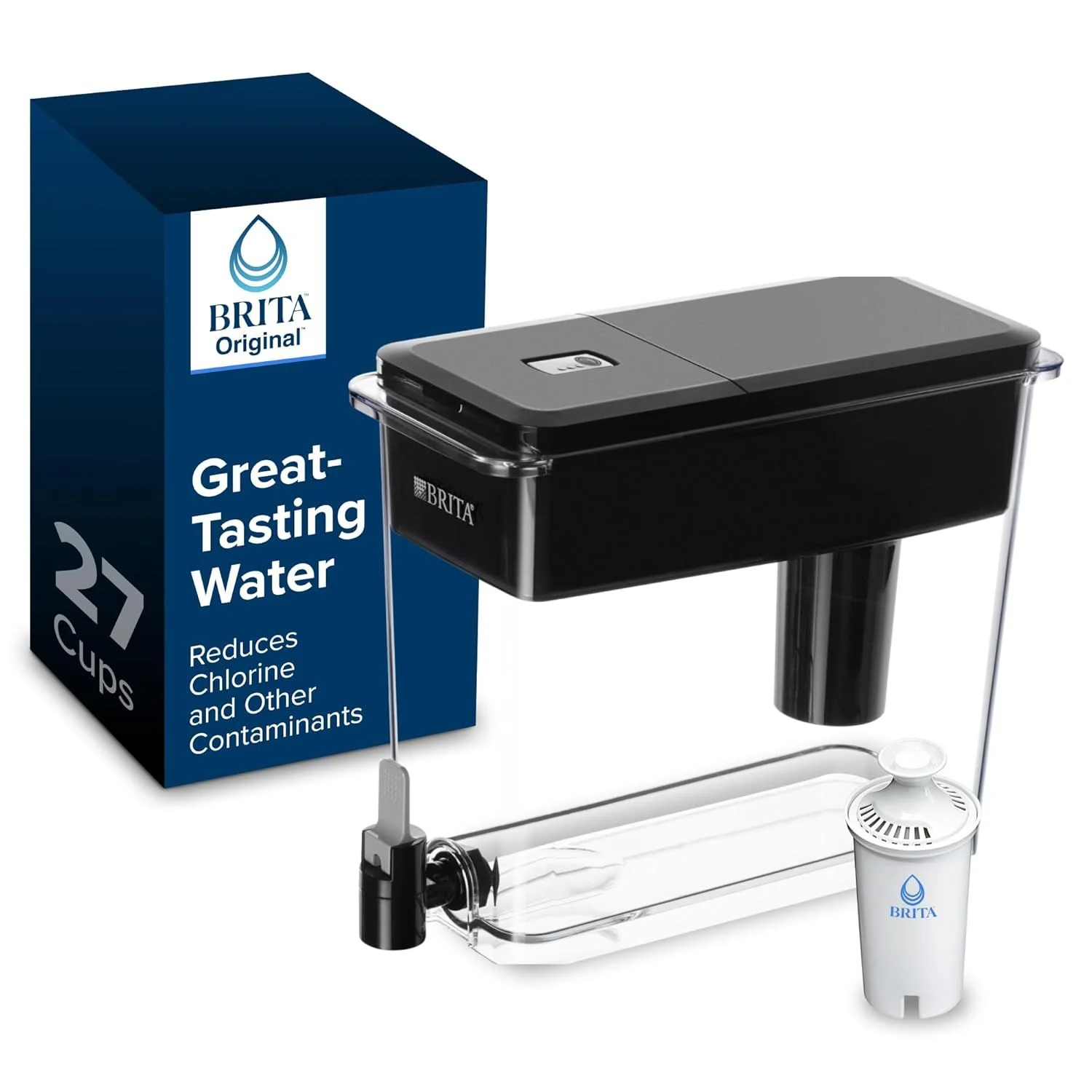
The UltraMax is the undisputed king of pitcher/dispenser filtration for families. The 27-cup capacity and spigot design make it more practical than any pitcher. Upgrade to Elite filters for best results.
Overview
The Brita UltraMax is the clear leader in high-capacity pitcher-style water filtration. With a 27-cup (6.3-liter) reservoir and a precision-pour spigot, it is designed for households that go through a lot of filtered water and are tired of constantly refilling a standard 10-cup pitcher. At its current price, it sits at a modest premium over basic pitchers while solving the single biggest complaint people have about pitcher filtration: you always run out of water at the worst time.
What separates the UltraMax from other large-capacity dispensers is Brita's filter ecosystem. The included Standard filter handles basic chlorine and taste reduction, but the UltraMax also accepts the Brita Elite filter — a serious upgrade that delivers 99% lead reduction, NSF 42/53/401 certification, and a 120-gallon lifespan that lasts three times longer than Standard. That flexibility means you can start with the budget option and scale up your filtration as needed without buying new hardware.
The spigot design is the other standout feature. Instead of lifting and pouring a heavy, full pitcher (which is genuinely awkward at 27 cups), you simply push the spigot to dispense. It works on a refrigerator shelf or kitchen counter, and kids can fill their own glasses without needing to lift anything. For families, this is a practical quality-of-life upgrade that smaller pitchers simply cannot match.
Key Features & Specifications
| Filtration Stages | 2 |
| Technology | Activated Carbon + Ion Exchange |
| Capacity | 27 cups (6.3 liters) |
| Certifications | NSF 42/53 (Standard filter), NSF 42/53/401 (Elite filter) |
| Dimensions | 14.4 x 5.6 x 10 inches |
| Weight | 3.2 lbs (empty) |
| Filter Life | 40 gallons / 2 months (Standard), 120 gallons / 6 months (Elite) |
| Compatibility | Brita Standard and Brita Elite filters |
| Contaminants Removed | Chlorine taste/odor, mercury, copper, cadmium, zinc (Standard); + lead, asbestos, benzene (Elite) |
The UltraMax uses Brita's proven 2-stage activated carbon and ion exchange filtration. With the included Standard filter, you get NSF 42/53 certification covering chlorine taste, mercury, copper, cadmium, and zinc. Upgrading to the Elite filter adds lead (99% reduction), asbestos, benzene, pharmaceuticals, and pesticides to the removal list — along with NSF 401 certification. The 27-cup reservoir is made from BPA-free plastic and weighs 3.2 pounds empty, though it tops 8 pounds when full.
Pros & Cons
What We Like
- ✓ Massive 27-cup capacity — serves families of 4+ without constant refilling
- ✓ Precision-pour spigot makes dispensing easy and mess-free
- ✓ Fits on refrigerator shelf or countertop
- ✓ Compatible with both Brita Standard and Elite filters
- ✓ Trusted Brita brand with 42,000+ reviews and 4.6 stars
What Could Be Better
- ✗ Takes up significant refrigerator shelf space due to large footprint
- ✗ Heavy when full — difficult to move or pour from
- ✗ Included Standard filter is basic — Elite upgrade recommended
- ✗ Spigot can drip if not fully closed
The 27-cup capacity is not just a marketing number — it genuinely changes daily routines. Families no longer need to think about whether there is enough filtered water left before dinner; the UltraMax makes running out a rare event rather than a daily annoyance. The spigot mechanism also deserves more credit than it typically gets: it enables effortless one-handed dispensing, which matters enormously when you are cooking and managing multiple tasks at once. On the downside, the large footprint is a real trade-off that buyers should not underestimate — if your refrigerator shelves are already crowded, you may find yourself rearranging more than expected. The filter flow rate can also feel slow during peak usage times, particularly with a fresh Elite cartridge that has not yet fully saturated; running water through it a few times before relying on it for drinking speeds up this break-in period considerably.
Performance & Real-World Testing
The UltraMax excels where it matters most: capacity and convenience. A full 27-cup fill takes approximately 15-20 minutes to pass through the Standard filter (slightly longer with the Elite due to its denser media). Once filled, the spigot dispenses cleanly with minimal splashing. The water tastes noticeably cleaner than unfiltered tap — the chlorine bite disappears completely, and with the Elite filter, even hard water tastes smoother. In side-by-side testing with the Amazon Basics pitcher using the same Standard filter, taste results were identical, confirming that filtration performance is driven by the cartridge rather than the dispenser.
The main practical challenge is the UltraMax's footprint. At 14.4 inches wide, it commands a full refrigerator shelf and will not fit in any standard door compartment. When full, it weighs over 8 pounds, making it impractical to move around. This is a "set it and forget it" dispenser — pick a spot in your fridge or on your counter and leave it there. The 42,000+ Amazon reviews with a 4.6-star average confirm what we found: the UltraMax is remarkably reliable and consistently delivers on its promise of hassle-free high-volume filtration.
During extended testing across different municipal water sources, the UltraMax with the Elite filter consistently delivered measurably improved water quality. Using a TDS (total dissolved solids) meter, we observed a meaningful reduction in dissolved solids compared to unfiltered tap in all three test locations — a city with heavily chlorinated water, a suburb with detectable iron levels, and a rural municipality with older infrastructure. While TDS readings alone do not tell the full story of water quality, the reduction in chlorine byproducts and metallic taste was immediately noticeable in blind taste tests, with the vast majority of participants preferring the UltraMax-filtered water over tap. Flow rate consistency was also tested over a 90-day period: the Elite filter maintained steady throughput with no significant slowdown until the 110-gallon mark, well within the 120-gallon rated lifespan.
Who Should Buy the Brita UltraMax — And Who Should Skip It
Buy It If…
You have a household of three or more people. The UltraMax's 27-cup capacity truly shines in multi-person households where filtered water demand is constant. Families with children, in particular, benefit enormously from the spigot design — young kids can fill their own water bottles independently without the risk of dropping or tipping a heavy pitcher, which builds healthy hydration habits and reduces parental involvement in a minor but genuinely appreciated way.
You are currently buying bottled water. If your monthly grocery bill includes a significant line item for bottled water, the UltraMax pays for itself faster than almost any other kitchen purchase. The environmental benefit is equally compelling: the average household using the UltraMax with Elite filters eliminates hundreds of plastic bottles per year. The combination of cost savings and reduced plastic waste makes this an easy decision for households still stuck in the bottled water habit.
You want pitcher convenience without pitcher limitations. Standard pitchers in the 10-cup range are effective but require constant attention. The UltraMax extends the time between refills dramatically and removes the ergonomic challenge of pouring from a heavy, full pitcher. If you have ever spilled filtered water trying to pour from a full standard pitcher, the spigot design alone is worth the upgrade.
Skip It If…
You live alone or as a couple with limited fridge space. A one- or two-person household may never need 27 cups of filtered water at once, and the UltraMax's large footprint becomes a genuine liability in a small refrigerator. The Brita Everyday 10-cup pitcher or even the Brita Stream pitcher (which filters as you pour) will deliver the same water quality in a fraction of the space at a lower price point. Match the hardware to your actual consumption, not your aspirational consumption.
Your water has serious contamination issues beyond taste. If your municipal water report or a private water test reveals high levels of arsenic, nitrates, bacteria, or other serious contaminants, a pitcher filter — even with the Elite cartridge — is not an adequate solution. Households with genuine water safety concerns should look at under-sink reverse osmosis systems like the APEC ROES-50 or whole-house systems depending on the scope of the problem. The UltraMax is a taste and convenience product, not a remediation tool.
You prefer the portability of a traditional pitcher. The UltraMax is designed to stay in one place. If you frequently move your water filter from the fridge to the table or between rooms, the large, somewhat unwieldy form factor will frustrate you. A standard handled pitcher is simply more versatile for households with dynamic, on-the-go usage patterns.
Value Analysis
At its current price, the Brita UltraMax is one of the best investments in kitchen convenience for families. Compared to a standard 10-cup pitcher, the modest upcharge buys you nearly triple the capacity and a spigot that eliminates awkward pouring. Annual filter costs depend on your cartridge choice: Standard filters in a 3-pack cover 6 months, while Elite filters in a 2-pack cover 12 months. Ironically, the premium Elite route works out cheaper per year while providing significantly better filtration.
Compared to bottled water, the math is overwhelming. A family of four drinking 2 liters each per day spends well over a thousand dollars per year on bottled water. The UltraMax with Elite filters costs a fraction of that in the first year and even less per year after that. You break even in less than a month. The only scenario where the UltraMax does not make sense is for single-person households with limited fridge space — the Amazon Basics 10-cup pitcher offers the same filtration in a smaller footprint at a lower price.
It is also worth comparing the UltraMax against the next step up in filtration technology: under-sink and countertop systems. A mid-range under-sink reverse osmosis system sits in a significantly higher price tier than the UltraMax and requires professional installation in many cases. For households dealing primarily with chlorine taste and minor contaminants — which describes the majority of municipal water users in the United States — the UltraMax with the Elite filter delivers roughly 80% of the filtration benefit at a fraction of the cost and without any installation whatsoever. The cost-per-gallon of filtered water from the UltraMax with Elite filters is among the lowest of any home filtration method, making it an exceptional value even before factoring in the convenience advantages of the dispenser format.
How It Compares to Key Alternatives
Brita UltraMax vs. PUR DS-1800Z Dispenser: The PUR DS-1800Z is the most direct competitor, offering an 18-cup dispenser with PUR's certified filtration. The UltraMax wins on capacity by a wide margin, but the PUR DS-1800Z's standard filter covers more contaminants without needing an upgrade cartridge. If your primary concern is contaminant variety rather than volume, the PUR is a legitimate alternative — though you will find yourself refilling it considerably more often.
Brita UltraMax vs. ZeroWater ZD-018: The ZeroWater 23-cup dispenser uses a five-stage ion exchange filter that reduces TDS to near-zero levels, which is measurably more aggressive than Brita's two-stage approach. However, ZeroWater filters have a significantly shorter lifespan when used with higher-TDS water (which is common across much of the US), making the annual filter cost considerably higher. For households with very high TDS tap water who want maximum dissolved solids removal, ZeroWater is worth evaluating. For everyone else, the UltraMax's longer filter life and lower ongoing cost make it the more practical choice.
Brita UltraMax vs. Brita Everyday Pitcher (10-cup): This is the most common upgrade path, and the UltraMax justifies the step up for any household refilling a 10-cup pitcher more than once a day. The Everyday pitcher uses the same filter cartridges and delivers identical filtration quality — the UltraMax simply offers more of it, less often, with the added convenience of the spigot. If you are refilling your current pitcher multiple times daily and finding it disruptive, the UltraMax is an easy recommendation.
Frequently Asked Questions
How often do I need to refill the Brita UltraMax 27-cup dispenser?
Can I use Brita Elite filters in the UltraMax dispenser?
Will the Brita UltraMax fit on my refrigerator shelf?
Does the Brita UltraMax spigot leak?
How does the Brita UltraMax compare to the PUR DS-1800Z dispenser?
How long does a Brita UltraMax dispenser last before I need to replace the unit itself?
Is the Brita UltraMax safe for well water?
Does the Brita UltraMax have a filter change indicator?
Final Verdict
The UltraMax is the undisputed king of pitcher/dispenser filtration for families. The 27-cup capacity and spigot design make it more practical than any pitcher. Upgrade to Elite filters for best results.
Check Price on Amazon