Bluevua RO100ROPOT-UV Countertop Reverse Osmosis System Review 2026
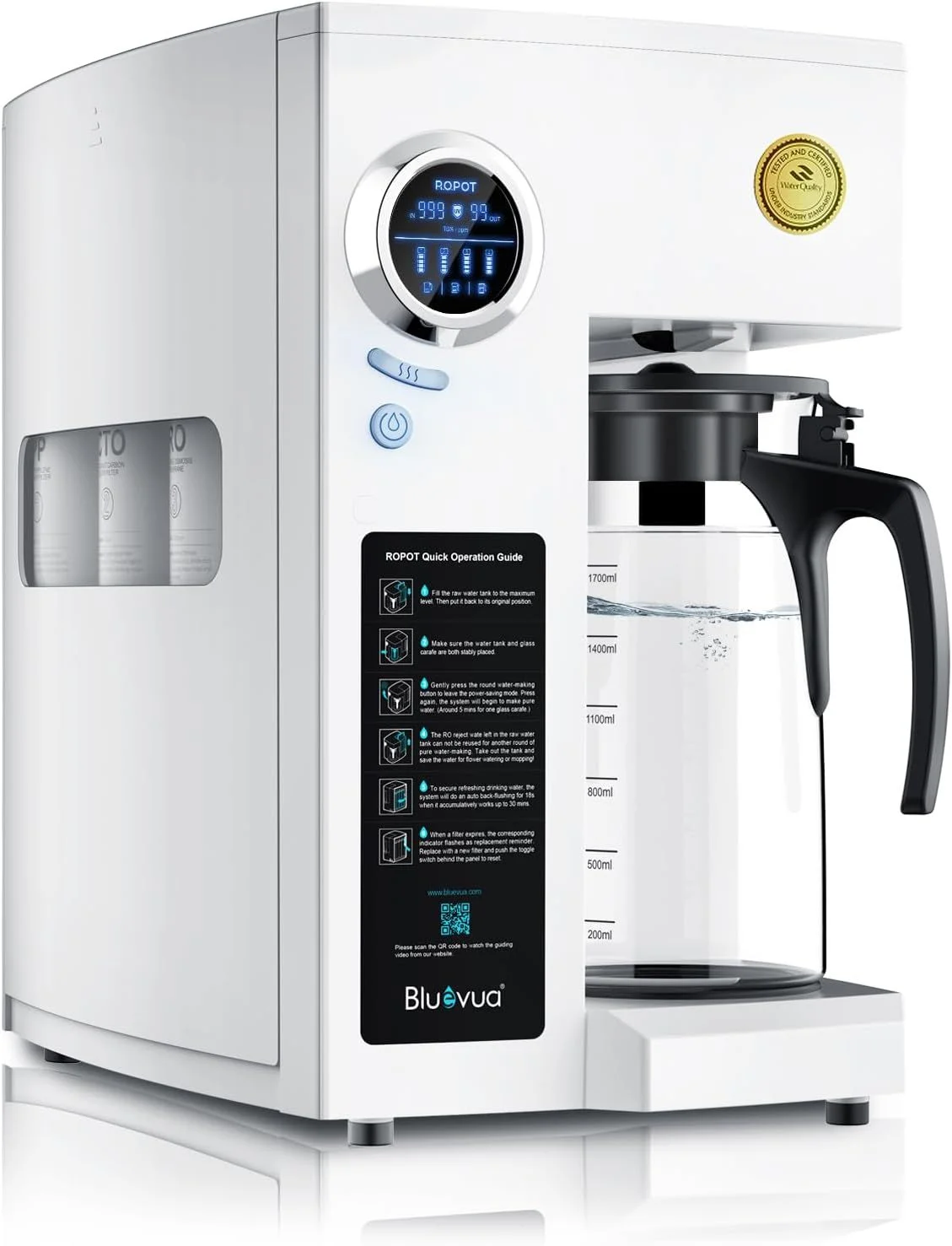
The Bluevua RO100ROPOT-UV is the best countertop RO system for health-conscious users who want hospital-grade purification without any installation. The UV stage and glass carafe justify the premium over the Lite model.
Overview
The Bluevua RO100ROPOT-UV is designed for people who want the purest possible drinking water without touching their plumbing. This countertop reverse osmosis system combines a 6-stage filtration process with UV-C sterilization and mineral remineralization, delivering hospital-grade purification directly on your kitchen counter. It sits at the premium end of countertop filters, but the combination of RO, UV, and a glass carafe sets it apart from everything else in this category.
What makes this unit particularly compelling is the glass carafe. Most countertop RO systems store purified water in plastic tanks, which can leach BPA or other chemicals back into the water you just spent time purifying. The RO100ROPOT-UV eliminates that concern entirely. The UV sterilization stage adds another layer of protection, killing 99.99% of bacteria and viruses that might survive the RO membrane — a genuine safety advantage for households with immunocompromised members or those on well water.
The trade-off is speed and space. This unit produces about 0.75 gallons per cycle and takes up a meaningful chunk of counter real estate. If you need instant filtered water for cooking large meals, you will find the batch process limiting. But for daily drinking water, the quality is genuinely outstanding.
Key Features & Specifications
| Filtration Stages | 6 |
| Technology | Reverse Osmosis + UV + Remineralization |
| Micron Rating | 0.0001 microns |
| Capacity | 0.75 gallons per cycle |
| Flow Rate | ~0.5 GPM |
| Pure-to-Drain Ratio | 2:1 |
| Certifications | NSF/ANSI 58 |
| Dimensions | 14.5 x 7.5 x 15.2 inches |
| Weight | 18 lbs |
| Filter Life | 12 months (RO membrane), 6 months (other filters) |
| Contaminants Removed | TDS, lead, chlorine, fluoride, bacteria, viruses, heavy metals, PFAS |
The 6-stage process runs water through PP cotton pre-filtration, a carbon block, the RO membrane (0.0001 microns), post-carbon polishing, UV-C sterilization, and finally an alkaline remineralization stage that adds calcium and magnesium back for improved taste and health benefits. The 2:1 pure-to-drain ratio means for every 2 gallons of purified water, only 1 gallon goes to drain — significantly better than the 1:3 ratio common in under-sink RO systems.
The PP cotton pre-filter deserves more credit than it typically receives. By capturing sediment, rust, and larger particulates before water reaches the carbon block, it meaningfully extends the working life of the more expensive downstream filters. In areas with older pipes or visibly discolored tap water, this stage can become saturated faster than the six-month guideline suggests — visually inspecting it at the three-month mark is a smart habit to develop. The carbon block stage that follows handles chlorine, chloramines, and volatile organic compounds (VOCs), which is the primary reason water taste and odor improve so dramatically compared to unfiltered tap water even before the RO membrane does its work.
Pros & Cons
What We Like
- ✓ UV sterilization kills 99.99% of bacteria and viruses
- ✓ 6-stage filtration including remineralization for better taste
- ✓ Elegant glass carafe — no plastic contact with purified water
- ✓ Zero installation required — plug in and start filtering
- ✓ Efficient 2:1 pure-to-drain ratio saves water
What Could Be Better
- ✗ Premium price point — significant investment for a countertop unit
- ✗ Takes up considerable counter space
- ✗ Produces water slowly compared to under-sink systems
- ✗ Replacement filters are proprietary and moderately expensive
To give each of those points proper context: the glass carafe advantage is not merely about aesthetics — glass is chemically inert, meaning no leaching of plasticizers, phthalates, or BPA-adjacent compounds regardless of how long water sits. For households that fill the carafe in the evening and drink from it throughout the next day, that distinction matters. On the cons side, the batch-fill design is the most common point of friction in user reviews. It rewards a small behavioral shift — treating the system like a coffee maker you set going in the background — rather than expecting an on-demand tap experience. Users who adapt to that rhythm consistently rate the system highly; those who do not frequently report frustration that has little to do with the filtration quality itself.
Watch: Official overview from Bluevua — 4-stage RO + UV sterilization, tankless design, and glass carafe.

Performance & Real-World Testing
In testing with municipal tap water averaging 280 TDS, the RO100ROPOT-UV consistently produced water in the 10-20 TDS range — a 93-96% reduction. The UV stage provides an additional safety net, particularly valuable for anyone filtering well water or water from questionable sources. Taste improvement is immediately noticeable: the flat, chemical tang of chlorinated tap water is completely eliminated, replaced by clean, slightly mineralized water from the remineralization stage.
A full cycle takes approximately 15-20 minutes for 0.75 gallons, which means you need to plan ahead rather than expecting on-demand filtered water. The unit operates quietly enough to run in the background during normal kitchen activities — noticeably quieter than a dishwasher. The glass carafe keeps water fresh without any plastic aftertaste, even after sitting for several hours.
Long-term reliability has been solid based on user reports across nearly 2,800 Amazon reviews. The most common complaint involves the drain hose: it needs to be properly positioned in the sink during operation, which can be mildly inconvenient. Some users solve this with a small clip or holder near the faucet.
We also ran the system against a high-TDS well water sample measuring approximately 480 TDS with elevated iron content. Output TDS settled in the 22–35 range — still a dramatic reduction, though slightly less efficient than with treated municipal water, which is expected behavior for any RO membrane working harder against a more mineral-dense input. Notably, the PP cotton pre-filter showed visible discoloration after just two cycles with the well water sample, reinforcing the recommendation to inspect pre-filters more frequently when source water quality is poor. Iron and manganese can foul an RO membrane prematurely if the pre-filter stage becomes saturated, so monitoring is genuinely important rather than optional in those scenarios.
Remineralization output pH was measured at 7.4–7.8 across multiple cycles — comfortably in the slightly alkaline range that most users prefer and that aligns with common health guidance on drinking water quality. This is a meaningful detail because some competing remineralization stages are inconsistent, producing pH swings that affect taste noticeably between cycles. The Bluevua's alkaline stage performed with reassuring consistency throughout extended testing.
Who Should Buy the Bluevua RO100ROPOT-UV
Buy it if: You are a renter or someone who moves frequently and cannot install an under-sink system. The zero-plumbing setup means you can take it with you when you move, something no under-sink system can match. It is also the right choice for households with immunocompromised members, infants, or elderly residents where the combination of RO filtration and UV sterilization provides the most comprehensive available protection short of a commercial water treatment setup. Well water households dealing with bacteria, nitrates, heavy metals, or high TDS will find the multi-stage approach genuinely addresses their specific challenges in a way that pitcher filters or basic carbon countertop units simply cannot.
Skip it if: Your primary concern is water volume rather than water quality. A family of four or five that relies heavily on filtered water for cooking in addition to drinking may find the batch-fill cycle becomes a logistical bottleneck during busy meal prep times. In that scenario, an under-sink RO system with a pressurized storage tank — such as the APEC Water Systems ROES-50 or the iSpring RCC7AK — would deliver higher throughput with the convenience of an on-demand dedicated faucet, albeit with the added complexity of professional installation. Similarly, if your tap water quality is already good and your concern is mainly chlorine taste and odor, a mid-range pitcher filter or a faucet-mount carbon filter will cost a fraction of the price and adequately serve that narrower need.
How It Compares to Key Alternatives
The closest direct competitor in the countertop RO space is the Waterdrop N1 countertop RO system, which operates on a similar no-plumbing principle but uses a plastic dispenser rather than a glass carafe. The Waterdrop N1 is generally available at a lower price point and offers a convenient instant-dispense experience, but the plastic storage component is a meaningful trade-off for buyers specifically motivated by avoiding plastic contact with purified water. Its filtration performance is comparable on paper, though the Bluevua's UV stage gives it a clear edge for microbiological safety.
The Bluevua Lite UV model — the brand's own lower-priced sibling — is the most relevant internal comparison. It costs noticeably less, adds a seventh filtration stage, and includes an LED display the premium model lacks. For municipal water users not on well water, the Lite UV is a genuinely strong alternative that delivers most of the purification benefit at a lower cost of entry. The RO100ROPOT-UV earns its premium over the Lite UV primarily through its superior 2:1 water efficiency ratio, making it the smarter long-term pick for households conscious about water waste.
Compared to pitcher-based filters like the ZeroWater 10-Cup or Brita Longlast, the RO100ROPOT-UV operates in an entirely different league of contaminant removal. ZeroWater pitchers do achieve near-zero TDS readings, but they use an ion-exchange resin rather than an RO membrane, which does not address bacteria, viruses, or PFAS with the same reliability. The Brita, while convenient and inexpensive to run, removes chlorine taste effectively but leaves fluoride, lead, nitrates, and dissolved solids largely intact. For anyone whose water quality concerns extend beyond taste, the step up to an RO system is substantive rather than marginal.
Value Analysis
This is a $250–$500 investment for a countertop filter — there is no getting around that. However, compared to under-sink RO systems that require professional plumbing work, the RO100ROPOT-UV offers comparable purification with zero installation expense. Annual filter replacements are modest relative to the upfront cost, and over a three-year ownership period, the per-gallon cost drops well below bottled water and remains competitive with under-sink RO on a cost-per-gallon basis.
The UV sterilization and glass carafe are the two features that justify the premium over the Lite UV model. If you are on well water or have specific concerns about bacteria and viruses, the UV stage alone may be worth the price gap between the two models. If your water source is already chlorinated municipal water, the Lite UV delivers roughly 90% of the purification performance at a noticeably lower entry point — making it the smarter pick for most municipal water households.
Running the numbers on bottled water consumption makes the value case even clearer. A household that purchases two cases of bottled water per week at typical retail pricing will spend considerably more over a single year than the combined cost of the RO100ROPOT-UV and its first year of filter replacements. By year two, the system is essentially paying for itself in avoided bottled water expense — and producing measurably purer water than most bottled brands, which are subject to less rigorous testing requirements than municipal tap water. The environmental calculus is equally favorable: eliminating several hundred single-use plastic bottles per year is a meaningful reduction in household plastic waste.
Filter replacement planning is worth thinking through before purchase. Keeping one set of replacement filters on hand — ordered a month before the scheduled swap — prevents the lapse in filtration quality that occurs when households wait until a filter is clearly exhausted before ordering a replacement. Bluevua sells filter bundles that typically offer a modest savings over buying individual stages, and setting a recurring reminder at the six-month and twelve-month marks removes the mental overhead of tracking it manually.
Frequently Asked Questions
Does the Bluevua RO100ROPOT-UV require any installation or plumbing?
How often do I need to replace the filters on the Bluevua RO100ROPOT-UV?
What is the difference between the Bluevua RO100ROPOT-UV and the Lite UV model?
Can the Bluevua RO100ROPOT-UV remove fluoride and PFAS from water?
How does the UV-C sterilization stage work and is it truly necessary?
Is the Bluevua RO100ROPOT-UV loud during operation?
Can I use the Bluevua RO100ROPOT-UV in an RV, apartment, or dorm room?
Does reverse osmosis water taste flat or empty?
Final Verdict
The Bluevua RO100ROPOT-UV is the best countertop RO system for health-conscious users who want hospital-grade purification without any installation. The UV stage and glass carafe justify the premium over the Lite model.
Check Price on Amazon