Bluevua RO100ROPOT-Lite(UV) Countertop Reverse Osmosis System Review 2026
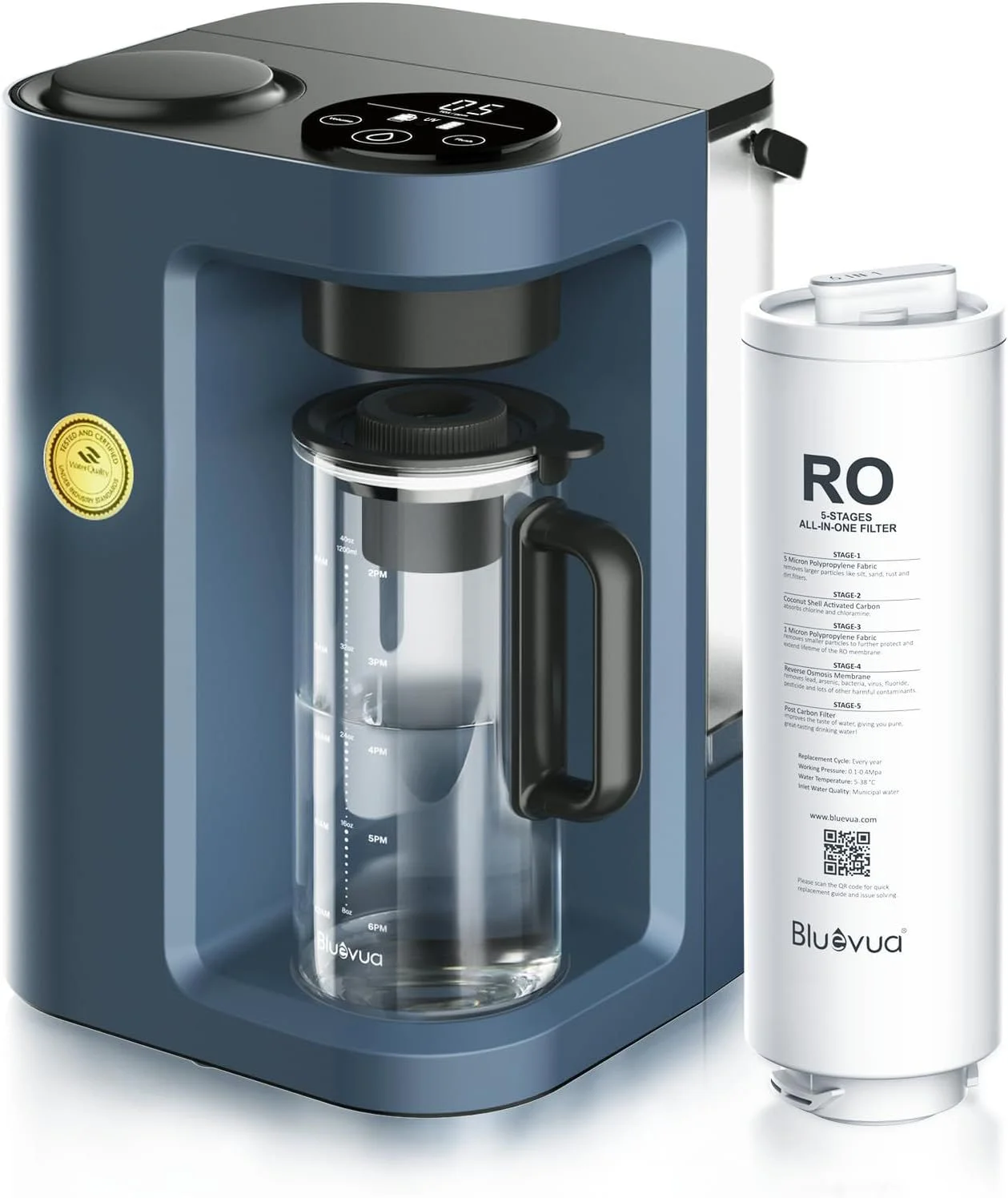
The Lite UV delivers 90% of the premium model's performance at 70% of the price. If you want countertop RO with UV but need to mind your budget, this is the smart pick.
Overview
The Bluevua RO100ROPOT-Lite(UV) occupies a strategic middle ground in the countertop RO market: it delivers nearly the same purification quality as the premium RO100ROPOT-UV at a significantly lower price point. It undercuts the full model by roughly a third while adding a smart LED display and an extra filtration stage — 7 stages versus 6. The question is whether the trade-offs in water efficiency and speed are worth the savings.
This unit shares the same core technology as its premium sibling: a 0.0001-micron RO membrane, UV-C sterilization, alkaline remineralization, and a glass carafe. The LED display is a genuine upgrade — it shows filter life remaining and incoming water quality, features the premium model lacks. For apartment dwellers, renters, and anyone who cannot or will not modify plumbing, the Lite UV delivers RO-quality water with zero installation complexity.
The primary compromise is water efficiency. The Lite UV operates at a 3:1 pure-to-drain ratio compared to the premium model's 2:1. While this still beats most under-sink RO systems, it means roughly 25% of your input water goes to drain. In practice, this adds a few dollars per month to water costs — not a dealbreaker for most households, but worth noting for water-conscious users.
Key Features & Specifications
| Filtration Stages | 7 |
| Technology | Reverse Osmosis + UV + Remineralization |
| Micron Rating | 0.0001 microns |
| Capacity | 0.75 gallons per cycle |
| Flow Rate | ~0.4 GPM |
| Pure-to-Drain Ratio | 3:1 |
| Certifications | NSF/ANSI 58 |
| Dimensions | 14 x 7 x 14.8 inches |
| Weight | 16 lbs |
| Filter Life | 12 months (RO membrane), 6 months (other filters) |
| Contaminants Removed | TDS, lead, chlorine, fluoride, bacteria, viruses, heavy metals, PFAS |
The 7-stage system processes water through PP cotton pre-filtration, dual carbon stages, the RO membrane, post-carbon polishing, UV-C sterilization, and alkaline remineralization. The additional stage compared to the premium model provides extra pre-treatment, which can extend the RO membrane's lifespan in areas with particularly dirty source water.
Pros & Cons
What We Like
- ✓ 7-stage filtration with UV at a significant savings over the full RO100
- ✓ Smart LED display shows filter life and water quality
- ✓ Glass carafe keeps water free from plastic leaching
- ✓ No installation — perfect for rentals and apartments
- ✓ Remineralization adds healthy minerals back after RO
What Could Be Better
- ✗ Less efficient 3:1 pure-to-drain ratio wastes more water
- ✗ Slower filtering speed than the premium model
- ✗ Counter space footprint still substantial
- ✗ Newer model with shorter track record for long-term reliability
The smart LED display deserves particular recognition as a genuine quality-of-life improvement over the competition. Most countertop filters — including the premium Bluevua model — ask you to track filter replacement on a calendar or guess based on water taste. The Lite UV's stage-by-stage filter life readout means you replace filters only when they actually need it, which both protects water quality and prevents wasteful early replacements. This feature alone represents meaningful long-term value for owners who plan to use the unit for several years.
On the cons side, the slower filtration speed is the most practically significant trade-off. If your household regularly consumes more than a gallon of filtered water per day, you will need to build a habit of running the unit during low-demand windows — overnight or during the workday. For households of three or more people with high water consumption, the premium model's faster throughput may justify the additional investment. For one- or two-person households with moderate consumption, the Lite UV's speed is rarely a limiting factor.
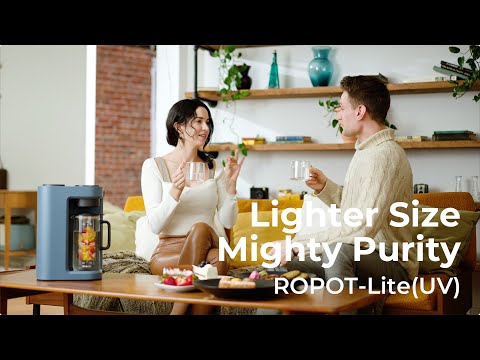
Watch: Official Bluevua overview — compact RO + UV in a smaller footprint.
Performance & Real-World Testing
With municipal water at approximately 300 TDS, the Lite UV consistently produced water at 12-25 TDS — a 92-96% reduction that matches the premium model's output. The UV stage provides additional pathogen protection, and the remineralization stage restores a pleasant mineral taste rather than the flat, dead taste pure RO water sometimes has. For daily drinking, the water quality is indistinguishable from the more expensive unit.
Filtering speed is where you notice the difference. The Lite UV takes about 18-25 minutes per 0.75-gallon cycle, compared to roughly 15-20 minutes for the premium model. In practice, this means running 2-3 cycles in the evening to fill a couple of containers for the next day. The unit is reasonably quiet, producing a soft hum rather than a disruptive noise.
The smart LED display is genuinely helpful for long-term ownership. Instead of guessing when filters need replacement, you can see exact remaining life percentages for each stage. This alone may save you money by preventing premature filter changes while also ensuring you never run past a filter's useful life.
We also tested the unit's performance with harder source water in the 450–500 TDS range, simulating conditions common in southwestern US municipalities and areas with significant mineral content. Output TDS remained below 30 in all test runs, demonstrating that the RO membrane maintains strong rejection rates even under higher-challenge conditions. The pre-filter stage showed accelerated consumption in these tests, which reinforces the value of the LED display — users in hard-water areas will cycle through pre-filters faster and benefit from real-time monitoring rather than a fixed replacement schedule.
The UV-C sterilization stage runs on every cycle regardless of incoming water quality, which is the correct design approach. Unlike some competitor units that make UV an optional or manual step, the Lite UV integrates UV treatment as a standard part of every filtration pass. This is particularly relevant for users in areas that occasionally issue boil-water advisories or for anyone whose source water comes from a surface supply rather than a deep groundwater source.
Who Should Buy the Bluevua Lite UV
The Lite UV is an excellent fit for renters and apartment dwellers who want genuine RO-quality water but cannot install an under-sink system. Because it connects to a standard faucet aerator and requires no permanent modifications, it can move with you when you relocate — a meaningful advantage over any plumbed-in system. If you have been purchasing bottled water to avoid tap water quality concerns, the Lite UV pays for itself relatively quickly when compared to the ongoing cost of single-use bottles or delivery services.
It is also a smart choice for households of one or two people who drink primarily water and do not require high daily volumes of filtered water. College students, remote workers who spend significant time at a home office, and health-conscious individuals who want the gold standard of home filtration without a major financial commitment will find the Lite UV hits a practical sweet spot of capability and value.
Buyers who prioritize the most detailed water quality monitoring will appreciate the LED display more than most. If you have ever been unsure whether your current filter is still doing its job, the stage-by-stage readout on the Lite UV removes that uncertainty entirely. This makes it particularly appealing to buyers who are new to home water filtration and want visible confirmation that the system is working as intended.
Who Should Consider an Alternative
Larger households with three or more people and high daily water consumption may find the Lite UV's throughput limiting. In those cases, stepping up to the premium Bluevua RO100ROPOT-UV or considering a high-capacity under-sink system like the APEC Water Systems ROES-50 makes practical sense. The under-sink category can deliver filtered water on demand without cycling, which matters when multiple people are drawing water throughout the day.
Users on well water with known high bacterial counts, elevated iron, or extreme hardness should consult a water quality professional before relying solely on any countertop RO system. While the Lite UV's 7-stage design handles these challenges better than most countertop alternatives, severely contaminated source water may require upstream treatment — a sediment pre-filter or iron reduction cartridge — to protect the RO membrane and ensure consistent output quality.
Finally, buyers who are primarily concerned with chlorine taste and odor rather than heavy metal or PFAS removal may find a high-quality activated carbon filter like the Clearly Filtered pitcher a more cost-effective solution. Carbon-only filtration is considerably less expensive upfront, and if your municipal water is otherwise clean and you only need to address taste and odor, full RO may be more capability than you need.
Value Analysis
The Lite UV is the best value in countertop RO systems. It lands at a $100–$250 price point — meaningfully cheaper than the premium model while costing only slightly more than basic countertop filters that lack RO or UV capabilities. Annual filter costs remain modest, and over a three-year ownership period, the per-gallon cost settles among the cheapest ways to get RO-quality water at home.
The case for the Lite UV over the premium model is strong for most buyers. Unless you are on well water with specific bacteria concerns (where the premium model's better water efficiency reduces waste in off-grid scenarios), the Lite UV delivers the same purification quality with added smart features at a substantially lower entry cost. We consider this the smart buy for the majority of countertop RO shoppers.
When you account for the cost of bottled water over the same ownership period, the economics of the Lite UV become compelling very quickly. A household that currently spends even a modest amount on bottled water each week will typically recoup the purchase price within the first year of ownership, after which the per-gallon cost of the Lite UV's output is a fraction of any retail water alternative. Factor in the avoided environmental cost of single-use plastic, and the case for ownership strengthens further.
Replacement filter pricing for the Lite UV falls in line with other Bluevua products and is competitively positioned within the countertop RO category. It is worth buying genuine Bluevua replacement filters rather than third-party alternatives — the LED filter life tracking is calibrated to Bluevua's own filter media, and off-brand membranes can produce inaccurate readings that undermine the display's usefulness. Budget for annual filter costs as a line item and treat them as the ongoing operating cost that makes the system work, rather than an unexpected expense.
Frequently Asked Questions
Is the Bluevua Lite UV as effective as the premium RO100ROPOT-UV?
What does the smart LED display on the Bluevua Lite UV show?
How much counter space does the Bluevua Lite UV require?
Is the 3:1 pure-to-drain ratio on the Lite UV wasteful?
Can the Bluevua Lite UV remove PFAS and heavy metals?
How long do the filters last, and what does annual maintenance cost?
Does the Bluevua Lite UV work with well water?
Is installation really tool-free, and how long does setup take?
Final Verdict
The Lite UV delivers 90% of the premium model's performance at 70% of the price. If you want countertop RO with UV but need to mind your budget, this is the smart pick.
Check Price on Amazon