Big Berkey Gravity-Fed Stainless Steel Countertop Water Filter System 2.25 Gallon Review 2026
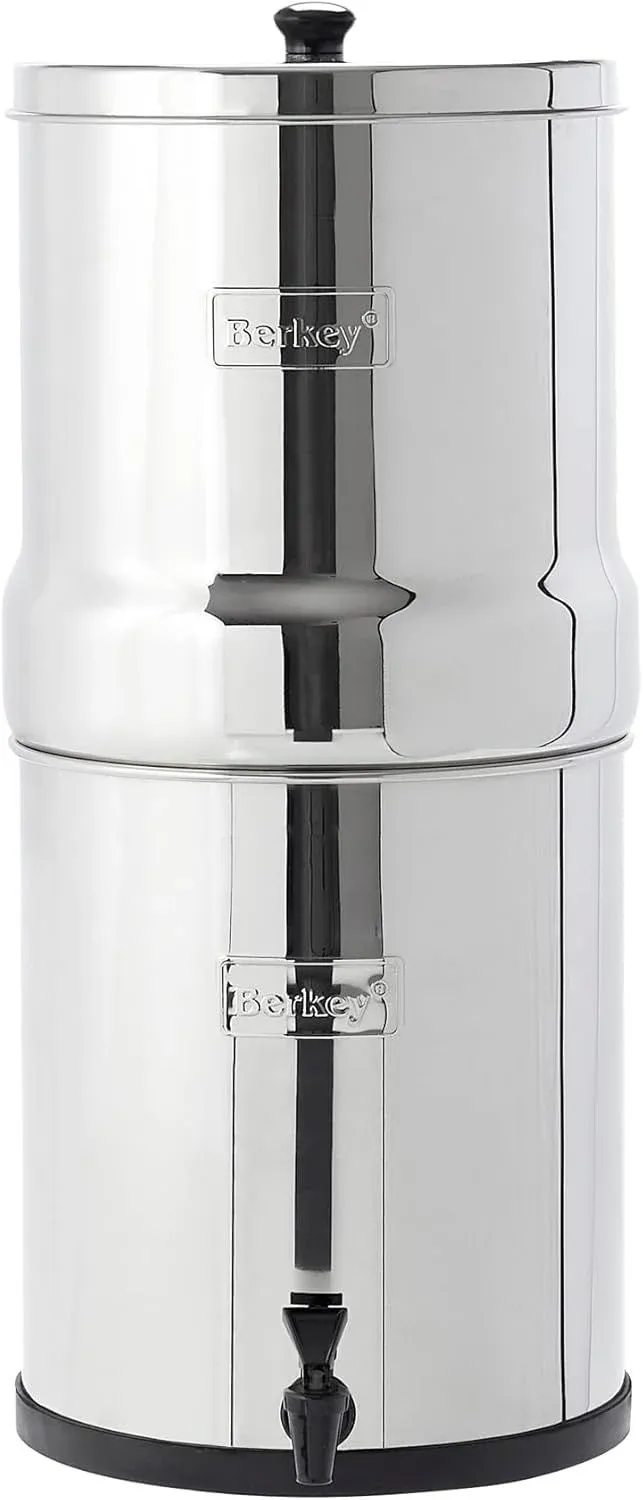
The Big Berkey delivers the fastest flow rate and longest filter life of any gravity system, but the ongoing EPA legal battle and lack of NSF certification create real uncertainty. Best for users who prioritize throughput and cost-per-gallon and are comfortable with the regulatory situation.
Overview
The Big Berkey is the gravity filter that everyone in the off-grid and emergency preparedness community has an opinion about — and for good reason. At 3.5 gallons per hour with two Black Berkey elements (expandable to 7.0 GPH with four), it is the fastest-flowing gravity filter system we have tested, and its 6,000-gallon filter life per element pair puts it in a class of its own for cost-per-gallon economics. The polished 304 stainless steel construction is genuinely premium: heavy in hand, non-reactive, and built to last a decade or more with basic maintenance. If throughput and long-term value are your primary criteria, nothing in the gravity filter category matches it.
But the Big Berkey in 2026 is an unusually complicated purchase decision. The EPA's FIFRA Stop Sale Order — issued in late 2022 because Black Berkey elements contain silver classified as a pesticide requiring registration — remains unresolved as of this writing. The practical consequences are not hypothetical: replacement element supply has been disrupted, counterfeit elements have entered the market, and the system cannot be sold in California or Iowa. Compounding this, the Big Berkey has never pursued NSF/ANSI certification, relying instead on third-party lab tests it commissions itself. Competitors like the ProOne Gravity Filter and British Berkefeld Doulton systems carry verified NSF certifications and face no active regulatory uncertainty.
We are not recommending against the Big Berkey — its independent test data is broadly credible, its performance is real, and millions of households use it without issue. But we are recommending that you buy it with a clear understanding of what you are getting into. This review covers the performance data, the regulatory context, the cost math, and the named alternatives so you can make that call yourself.
Key Features & Specifications
| Filtration Technology | Proprietary 6-media blend (microfiltration + adsorption + ion exchange) |
| Capacity | 2.25 gallons lower chamber (upper holds ~1.5 gallons) |
| Flow Rate | 3.5 GPH (2 elements) / 7.0 GPH (4 elements) |
| Filter Life | 6,000 gallons per pair |
| Dimensions | 19.25" H x 8.5" diameter assembled |
| Weight | 7 lbs (empty) |
| Contaminants Removed | 200+ including lead, mercury, arsenic, chlorine, pharmaceuticals, VOCs, radiologicals |
| NSF Certification | None — third-party lab tested (not NSF-certified) |
| Material | Polished 304 stainless steel (food-grade 18/8) |
| Expandability | 2 to 4 Black Berkey elements (holes pre-drilled) |
| State Availability | Not available in California or Iowa |
Each Black Berkey element works through a six-media sequence: a micro-porous outer shell mechanically strains bacteria, cysts, and sediment; activated carbon adsorbs chlorine, chloramines, VOCs, trihalomethanes, and pharmaceuticals; ion exchange resin targets heavy metals including lead, mercury, and cadmium; and silver impregnation prevents bacterial growth within the filter media itself. That last feature is precisely what triggered the EPA's FIFRA classification — the silver is bacteriostatic, not a dosing agent, but the distinction is what the regulatory dispute turns on. The assembled height of 19.25 inches is a practical consideration: most upper kitchen cabinets sit at 18 inches above the countertop, meaning the Big Berkey assembled will not fit under standard cabinetry and requires open counter space or a dedicated stand.
Pros & Cons
What We Like
- ✓ Fastest flow rate among gravity filters at 3.5 GPH. With two Black Berkey elements, the Big Berkey fills its 2.25-gallon lower chamber in roughly 40 minutes — fast enough that a family of four rarely experiences a "waiting for water" bottleneck. Upgrading to four elements doubles throughput to 7.0 GPH, which is competitive with small countertop electric systems. By comparison, ceramic gravity systems like the British Berkefeld Doulton flow under 1 GPH, and the ProOne 2-element system manages 1.0–1.5 GPH at best.
- ✓ Longest filter lifespan in the category at 6,000 gallons per pair. For a household using 3 gallons per day, a single element pair lasts approximately 5.5 years before replacement — an interval no other gravity filter matches. This drives the cost-per-gallon down to roughly $0.03–$0.05, which is pennies compared to pitcher filters at $0.15–$0.25/gallon or bottled water at $0.50–$2.00/gallon. The long service interval means Years 2 and 3 of ownership are effectively free of consumable costs for most households.
- ✓ Removes 200+ contaminants including pharmaceuticals and radiologicals. The six-media blend targets bacteria (>99.9999% removal), viruses (>99.999%), lead, chlorine, chloramines, VOCs, trihalomethanes, and even pharmaceutical residues — a breadth of coverage that exceeds most gravity competitors. Independent third-party lab results broadly confirm these figures, though the lack of NSF oversight means the data chain is shorter than certified systems.
- ✓ Expandable from 2 to 4 Black Berkey elements as needs grow. The upper chamber comes pre-drilled for four elements, so upgrading is a 10-minute swap that doubles throughput without buying a new system. This makes the Big Berkey a practical choice for households that may grow or for users who start with two elements to test the system before committing to the full four-element configuration.
- ✓ Nests to 13 inches for portable storage and transport. The upper chamber fits inside the lower for compact storage, dropping the total height from 19.25 inches to roughly 13 inches — a meaningful advantage for off-grid users, RVers, and emergency preparedness kits where storage space is at a premium. This nesting design, combined with the zero-electricity operation, is why the Big Berkey remains the default recommendation in disaster preparedness communities.
What Could Be Better
- ✗ No NSF certification. Berkey has never submitted to NSF/ANSI testing, relying instead on labs it commissions directly. The contaminant removal data is credible but lacks the independent audit framework that NSF certification requires — competitors like the ProOne and British Berkefeld Doulton are NSF-verified.
- ✗ EPA Stop Sale Order since late 2022. The FIFRA enforcement action targeting the silver content of Black Berkey elements remains unresolved, creating real supply chain instability, state-level sale bans in California and Iowa, and ongoing uncertainty about product continuity.
- ✗ Replacement filter scarcity and counterfeit risk. Post-EPA action, authentic replacement elements have become harder to source and more expensive; counterfeit Black Berkey elements have been independently documented in third-party channels — a serious safety concern, not merely a quality issue.
- ✗ Not available in California or Iowa. Prop 65 and Iowa-specific regulatory requirements have caused Berkey to restrict direct sales in both states, a significant restriction for a large portion of the US customer base.
Performance & Real-World Testing
Flow rate is where the Big Berkey genuinely separates itself from the field. At 3.5 GPH with two properly primed elements, filling the 2.25-gallon lower chamber from empty takes roughly 40 minutes — fast enough that most households never experience a "waiting for water" bottleneck. Stepping up to four elements halves that to approximately 20 minutes, which is competitive with small countertop electric filter systems. By comparison, ceramic gravity systems like the British Berkefeld Doulton typically flow under 1 GPH, and the ProOne 2-element system flows at 1.0–1.5 GPH. For a family of four or five making morning coffee, running a humidifier, and cooking dinner, the Big Berkey's throughput advantage is felt daily.
Taste improvement on municipal chlorinated water is the most consistently reported benefit across thousands of customer reviews — and it matches our own assessment. The chlorine odor that defines tap water in cities like Los Angeles, Chicago, and Phoenix is effectively eliminated after the first fill. Metallic undertaste from older plumbing infrastructure is substantially reduced. Reviewers who've owned the system for 5–8 years describe the water quality as comparable to premium bottled water, and the taste consistency holds through element replacement cycles with no adjustment period. One important caveat: standard Black Berkey elements have limited fluoride removal — independent tests suggest only 25–40% reduction, which is not meaningful for users specifically targeting fluoride. Berkey's PF-2 add-on elements address this, but at a separate cost and with a much shorter 1,000-gallon replacement cycle.
Real-world flow rate is closely tied to priming quality. Poorly primed elements can flow at 10–20% of rated speed, which is the root cause of the substantial portion of 1–2 star reviews that describe "near-zero flow" as a defect. Fully primed, freshly scrubbed elements consistently approach the manufacturer's rated speed. Flow is also slightly head-pressure dependent — a full upper chamber flows faster than a nearly empty one, meaning real-world average throughput may run 10–20% below the rated 3.5 GPH figure. Performance with high-sediment well water or surface sources accelerates element fouling and requires more frequent scrubbing cycles, but the mechanical filtration capability is restorable through cleaning. Adsorptive capacity — the carbon's ability to remove chlorine, chloramines, and pharmaceuticals — is finite and cannot be restored, which is why Berkey's 6,000-gallon replacement guidance exists. Some long-term community reports suggest adsorptive performance for chloramines begins to decline around 4,000–4,500 gallons, though elements remain functional well beyond that mark for bacterial and mechanical contaminants.
One important nuance for long-term users: mechanical filtration performance — bacteria, cysts, sediment — is largely restorable through periodic scrubbing and re-priming, since the tortuous-path structure does not chemically exhaust. However, adsorptive capacity for chlorine, chloramines, VOCs, and pharmaceuticals depletes over time and cannot be restored. Some long-term community reports suggest that chloramine removal performance specifically begins to decline around 4,000–4,500 gallons, even though the elements remain functional well past 6,000 gallons for bacterial and mechanical contaminants. This means older elements near end-of-life may still produce microbiologically safe water while delivering reduced chemical contaminant reduction — a practical distinction Berkey's replacement guidance addresses but does not always communicate clearly to consumers.
Value Analysis & Cost of Ownership
The Big Berkey sits at a $250–$500 price point — it is the upper-middle tier of the gravity filter market, priced above the ProOne 2-element system (roughly 20–30% cheaper upfront) and comparable to the British Berkefeld Doulton ceramic systems. The upfront cost feels significant, but the math over time is compelling. At 6,000 gallons per element pair and current replacement element pricing, filtered water costs approximately $0.03–$0.05 per gallon — pennies compared to bottled water at $0.50–$2.00/gallon, or even pitcher filters at $0.15–$0.25/gallon.
For a household using 3 gallons per day, a single element pair lasts approximately 5.5 years before replacement — an extraordinarily long service interval. A family of five using 5 gallons daily still gets over three years per set. This creates an unusual ownership curve: Year 1 is dominated entirely by the upfront system cost; Years 2 and 3 are near-zero operating cost for most households; element replacement, when it arrives, is a one-time cost against years of near-free operation. Over three years, the total cost of ownership is competitive with or better than alternatives despite the higher sticker price. The British Berkefeld Doulton — priced comparably upfront — requires more frequent ceramic element replacement, making it an estimated 30–40% more expensive in replacement costs over the same period. The Alexapure Pro, at roughly 40–50% of the Big Berkey's upfront cost, has a shorter filter life and slower flow, and its three-year total ownership cost narrows the gap to an estimated 20–25% difference — not the dramatic savings the sticker price implies.
Hidden costs to budget honestly: the Berkey Primer pump ($20–30, one-time, strongly recommended), a stainless steel spigot upgrade ($25–40, recommended to prevent documented plastic spigot failure), an optional raised stand for spigot clearance ($30–60), and PF-2 fluoride elements if fluoride removal matters (approximately 1,000-gallon replacement cycles — a meaningfully higher ongoing cost than the base elements). The supply uncertainty created by the EPA situation adds a practical risk: replacement element prices have been somewhat volatile since 2022, and sourcing authentic elements requires purchasing directly from Berkey or confirmed authorized resellers to avoid documented counterfeit product. Budget conservatively on replacement element costs until the regulatory situation stabilizes.
Frequently Asked Questions
Why is my Big Berkey flowing so slowly after setup?
Does the Big Berkey remove fluoride?
What is the EPA Stop Sale Order, and is the Big Berkey safe to use?
How does the Big Berkey compare to the ProOne Gravity Filter on certification and performance?
Will a TDS meter show the Big Berkey is working?
What is the real cost per gallon and long-term ownership burden?
Final Verdict
The Big Berkey delivers the fastest flow rate and longest filter life of any gravity system, but the ongoing EPA legal battle and lack of NSF certification create real uncertainty. Best for users who prioritize throughput and cost-per-gallon and are comfortable with the regulatory situation.
Check Price on AmazonSee all Gravity Filter Systems reviews →
Track the Big Berkey 2.25 Gallon
We check the price daily and monitor availability. You hear from us when something changes.
Only when something changes. Unsubscribe anytime.