iSpring RCC7AK vs Waterdrop G5P500: Tank vs Tankless RO — Which Under-Sink System Wins in 2026?
Quick Verdict: The iSpring RCC7AK ($100–$250) is the proven veteran — 6-stage RO with built-in alkaline remineralization, 18,000+ reviews, and NSF 58 certification at a price that defines value in this category. The Waterdrop G5P500 ($100–$250) is the modern contender — tankless design, 500 GPD (nearly 7x faster), 70% less space, and better water efficiency. Both cost essentially the same. Choose the iSpring for alkaline water and proven track record, or the Waterdrop for speed and space savings.
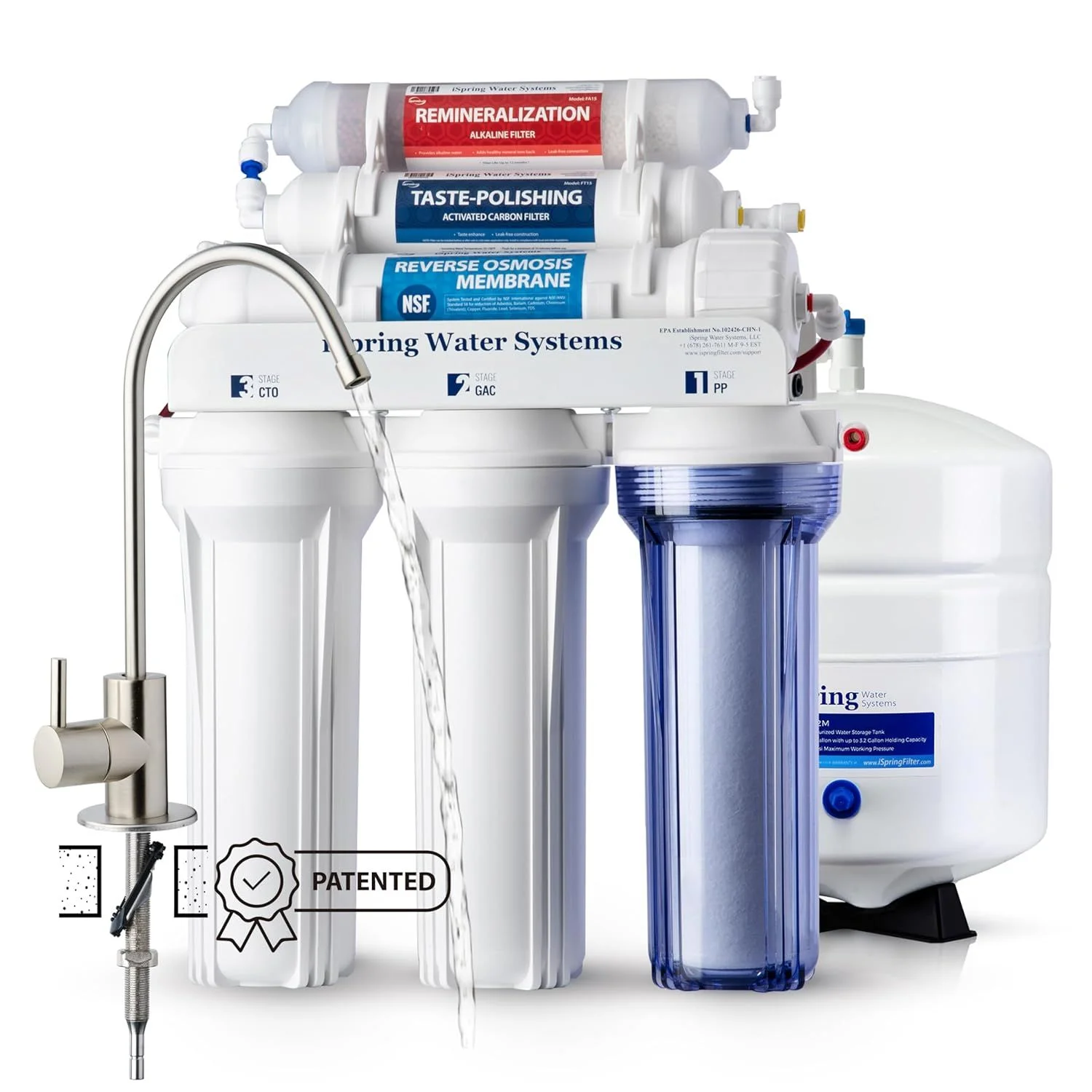
iSpring RCC7AK 6-Stage Reverse Osmosis System
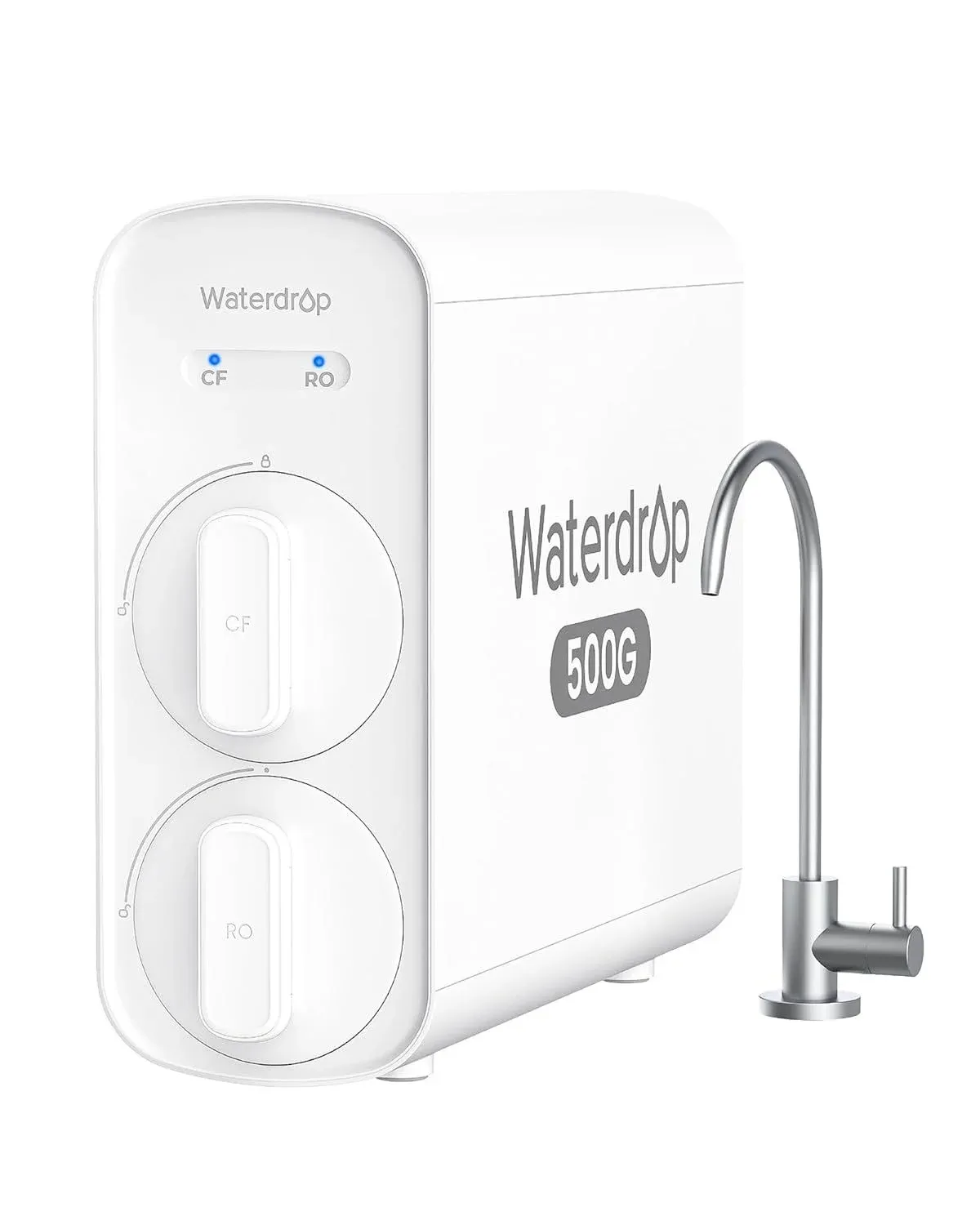
Waterdrop G5P500 Reverse Osmosis Water Filter 500 GPD
At a Glance
| Feature | Editor's Pick iSpring RCC7AK 6-Stage Reverse Osmosis System | Waterdrop G5P500 Reverse Osmosis Water Filter 500 GPD |
|---|---|---|
| Price | $100–$250 | $100–$250 |
| Filtration Stages | 6 | 7-stage RO |
| Flow Rate / GPD | 75 GPD | 500 GPD |
| Certifications | NSF 58 | NSF 58/372 |
| Filter Life | 6-12 months (pre/post filters), 2-3 years (RO membrane) | — |
| Contaminants Removed | TDS (93-98%), lead (>98.9%), PFAS (96-99%), fluoride, chlorine, arsenic, bacteria | 1,000+ impurities including TDS, PFOA/PFOS, chlorine, fluoride, lead, bacteria |
| Check Price | Check Price |
This is the most important decision in under-sink RO filtration right now: do you go with the proven tank-based iSpring that has been the category benchmark for years, or the new generation Waterdrop tankless system that produces water nearly seven times faster while saving 70% of under-sink space? Both cost essentially the same — around two hundred dollars — making this a pure feature-versus-feature comparison. The answer depends on whether you value alkaline water and a 15-year track record, or speed, space savings, and modern engineering.
Category-by-Category Breakdown
Production Speed & Flow Rate
The Waterdrop G5P500 produces 500 gallons per day — nearly seven times the iSpring's 75 GPD. In practical terms, the Waterdrop fills a glass in approximately 8 seconds directly from the faucet. The iSpring draws from its pressure tank, which provides good initial flow but slows as the tank depletes and needs time to refill. During peak usage — morning coffee, cooking dinner, filling water bottles — the iSpring's tank can run low and leave you waiting.
The tankless architecture of the Waterdrop means there is no buffer between demand and production. Turn on the faucet, and purified water flows immediately at a consistent rate. There is no tank to deplete and no recovery time. For households that use RO water heavily — cooking with it, making coffee and tea, filling pet bowls, and drinking throughout the day — this on-demand capability is a genuine daily quality-of-life improvement over the tank-and-wait cycle of traditional systems.
The iSpring's 75 GPD is not a problem for light to moderate use. A single person or couple who primarily uses RO water for drinking will rarely empty the tank. But as household size or usage intensity increases, the 500 GPD headroom of the Waterdrop becomes increasingly valuable. If you have ever been frustrated by waiting for an RO tank to refill, the Waterdrop eliminates that frustration permanently.
Alkaline Remineralization
The iSpring RCC7AK includes a dedicated alkaline remineralization stage — stage 6 in its filtration sequence — that adds calcium and magnesium back into the water after the RO membrane strips everything out. RO-purified water without remineralization sits at roughly pH 5 to 6, which tastes flat or slightly acidic to many people. The iSpring's alkaline stage raises pH to a neutral or slightly alkaline 7 to 8, producing water that tastes more like high-quality spring water than laboratory-grade purified water.
The Waterdrop G5P500 does not include remineralization. Its output is pure RO water — exceptionally clean, with TDS levels near zero, but without the mineral restoration that many palates prefer. If you are accustomed to mineral water or have tasted the difference between remineralized and pure RO water, the absence of minerals is noticeable. Some users describe pure RO water as tasting "empty" or "sterile" — not unsafe, but lacking the character that small amounts of calcium and magnesium provide.
This is the iSpring's most differentiating feature against the base G5P500. If alkaline water matters to you and you want it built into the system rather than added separately, the iSpring delivers this out of the box at no extra cost. The Waterdrop does offer the G5P500A variant with alkaline remineralization for a modest premium, but the base G5P500 compared here does not include it. For this specific comparison, the iSpring wins the alkaline category decisively.
Space Requirements & Installation
The Waterdrop G5P500's tankless design is its biggest physical advantage. The entire unit measures approximately 16.7 x 5.7 x 13.9 inches — compact enough to fit in one corner of a standard under-sink cabinet while leaving the majority of the space available for cleaning supplies, garbage disposals, and storage. Waterdrop claims 70% space savings compared to tank-based systems, and based on the dimensions, this is accurate.
The iSpring RCC7AK requires space for both the filter assembly (15 x 5.2 x 17.5 inches) and a separate pressure tank that is roughly the size of a small propane cylinder. Together, these two components consume most of the usable space under a standard kitchen sink. In smaller kitchens or apartments with compact under-sink cabinets, the iSpring's space requirements can be a genuine installation barrier. Some users report having to remove or relocate items they previously stored under the sink to accommodate the system.
Installation complexity follows the same pattern. Both require connecting to the cold water supply, routing a drain line, and mounting a dedicated faucet. The iSpring adds the step of positioning the tank, connecting its pressurized line, and ensuring the tank has enough clearance to be removed for periodic sanitization. The Waterdrop eliminates all tank-related steps. For DIY installers, the Waterdrop is meaningfully simpler to set up. For professional installation, the time and cost difference is modest but the Waterdrop still finishes faster.
Water Efficiency
The Waterdrop G5P500 produces 2 gallons of purified water for every 1 gallon sent to drain — a 2:1 pure-to-waste ratio. The iSpring RCC7AK produces 1 gallon of purified water for every 3 gallons sent to drain — a 1:3 ratio. This means the Waterdrop is six times more water-efficient than the iSpring per gallon of purified output.
Over a year of typical household RO usage — roughly 500 to 700 gallons of purified water consumed — the water waste difference is substantial. The iSpring would send approximately 1,500 to 2,100 gallons to drain to produce that volume. The Waterdrop would send 250 to 350 gallons. If you pay for water by the gallon (metered municipal supply or well water), or if you live in a drought-prone region where water conservation matters, the Waterdrop's efficiency advantage translates directly into cost savings and environmental benefit.
The efficiency difference is a consequence of engineering generation. The iSpring uses a traditional low-pressure RO design where much of the feed water passes across the membrane without being pushed through. The Waterdrop uses a booster pump that maintains higher trans-membrane pressure, forcing more water through the membrane on each pass. This is why newer tankless systems consistently outperform traditional tank-based designs on water efficiency — the pump technology has improved significantly in the last few years.
Track Record & Proven Reliability
The iSpring RCC7AK has 18,000+ reviews with a 4.6-star rating — one of the most extensively reviewed RO systems on the market. This review volume represents years of real-world installations across a wide variety of plumbing configurations, water sources, and usage patterns. The common issues are well-documented and manageable: occasional leaks at fittings (user installation error, not product defect), tank taking up space, and the 1:3 waste ratio. The system's core filtration performance is consistently praised, and the alkaline stage is frequently cited as a standout feature.
The Waterdrop G5P500 has 1,200+ reviews with a 4.6-star rating — strong for a newer product but significantly less proven than the iSpring. The review data suggests excellent initial performance and user satisfaction, but a product with 1,200 reviews has not yet been tested across the full range of edge cases and long-term scenarios that a product with 18,000 reviews has survived. Some users report noise levels that are higher than expected — described as a "loud machine" that requires 1 inch of cabinet clearance for airflow — which is a trade-off of the internal booster pump that enables the tankless design.
For buyers who prioritize proven, multi-year reliability from a product that has been battle-tested by tens of thousands of households, the iSpring has an insurmountable advantage. For buyers comfortable being earlier on a product's lifecycle in exchange for newer technology, the Waterdrop's early review data is encouraging. Both share the same 4.6-star rating, but the iSpring's rating is backed by fifteen times more data points.
Cost of Ownership Over Time
Both systems land in the same general price tier at purchase, but their ongoing costs diverge in structure if not in total. The iSpring RCC7AK spreads its annual maintenance across five separate cartridges at different intervals — some replaced every six months, others annually, and the membrane every two to three years. Each individual cartridge is inexpensive, sitting comfortably in the budget-friendly range, which makes any single replacement feel painless. The cumulative annual spend across all stages is moderate, but you need to stay organized about which filter is due when. A missed replacement — especially on a pre-filter — can shorten membrane life significantly and turn an inexpensive oversight into a costly membrane replacement.
The Waterdrop G5P500's two-filter maintenance model trades lower per-unit cost for simplicity. The composite filter and RO membrane are priced in the mid-range per replacement, but the tool-free swap process — literally a three-second twist — removes all friction from the maintenance routine. The Waterdrop also features a built-in filter life indicator on many configurations, so you are never guessing when a replacement is due. Over a three-year ownership window, total filter costs for both systems are roughly comparable, making the real differentiator convenience rather than dollars.
💡 ProTip: Whichever system you choose, buy a TDS meter (widely available in the budget-friendly range) and test your output water every few months. A rising TDS reading — especially above 50 ppm from a starting point near zero — is the earliest signal that your RO membrane is losing effectiveness, often before any visible or taste-based indicator appears. Catching membrane degradation early prevents you from unknowingly drinking under-filtered water for weeks or months.
Who Should Get Which?
Get the iSpring RCC7AK 6-Stage Reverse Osmosis System if...
- You want alkaline remineralization built in — better-tasting water out of the box
- You value the proven track record of 18,000+ reviews over 15x more data points
- You have adequate under-sink space for both the filter unit and pressure tank
- Your household uses RO water moderately — 75 GPD covers drinking and cooking
- You prefer the lowest upfront cost for a complete alkaline RO system
Get the Waterdrop G5P500 Reverse Osmosis Water Filter 500 GPD if...
- You want on-demand RO water with no tank — 500 GPD fills a glass in 8 seconds
- Under-sink space is limited — tankless design saves 70% of cabinet space
- Water efficiency matters — 2:1 ratio vs iSpring's 1:3 (6x less waste)
- You prefer simple maintenance — tool-free 3-second filter replacement
- You do not need alkaline remineralization (or are willing to upgrade to the G5P500A)
Who Should Skip Both
Neither system is the right choice for every buyer. If your primary concern is whole-house filtration rather than a single point-of-use tap, both the iSpring and Waterdrop are under-sink systems only — they filter water at the kitchen faucet but leave the rest of your household plumbing untouched. In that scenario, a whole-house sediment and carbon filter paired with a separate RO system for drinking water is a more appropriate solution.
If your household water source is extremely high in iron (above 0.3 ppm), manganese, or hydrogen sulfide, a dedicated iron pre-filter should be installed upstream of either system before you commit to a purchase. Both RO membranes can be fouled or stained by high iron concentrations, and neither system includes iron-specific pre-treatment in its standard configuration. Buying an under-sink RO without addressing upstream iron is a way to prematurely destroy a membrane that would otherwise last two to three years.
Finally, renters who cannot drill a hole in the sink deck for a dedicated faucet, or who are not permitted to tap into the cold water supply line, should look at countertop RO systems instead. Both the iSpring RCC7AK and Waterdrop G5P500 require a permanent under-sink installation that is not suitable for all living situations.
Frequently Asked Questions
Is 75 GPD enough for a typical household?
Does the iSpring RCC7AK really need a tank?
Which system wastes more water?
Does the iSpring alkaline stage really improve water quality?
How difficult is installation for each system?
Which system has lower long-term maintenance costs?
Can either system handle well water?
How do these two compare to the APEC ROES-50 or similar budget alternatives?
Our Final Recommendation
The iSpring RCC7AK and Waterdrop G5P500 both deliver excellent reverse osmosis filtration at essentially the same price point — roughly two hundred dollars. The choice between them is genuinely difficult because each has clear, undeniable advantages in different areas. This is not a case where one product is better across the board.
The iSpring RCC7AK is our recommendation for buyers who value alkaline water and proven reliability above all else. The built-in alkaline remineralization stage produces noticeably better-tasting water than pure RO output, and the 18,000+ review track record provides a level of confidence that newer products cannot yet match. If you have the under-sink space for a tank and your household's daily RO usage is moderate, the iSpring delivers everything you need at a price that has defined the value benchmark in this category for years.
The Waterdrop G5P500 is our recommendation for buyers who prioritize modern engineering — speed, space efficiency, and water conservation. At 500 GPD, it eliminates the tank-depletion problem entirely. At a 2:1 waste ratio, it is six times more water-efficient. And its compact tankless design reclaims most of your under-sink cabinet. The trade-off is no alkaline remineralization (upgrade to the G5P500A for that) and a shorter real-world track record at 1,200 reviews. For buyers who are comfortable with a newer product in exchange for genuinely better technology, the Waterdrop represents the future of affordable under-sink RO.
If alkaline water is important, get the iSpring — or consider the Waterdrop G5P500A Alkaline at a modest premium. If space and speed are important, get the Waterdrop G5P500. Both are strong purchases that will serve any household well for years. At this price point, you cannot make a bad choice.
Track Both Products
We'll email you if either price drops or availability changes.
Only when something changes. Unsubscribe anytime.