iSpring RCC7AK 6-Stage Reverse Osmosis System vs Waterdrop G3P600 Tankless Reverse Osmosis System: Which Is Better in 2026?
Quick Verdict: The iSpring RCC7AK ($100–$250) is the best value in under-sink RO — it delivers 93-98% TDS reduction with alkaline remineralization at a budget-friendly price point. The Waterdrop G3P600 ($250–$500) is the premium pick for those who need tankless space savings, 8x faster flow, and superior water efficiency. Both produce excellent water; the question is how much you value speed and space.
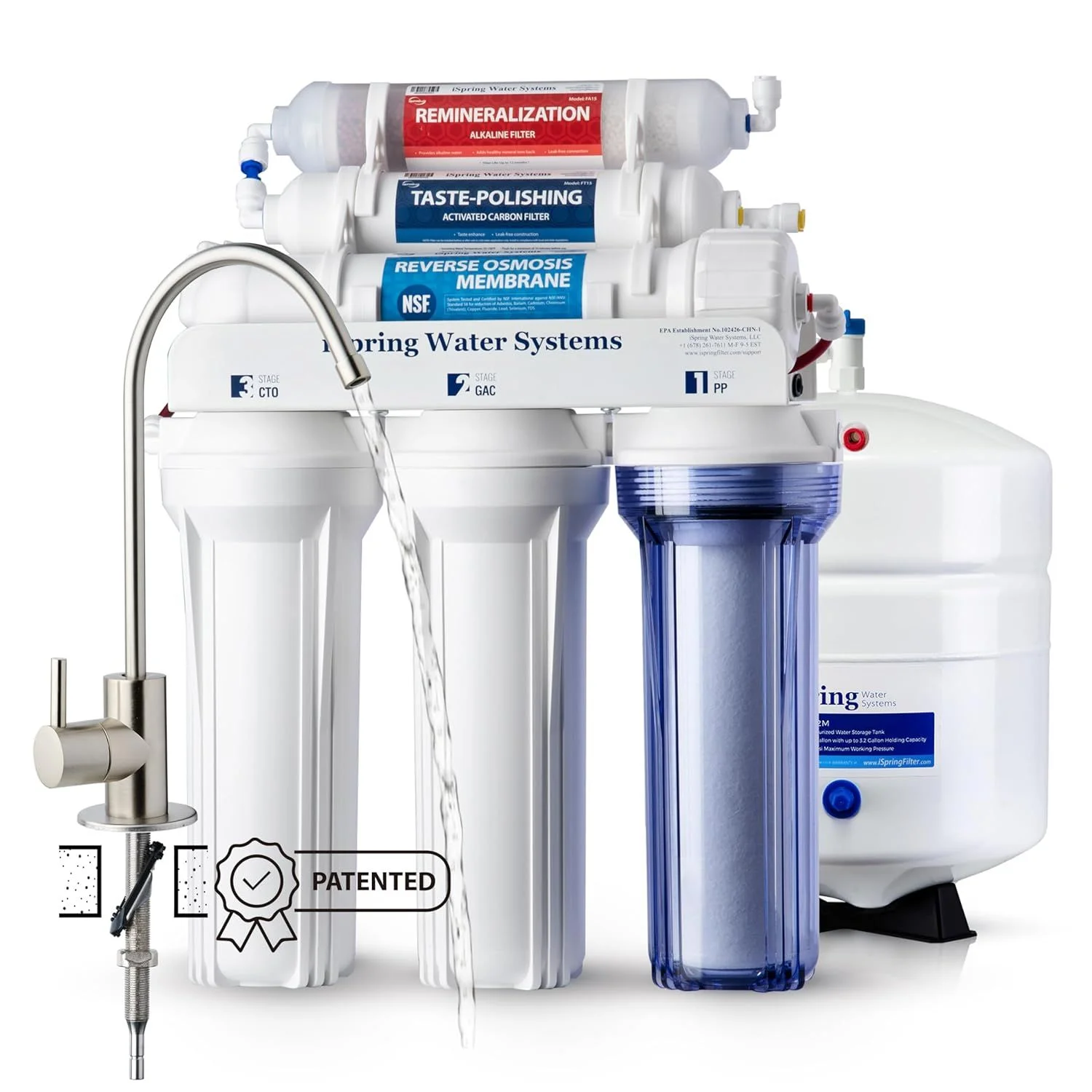
iSpring RCC7AK 6-Stage Reverse Osmosis System
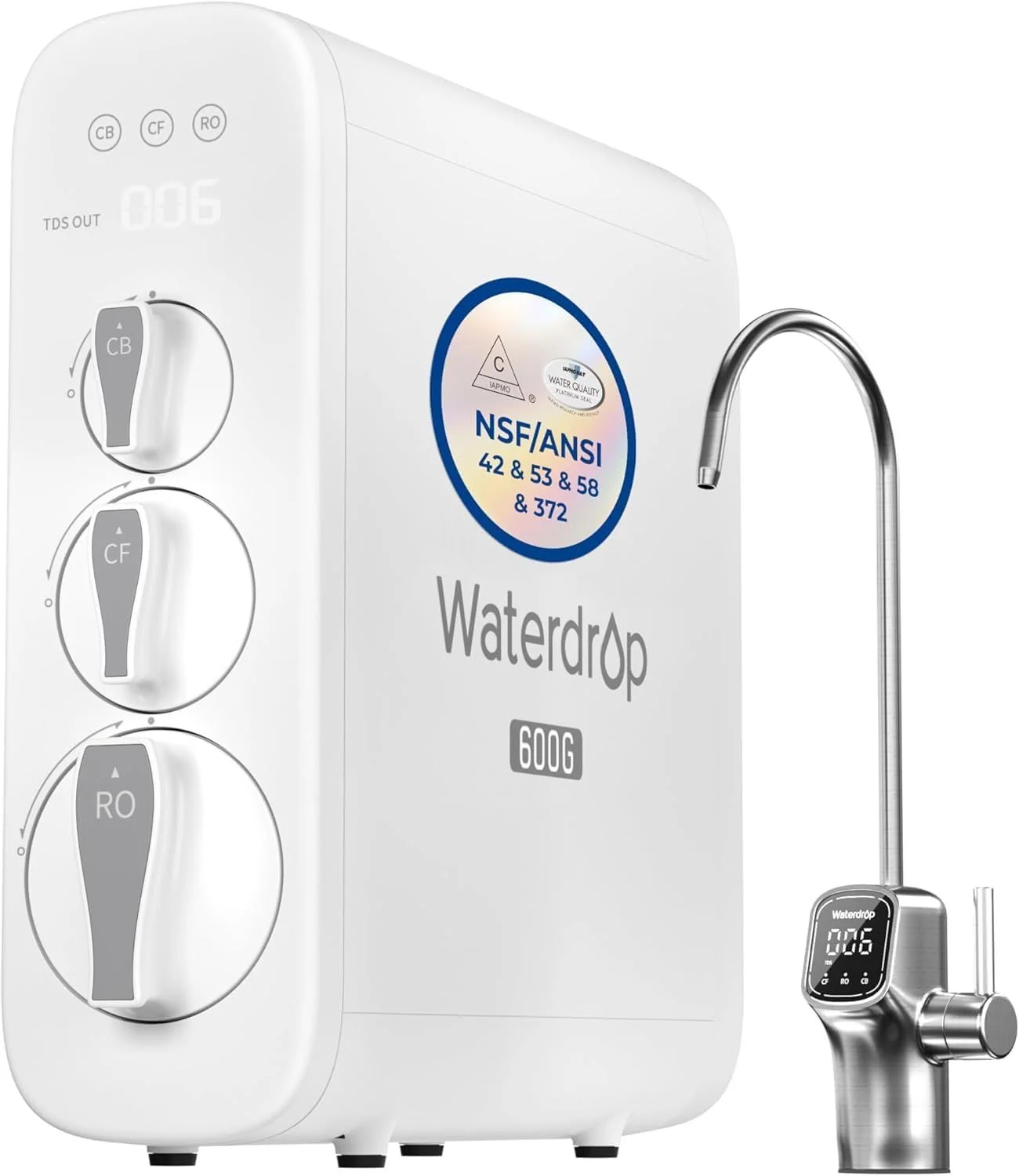
Waterdrop G3P600 Tankless Reverse Osmosis System
At a Glance
| Feature | Editor's Pick iSpring RCC7AK 6-Stage Reverse Osmosis System | Waterdrop G3P600 Tankless Reverse Osmosis System |
|---|---|---|
| Price Range | $100–$250 | $250–$500 |
| Stages | 6 | 8 |
| Technology | Sediment + GAC + CTO + RO Membrane + Alkaline Remineralization | PP + CTO + RO Membrane + Post Carbon (tankless) |
| Capacity | 75 GPD | 600 GPD |
| Flow Rate | 75 GPD | 600 GPD |
| Micron Rating | 0.0001 | 0.0001 |
| Filter Life | 6-12 months (pre/post filters), 2-3 years (RO membrane) | 6 months (CF filter), 12 months (MRO filter), 24 months (CB filter) |
| Check Price | Check Price |
The iSpring RCC7AK and Waterdrop G3P600 represent the two dominant approaches to home reverse osmosis: traditional tank-based value vs modern tankless performance. Both remove 99%+ of contaminants, but they differ dramatically in price, speed, space requirements, and water efficiency.
These two systems are among the most-reviewed under-sink RO units currently available, and for good reason — each excels in its own lane. The iSpring RCC7AK has accumulated tens of thousands of verified buyer reviews over years on the market, a testament to its reliable performance and accessible price point. The Waterdrop G3P600, while a newer entrant, has rapidly earned a loyal following among buyers who prioritize modern design, water conservation, and high-output performance. Understanding the fundamental architectural differences between a tank-based system and a tankless, pump-driven system is key to making the right call for your household.
Category-by-Category Breakdown
Filtration Quality
Both systems use 0.0001-micron RO membranes and achieve 93-98% TDS reduction. The iSpring's 6-stage system includes sediment, GAC, CTO, RO membrane, and crucially, an alkaline remineralization stage that raises water pH and adds beneficial minerals back. The Waterdrop's 8-stage system uses PP, CTO, RO membrane, and post-carbon stages. The iSpring holds a broader NSF 58 certification, while the Waterdrop boasts NSF 42/53/58/372 — the most comprehensive certification set. In lab-grade purity, they are neck and neck, but the iSpring's remineralization gives it a taste edge.
When it comes to specific contaminant removal, both systems effectively target the most common and concerning water quality issues found in municipal and well water supplies. Lead reduction is a priority for both — the RO membranes in each system are independently verified to remove in excess of 95% of dissolved lead, a critical consideration for homes with older plumbing. PFAS compounds, sometimes called "forever chemicals," are also reduced to near-undetectable levels by both membranes. The iSpring's pre-filtration sediment stage gives it a slight edge when dealing with particularly turbid or particulate-heavy source water, as it protects the RO membrane more aggressively. The Waterdrop's composite filter design, while more proprietary, integrates multiple filtration media into a single streamlined cartridge, which reduces the number of individual components that can fail or develop leaks over time.
Speed & Flow Rate
This is the Waterdrop's standout advantage. At 600 GPD, the G3P600 produces water 8 times faster than the iSpring's 75 GPD. The Waterdrop delivers RO water on demand — no waiting for a tank to refill. The iSpring fills its pressurized tank over time and relies on stored water for instant access, but if you drain the tank, you will wait. For households that use a lot of filtered water for cooking and drinking, the Waterdrop's instant production is transformative.
In practical daily use, the flow rate difference is most noticeable in high-demand scenarios. Filling a large stock pot for pasta, topping off a countertop ice maker, or running filtered water for batch cooking can quickly drain the iSpring's storage tank. Once the tank pressure drops, flow slows noticeably until the system replenishes the reserve — a process that can take anywhere from 30 minutes to several hours depending on your incoming water pressure. The Waterdrop sidesteps this entirely because its booster pump actively drives water through the membrane on demand. Large families, home cooks who rely heavily on filtered water, or anyone running a countertop appliance that draws directly from the RO line will appreciate the G3P600's consistent, uninterrupted delivery.
Price & Value
The iSpring RCC7AK sits in the $100–$250 range, making it one of the best deals in home water filtration. You get a complete 6-stage RO system with alkaline remineralization backed by 18,000+ reviews. The Waterdrop commands a $250–$500 price tag — more than double what the iSpring costs. While the Waterdrop offers real advantages in speed and efficiency, the iSpring's price-to-performance ratio is genuinely remarkable. Annual filter costs also favor the iSpring, with replacement cartridges running roughly half the cost of the Waterdrop's proprietary filters.
A full cost-of-ownership analysis over a three-year window makes the iSpring's value proposition even clearer. When you factor in the initial purchase price plus estimated annual filter replacement costs, the total three-year outlay for the iSpring remains comfortably within the budget-to-mid-range tier, while the Waterdrop climbs into the premium tier when ongoing filter costs are included. That said, the Waterdrop's superior water efficiency offsets some of its cost premium — households in areas with higher water rates or water scarcity surcharges will recoup a portion of the price difference through lower water bills over time. The breakeven point varies by local water pricing, but environmentally conscious buyers in water-stressed regions should factor this into their total cost calculation rather than focusing solely on sticker price and filter costs.
Space & Installation
The Waterdrop's tankless design is a major advantage for kitchens with limited under-sink space. The iSpring requires room for both the filter assembly and a 3-4 gallon pressurized storage tank, consuming most of the cabinet. The Waterdrop's compact unit takes up roughly half the space. However, the Waterdrop requires an electrical outlet under the sink for its booster pump — which not every kitchen has. The iSpring operates on water pressure alone with no electricity required.
For renters or those in apartments and condos where cabinet real estate is at a premium, the tankless Waterdrop is often the only practical option. Modern kitchens with deep drawers or pull-out cabinet inserts may not accommodate the iSpring's footprint at all without some creative rearrangement. On the other hand, if your kitchen already has an outlet under the sink — common in remodeled kitchens and newer construction — the Waterdrop's installation is surprisingly straightforward. For those without an outlet, adding one typically requires an electrician and adds to the total cost of the Waterdrop installation, a hidden expense worth budgeting for in advance. The iSpring's no-electricity requirement also means there is no concern about power outages disrupting your filtered water access, since the pressurized tank continues to dispense stored water even without power.
Water Efficiency
The Waterdrop dominates here with its 2:1 pure-to-drain ratio — for every 2 gallons of purified water, only 1 goes to waste. The iSpring's 1:3 ratio means 3 gallons are wasted for every 1 gallon of purified water. That is a 6x difference in water efficiency. For environmentally-conscious buyers or those in drought-prone regions, this alone could justify the Waterdrop's premium. A family filtering 3 gallons daily would waste roughly 1,095 extra gallons per year with the iSpring.
It is worth noting that the iSpring's wastewater can be partially reclaimed with some ingenuity — some homeowners route the drain line to a bucket used for watering plants or flushing toilets, which helps offset the efficiency gap. However, this requires additional plumbing setup and ongoing attention that most buyers will not want to manage. The Waterdrop's efficiency advantage is built into the system itself and requires no extra effort from the user. In states with tiered water billing or drought restrictions, the efficiency difference can translate into a meaningful reduction in your monthly utility bill, gradually narrowing the price gap between the two systems over a multi-year ownership period.
Smart Features & Monitoring
The Waterdrop G3P600 includes a smart LED faucet that displays real-time TDS readings, giving you instant visual confirmation that your system is working correctly. The LED ring changes color based on water quality — a genuinely useful feature that takes the guesswork out of knowing when filters need replacement. The iSpring RCC7AK takes a more traditional approach: it ships with a TDS meter you can use manually, but there is no integrated display or smart monitoring built into the faucet. For buyers who want a set-it-and-forget-it experience with built-in performance verification, the Waterdrop's smart faucet is a meaningful differentiator. For buyers who rarely think about monitoring their system and just want clean water flowing from the tap, the iSpring's simpler approach is perfectly adequate.
Build Quality & Longevity
The iSpring RCC7AK has the advantage of a longer track record. With years of data from a massive installed base, its reliability profile is well-documented — occasional O-ring replacements and standard filter swaps are the most common maintenance tasks reported. The individual filter housings are color-coded and tool-free to swap, which makes DIY maintenance accessible even for non-technical users. The Waterdrop G3P600's composite filter design reduces the number of connection points and potential leak sites, which is a genuine engineering advantage. Its all-in-one filter blocks simplify the replacement process but do mean you replace multiple filtration stages simultaneously even if only one stage is depleted — a minor inefficiency offset by the convenience of fewer components to manage.
How These Systems Compare to Other RO Options
It is helpful to place both systems in the broader context of the under-sink RO market. Budget-oriented buyers who find the iSpring RCC7AK compelling might also consider the APEC Water ROES-50, another highly-rated tank-based system in a similar price range, though the iSpring's alkaline remineralization stage gives it a distinct taste advantage over the APEC's standard 5-stage design. On the premium tankless side, the Waterdrop G3P600 competes with systems from brands like EXPRESS WATER and the AquaTru countertop RO — but the G3P600's 600 GPD output puts it in a higher performance class than most countertop alternatives. For buyers who want tankless convenience but are not yet ready for the G3P600's price tier, the Waterdrop G2 and G3 (400 GPD) offer a slight step down in output at a more accessible price, though they sacrifice some of the G3P600's efficiency gains.
Who Should Get Which?
Get the iSpring RCC7AK 6-Stage Reverse Osmosis System if...
- You want the best RO water quality at a $100–$250 price point — unbeatable value
- You prefer alkaline remineralized water with improved taste and pH
- You have adequate under-sink cabinet space for the tank system
- You do not have an electrical outlet under your sink
Get the Waterdrop G3P600 Tankless Reverse Osmosis System if...
- Cabinet space is limited and you need a compact, tankless system
- You want instant RO water on demand — no waiting for tank refills
- Water efficiency matters to you (2:1 vs 1:3 pure-to-drain)
- You want the smart LED faucet with real-time TDS monitoring
Extended "Who Should Skip This" Scenarios
Skip the iSpring RCC7AK 6-Stage Reverse Osmosis System if...
- Your under-sink cabinet is small or already full — the pressurized storage tank takes up significant space that may not be available in compact kitchens or apartments.
- You regularly drain your filtered water supply and cannot tolerate waiting for the tank to replenish — in high-demand households, the 75 GPD output can feel like a bottleneck.
- Water conservation is a top priority — the 1:3 waste ratio is among the least efficient in the RO category and will meaningfully increase your household water consumption.
- You want built-in real-time water quality monitoring without purchasing and using a separate handheld TDS meter.
Skip the Waterdrop G3P600 Tankless Reverse Osmosis System if...
- Your budget is firmly in the mid-range or lower — the G3P600's premium price tier is a real barrier, and the iSpring delivers excellent filtration at a fraction of the cost.
- You do not have an electrical outlet under your sink and are unwilling to have one installed — the booster pump requires power and there is no workaround for this requirement.
- You specifically want alkaline remineralized water — the G3P600 does not include a remineralization stage, and adding an inline alkaline filter is an additional expense and complexity.
- You prefer open-market replacement filters — the Waterdrop's proprietary composite filter design locks you into brand-specific cartridges at a premium ongoing cost.
Pro Tip: If you are leaning toward the iSpring RCC7AK but are concerned about water waste, consider routing the drain line to a large collection bucket under the sink. The reject water from an RO system is not contaminated — it is simply concentrated tap water — and is perfectly suitable for watering plants, pre-rinsing dishes, or flushing toilets. This simple step can cut the iSpring's effective waste ratio significantly without any additional equipment cost.
Pro Tip: Before purchasing the Waterdrop G3P600, check whether your under-sink cabinet has an accessible electrical outlet. If not, get an electrician's quote for adding one before you commit to the purchase — this is a commonly overlooked installation cost that can add to the total investment. Alternatively, confirm whether a GFCI outlet can be added to an adjacent circuit during a bathroom or kitchen update you may already have planned.