British Berkefeld vs ProOne Big+: Which Gravity Filter Is Better in 2026?
Quick Verdict: The ProOne Big+ wins on certifications, fluoride removal, and price — it costs $15 less, carries four NSF certifications (vs one), and removes fluoride without add-ons. The British Berkefeld wins on flow rate (roughly 2x faster) and 200 years of ceramic filtration heritage from Doulton UK. Choose the ProOne for the most independently verified filtration per dollar. Choose the Berkefeld if you value proven ceramic technology and faster throughput.
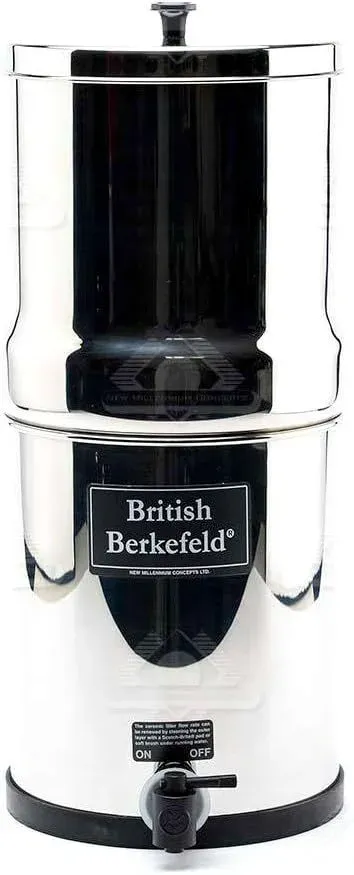
British Berkefeld Gravity Water Filter with 4 Super Sterasyl Ceramic Elements
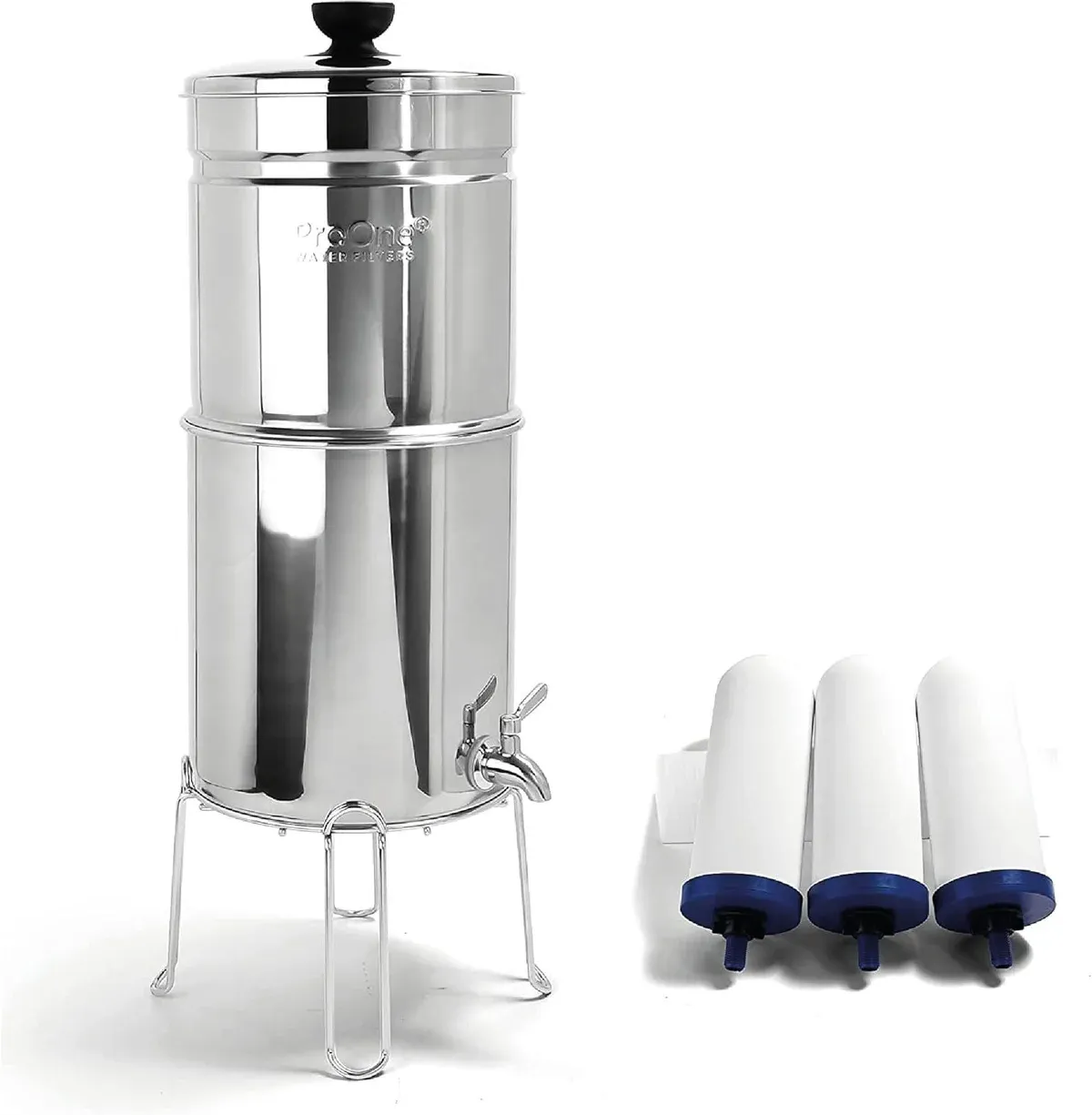
ProOne Gravity Water Filter System 3 Gallon with 2 Filter Elements
At a Glance
| Feature | British Berkefeld Gravity Water Filter with 4 Super Sterasyl Ceramic Elements | Editor's Pick ProOne Gravity Water Filter System 3 Gallon with 2 Filter Elements |
|---|---|---|
| Price | $250–$500 | $250–$500 |
| Filtration | Triple-stage ceramic (0.2 micron shell + GAC + heavy metal media) | 3-stage G3.0 (ceramic shell + carbon granular media + carbon block core) |
| Capacity | ~2.1 gallons | 3 gallons |
| Flow Rate | ~1 GPH (4 filters) | ~0.52 GPH (2 filters) |
| Filter Life | 400 gallons per filter | 1,000 gallons per filter |
| Certifications | NSF/ANSI 401 | IAPMO — NSF 42/53/401/372 |
| Contaminants | Bacteria 99.99%, cysts 99.99%, chlorine 99%, lead, PFAS, microplastics, pesticides | 200+ including lead, fluoride, PFAS, chlorine, microplastics, bacteria, pharmaceuticals |
| Weight | ~9 lbs | ~10 lbs |
| Check Price | Check Price |
The British Berkefeld and ProOne Big+ represent two fundamentally different philosophies in gravity water filtration. The Berkefeld is built on 200 years of Doulton ceramic heritage — four hand-crafted Ultra Sterasyl candle filters in a polished stainless steel housing, manufactured in Staffordshire, England, by the company that quite literally invented ceramic water filtration in 1826. The ProOne Big+ is the modern certified challenger — a hybrid ceramic-carbon filter system with the broadest independent certification stack of any gravity filter on the market, built-in fluoride removal, and a price that undercuts the Berkefeld by $15. This comparison is heritage versus innovation, and the right choice depends on what you value most in your water filtration.
Category-by-Category Breakdown
Certifications & Independent Verification
The ProOne Big+ carries IAPMO certification to four NSF/ANSI standards: NSF 42 (aesthetic effects including chlorine taste and odor), NSF 53 (health effects including lead and cysts), NSF 401 (emerging contaminants including pharmaceuticals, PFAS, and pesticides), and NSF 372 (lead-free materials). These certifications mean that an independent, ANSI-accredited laboratory has tested the ProOne's G3.0 filters and confirmed their contaminant removal claims under standardized conditions — not just once, but through ongoing production sampling and annual recertification.
The British Berkefeld's Ultra Sterasyl filters carry NSF/ANSI 401 certification only. This is a meaningful certification — NSF 401 covers 15 emerging contaminants including pharmaceuticals, herbicides, and pesticides that many cheaper filters do not address. But the single certification leaves significant gaps in third-party verification. The Berkefeld's claims about bacteria removal (99.99%), lead reduction, and chlorine removal are based on Doulton's own testing and the well-established performance of their 0.2-micron ceramic technology, but they have not been independently verified through the full NSF 42 or NSF 53 certification process.
The practical difference matters most for lead and health-effect contaminants. The ProOne's NSF 53 certification specifically verifies lead removal performance — critical for households with older plumbing or municipal water systems with known lead issues. The Berkefeld's ceramic technology is capable of lead reduction (the heavy metal media in the Ultra Sterasyl candle is designed for exactly this), but without NSF 53 certification, that capability is a manufacturer's claim rather than an independently verified fact. For buyers who prioritize documented, third-party-verified filtration performance, the ProOne's certification stack is objectively stronger.
Flow Rate & Daily Throughput
The British Berkefeld with four Ultra Sterasyl ceramic candles delivers approximately 1 GPH of filtered water. The ProOne Big+ with two G3.0 filters delivers approximately 0.52 GPH. The Berkefeld is roughly twice as fast — a noticeable difference in daily use that compounds over time.
In practical terms, filling the Berkefeld's 2.1-gallon upper chamber produces a full batch of filtered water in approximately 2 hours. Filling the ProOne Big+'s 3-gallon upper chamber takes approximately 6 hours for a complete cycle. The ProOne holds more water per batch (3 gallons vs 2.1), but the Berkefeld's faster flow means it can produce more total gallons per day if you refill promptly. Over a 12-hour active day, the Berkefeld can theoretically produce about 12 gallons if continuously refilled, while the ProOne tops out around 6 gallons.
The Berkefeld's flow rate advantage comes from running four filter candles versus the ProOne's two. Each Ultra Sterasyl candle has a modest individual flow rate, but four candles working in parallel deliver meaningful throughput. The ProOne can be upgraded to three G3.0 filters (increasing flow to approximately 0.78 GPH), but even with three filters, the ProOne remains slower than the Berkefeld's four-candle configuration. For families of four or more who consume 3+ gallons per day of filtered water for drinking, cooking, coffee, and ice, the Berkefeld's flow rate is a genuine quality-of-life advantage that reduces the planning required to keep filtered water available.
The counter-argument is that the ProOne's larger 3-gallon lower reservoir partially compensates for slower flow. If you fill the upper chamber before bed, you wake up to 3 gallons of filtered water — enough for most families' morning needs. The flow rate matters most for households that drain the reservoir faster than the system can replenish it, which becomes likely at 4+ gallons per day of consumption.
Fluoride Removal
The ProOne Big+ removes fluoride as a standard part of its G3.0 filtration process. Every G3.0 filter element contains activated alumina media that adsorbs fluoride during normal gravity filtration. There is no add-on, no extra cost, and no separate replacement schedule — fluoride removal is built into the same filter that handles chlorine, lead, bacteria, PFAS, and pharmaceuticals. This integrated approach is one of the ProOne's strongest differentiators in the gravity filter market.
The British Berkefeld does not remove fluoride with its standard Ultra Sterasyl ceramic candles. Doulton manufactures a separate Ultra Fluoride filter candle that reduces fluoride, but there is a critical limitation: you cannot mix Ultra Sterasyl and Ultra Fluoride candles in the same system. The Berkefeld must run all four filters as the same type. Switching to Ultra Fluoride candles sacrifices the Ultra Sterasyl's superior contaminant removal profile — the two candle types have different internal media formulations optimized for different contaminant classes. This creates an undesirable either/or choice that the ProOne avoids entirely.
For the approximately 73% of American households on fluoridated municipal water, fluoride removal is a common request. The ProOne delivers it seamlessly. The Berkefeld forces a compromise. This is a clear and meaningful advantage for the ProOne that directly affects daily water quality for the majority of US buyers.
Filter Lifespan & Ongoing Cost
The ProOne Big+'s G3.0 filters are rated for 1,000 gallons each — 2,000 gallons per pair. The British Berkefeld's Ultra Sterasyl candles are rated for 400 gallons each — 1,600 gallons for all four. On total system capacity, the ProOne's two filters actually outlast the Berkefeld's four, delivering 25% more total gallons before all filters need replacement.
The per-filter economics tell a more nuanced story. A 2-pack of ProOne 7-inch G3.0 replacement filters costs approximately $146. A replacement set of four Ultra Sterasyl candles for the Berkefeld runs approximately $120-140 (pricing varies by retailer). On a cost-per-gallon basis, the ProOne delivers filtered water at approximately $0.073 per gallon (1,000 gallons per $73 filter). The Berkefeld's cost-per-gallon is approximately $0.075-0.088 per gallon (400 gallons per $30-35 filter). The two systems are remarkably close in ongoing operating cost despite their different filter architectures.
One important nuance: the Berkefeld's ceramic candles are cleanable. When flow rate slows (a sign the ceramic pores are clogging with sediment), you can remove the candle and gently scrub the outer ceramic shell with a soft abrasive pad under running water. This restores flow rate and can be done dozens of times before the internal carbon and heavy metal media are exhausted. This cleaning capability can extend the practical life of Ultra Sterasyl candles beyond their rated 400-gallon capacity, particularly in cleaner municipal water sources where the ceramic does not clog quickly. The ProOne's G3.0 filters are also cleanable, but ProOne recommends replacement at the rated 1,000-gallon capacity to maintain certified performance.
Heritage, Build Quality & Design
The British Berkefeld is manufactured by Doulton Ceramics at their facility in Staffordshire, England — the same company that has been making ceramic water filters since 1826. This is not marketing heritage; it is genuine manufacturing continuity spanning nearly two centuries. Doulton's ceramic filtration technology was adopted by Queen Victoria's Royal household, deployed across the British Empire, and remains in active use in humanitarian water purification worldwide. The Ultra Sterasyl candle filter is the current-generation expression of that heritage — a 0.2-micron absolute ceramic shell surrounding granular activated carbon and heavy metal reduction media.
The ProOne Big+ is manufactured in the United States with a brushed 304 stainless steel housing and G3.0 filters that represent modern hybrid filtration engineering. The G3.0 is a three-stage filter — ceramic outer shell, carbon granular media, and carbon block core — designed from the ground up for maximum certified contaminant removal. It is a newer product with a shorter track record, but its engineering is purpose-built for the certifications it carries.
Both systems use 304 stainless steel housings, and both feel solidly constructed. The Berkefeld's polished finish has a classic, timeless appearance. The ProOne's brushed finish is more practical, hiding fingerprints and water spots. The Berkefeld measures approximately 19.25 inches tall and 8.5 inches in diameter (roughly 2.1-gallon capacity). The ProOne is taller at 22.75 inches (28.75 with stand) and 9 inches in diameter, holding 3 gallons. The ProOne's larger reservoir is a capacity advantage, but the taller profile can be problematic under standard kitchen cabinets.
For buyers who value provenance, manufacturing pedigree, and the confidence that comes from a product with nearly 200 years of continuous refinement, the British Berkefeld is unmatched. No other gravity filter manufacturer can claim anything close to Doulton's heritage. The ProOne's strength is not history but engineering — it is a system designed to pass the most rigorous modern certification standards, and it succeeds at that goal.
Price & Overall Value
The ProOne Big+ at $290 is $15 less than the British Berkefeld at $305. The price difference is modest, but the value difference is significant when you account for what each dollar buys. The ProOne's $290 includes: IAPMO certification to four NSF standards, built-in fluoride removal, 3-gallon capacity, 2,000 gallons of total filter life, and a system with no regulatory complications. The Berkefeld's $305 includes: one NSF certification (401), no fluoride removal with standard filters, 2.1-gallon capacity, 1,600 gallons of total filter life, and 200 years of ceramic filtration heritage.
The Berkefeld includes four filter candles versus the ProOne's two, which partially justifies the higher price — you are getting twice as many physical filter elements. But each Berkefeld candle lasts only 400 gallons (1,600 total) versus each ProOne element lasting 1,000 gallons (2,000 total). More filters does not translate to more total capacity in this comparison.
For pure certification-to-dollar value, the ProOne delivers more independently verified filtration capability for less money. For heritage-conscious buyers who trust two centuries of Doulton ceramic manufacturing over modern IAPMO certification paperwork, the Berkefeld's $15 premium is negligible. The right choice depends on whether you value third-party certification or manufacturing heritage as your primary trust signal.
The Culligan Transition: What ProOne Buyers Should Know
ProOne is transitioning its product line to the Culligan MaxClear brand. Culligan is a well-established water treatment company with over 75 years of industry presence, significant manufacturing capacity, and nationwide retail distribution. The transition is expected to continue the G3.0 filter technology under the Culligan name, potentially with improvements and broader retail availability through home improvement stores and Culligan's dealer network.
During the transition period, there is some uncertainty about G3.0 filter replacement availability. Current ProOne G3.0 filters remain available while supplies last, and the Culligan MaxClear 7-inch replacement filters are already entering the market. We recommend that ProOne Big+ buyers purchase one or two spare G3.0 filter sets at the time of system purchase as insurance against any availability gaps. The sealed filters have an indefinite shelf life in their original packaging.
For British Berkefeld buyers, this transition is largely irrelevant — Doulton's Ultra Sterasyl candle supply chain is separate from the ProOne/Culligan ecosystem and operates through Doulton's own manufacturing and distribution network in the UK. Berkefeld replacement filters have been continuously available for decades and are not affected by any US brand transitions.
Who Should Get Which?
Get the British Berkefeld Gravity Water Filter with 4 Super Sterasyl Ceramic Elements if...
- Flow rate matters — ~1 GPH with 4 filters vs ~0.52 GPH is nearly double the throughput
- You value 200 years of Doulton ceramic heritage and UK manufacturing
- You do not need fluoride removal (or are willing to switch to Ultra Fluoride candles)
- The single NSF 401 certification is sufficient for your confidence level
- You want cleanable ceramic candles that can extend filter life beyond rated capacity
- Supply chain stability matters — Doulton's filter supply is independent of US brand transitions
Get the ProOne Gravity Water Filter System 3 Gallon with 2 Filter Elements if...
- Certifications are your primary trust signal — NSF 42/53/401/372 is the broadest stack available
- You want built-in fluoride removal without compromise or add-on filters
- You prefer the lower price — $290 vs $305 with more total filter capacity (2,000 vs 1,600 gal)
- You need NSF 53 verification for lead removal (critical for older plumbing)
- You are on well water and want Protocol P231 microbiological purification certification
- You can plan ahead for slower flow — fill before bed, draw from full reservoir during the day
Pro Tip: If you already own a British Berkefeld and want fluoride removal, consider replacing the Ultra Sterasyl candles with ProOne 7-inch G3.0 filters instead of buying a whole new system. The G3.0 filters are physically compatible with the Berkefeld housing, and you gain fluoride removal plus broader NSF certification while keeping your existing stainless steel housing. A 2-pack of ProOne 7-inch G3.0 filters costs $146 — significantly less than buying a new ProOne Big+ system. You lose two filter slots (the Berkefeld holds 4 candles, and you would run 2-4 G3.0 filters depending on your configuration), but the G3.0's higher per-filter capacity (1,000 gallons vs 400) means you are not sacrificing total system capacity.
Frequently Asked Questions
Can I use ProOne G3.0 filters in a British Berkefeld housing?
Why does the British Berkefeld only have NSF 401 while ProOne has four NSF certifications?
Is the British Berkefeld the same as a Berkey?
Which system is better for well water?
How often do I need to replace filters on each system?
Does the British Berkefeld remove fluoride?
Our Final Recommendation
For most buyers in 2026, the ProOne Big+ at $290 is the stronger purchase. It delivers four NSF certifications where the Berkefeld offers one, includes fluoride removal where the Berkefeld requires a compromise, provides more total filter capacity (2,000 vs 1,600 gallons), and costs $15 less. The certification advantage is not abstract — it means an independent laboratory has tested and verified the ProOne's contaminant removal claims under standardized conditions, with ongoing production audits that ensure consistency across manufactured units.
The British Berkefeld at $305 is the right choice for a specific buyer: someone who values Doulton's 200-year ceramic filtration heritage, prefers the faster ~1 GPH flow rate for a busy household, does not need fluoride removal, and trusts manufacturing pedigree over modern certification paperwork. The Berkefeld's Ultra Sterasyl ceramic technology is genuinely excellent — Doulton's ceramic filters have been saving lives in disaster relief and rural water systems for nearly two centuries. The single NSF 401 certification verifies the system's performance against emerging contaminants, and the cleanable ceramic candles offer practical longevity that spec sheets understate.
Both systems produce excellent drinking water from a stainless steel housing with no electricity and no plumbing. Neither is a bad choice. But for the buyer who wants the most certified, most versatile, and most cost-effective gravity filter in 2026, the ProOne Big+ is the system we would buy with our own money. The Berkefeld is a legacy system from a legendary manufacturer — and for some buyers, that heritage is worth the premium and the narrower certification. Know which type of buyer you are, and choose accordingly.
Track Both Products
We'll email you if either price drops or availability changes.
Only when something changes. Unsubscribe anytime.