British Berkefeld W9361139 vs ProOne Big+: Which Gravity Filter Fits Your Home in 2026?
Quick Verdict: The ProOne Big+ is the better value at $290 — it offers broader certifications (NSF 42/53/401/372), built-in fluoride removal, a larger 3-gallon capacity, and upgrade potential to 3 filters. The British Berkefeld W9361139 is the right pick for smaller households that want a more compact system with faster flow rate, 200 years of Doulton ceramic heritage, and guaranteed long-term filter availability.
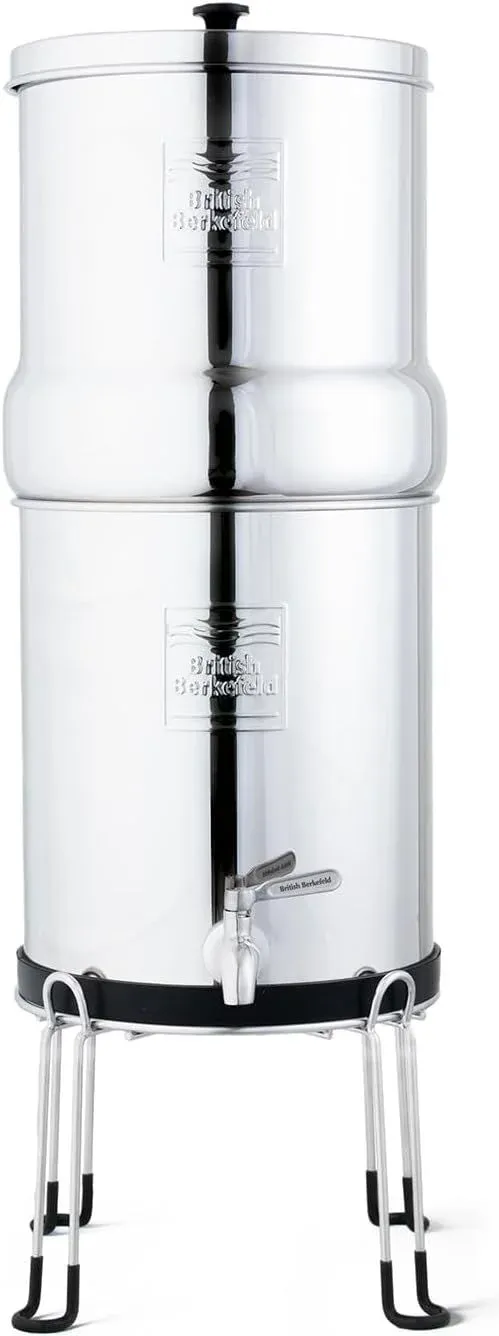
British Berkefeld Doulton W9361139 Gravity Countertop Water Filtration System
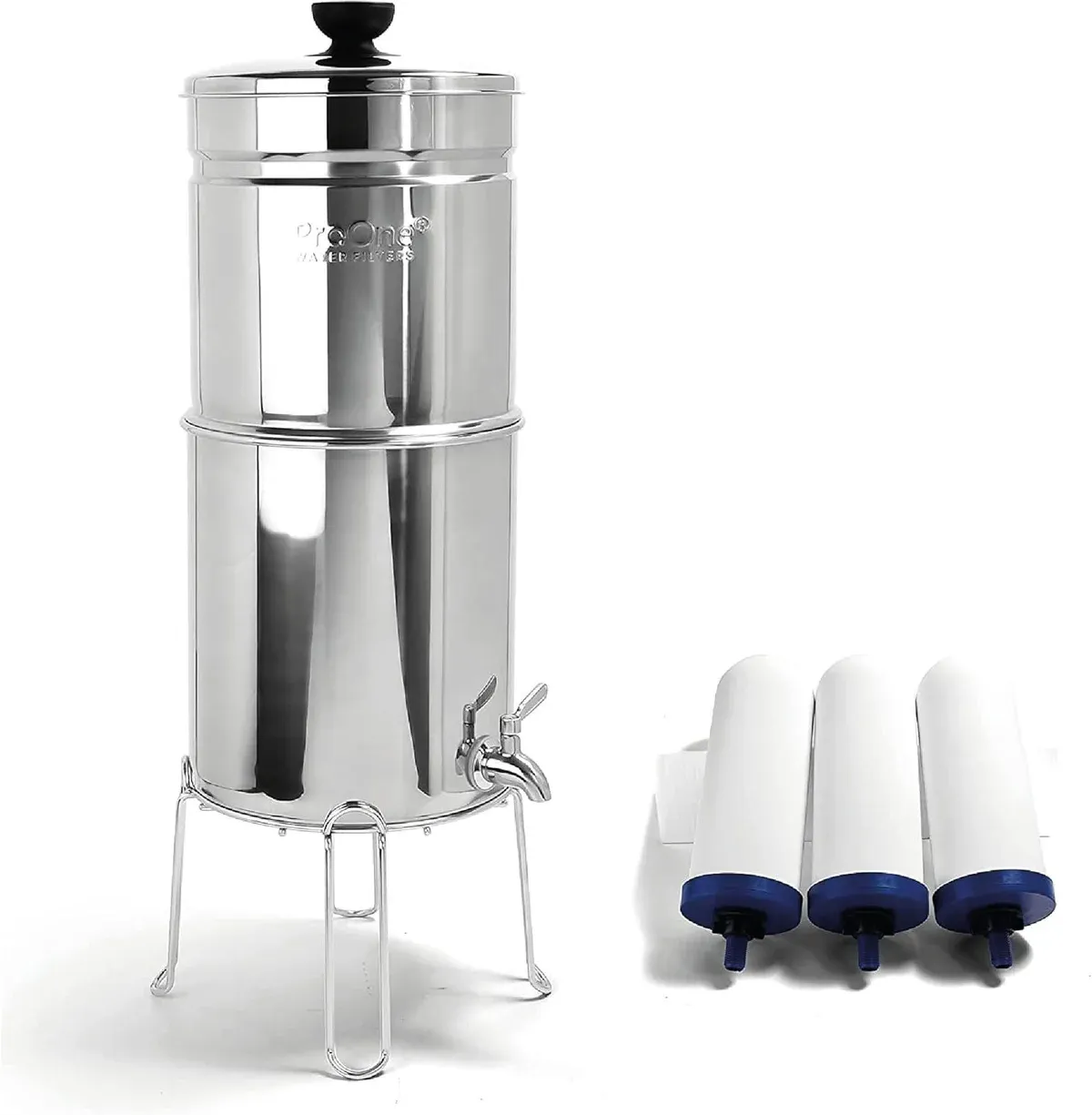
ProOne Gravity Water Filter System 3 Gallon with 2 Filter Elements
At a Glance
| Feature | British Berkefeld Doulton W9361139 Gravity Countertop Water Filtration System | Editor's Pick ProOne Gravity Water Filter System 3 Gallon with 2 Filter Elements |
|---|---|---|
| Price | $250–$500 | $250–$500 |
| Filtration | Triple-stage ceramic (0.2 micron shell + GAC + heavy metal media) | 3-stage G3.0 (ceramic shell + carbon granular media + carbon block core) |
| Capacity | 2.25 gallons | 3 gallons |
| Flow Rate | ~1-2 GPH (4 filters) | ~0.52 GPH (2 filters) |
| Filter Life | 400 gallons per filter | 1,000 gallons per filter |
| Certifications | NSF/ANSI 401 | IAPMO — NSF 42/53/401/372 |
| Contaminants | Bacteria 99.99%, cysts, chlorine, lead, PFAS, microplastics, pharmaceuticals | 200+ including lead, fluoride, PFAS, chlorine, microplastics, bacteria, pharmaceuticals |
| Weight | ~9 lbs | ~10 lbs |
| Check Price | Check Price |
This comparison highlights a fundamental trade-off in gravity water filtration: the compact, heritage-backed British Berkefeld W9361139 versus the larger, value-oriented ProOne Big+ with its upgrade path. The Berkefeld is a 2.25-gallon system powered by 200 years of Doulton ceramic expertise and NSF 401 certification. The ProOne Big+ is a 3-gallon system with the broadest certification stack available and built-in fluoride removal — at the lowest price in our gravity filter lineup. Depending on your household size, kitchen space, and filtration priorities, one of these systems is clearly the better fit.
Category-by-Category Breakdown
Price & Entry Cost
The ProOne Big+ at $290 is the least expensive gravity filter system in our catalog. The British Berkefeld W9361139 at $305 is $15 more. While the price difference is modest in absolute terms, it becomes more significant when you consider what each dollar buys in terms of capacity and certification coverage.
The ProOne Big+ delivers 3 gallons of reservoir capacity and IAPMO certification to four NSF standards for $290. The Berkefeld delivers 2.25 gallons and NSF 401 certification for $305. On a per-gallon-of-capacity basis, the ProOne costs roughly $97 per gallon of reservoir capacity versus $136 per gallon for the Berkefeld. On a per-certification basis, the ProOne covers four standards for $73 each versus the Berkefeld's single standard at $305.
These per-unit calculations are imperfect — no one buys a gravity filter based on cost-per-certification — but they illustrate the value proposition clearly. The ProOne Big+ gives you more capacity, more certifications, and fluoride removal for less money. The Berkefeld's premium buys you heritage, faster flow, and a more compact footprint. Whether that premium is worth $15 depends entirely on which attributes matter most to your household.
Physical Size & Kitchen Fit
The British Berkefeld W9361139 measures 19.25 inches tall and 8.5 inches in diameter. The ProOne Big+ measures 22.75 inches tall — and with the included stand, reaches up to 28.75 inches. The diameter is 9 inches. That height difference is significant in real kitchens.
Standard upper kitchen cabinets are mounted 18 inches above the countertop in most homes, with some installations at 15 or 20 inches. The Berkefeld at 19.25 inches fits comfortably under an 18-inch gap with nearly an inch to spare — you can access the lid, fill the upper chamber, and check the system without moving it. The ProOne at 22.75 inches (without stand) exceeds an 18-inch gap by nearly 5 inches. Even in kitchens with 20-inch clearance, the ProOne protrudes above the cabinet line. With the stand, the ProOne at 28.75 inches only fits in open counter areas with no overhead cabinets.
For apartments, condos, and smaller kitchens where every inch of counter space is contested, the Berkefeld's more compact footprint is a practical advantage that users experience every single day. The ProOne's larger capacity is appealing on paper, but if the system does not physically fit where you want to put it, capacity becomes irrelevant. Measure your available space before purchasing either system — this is one of the most common reasons for gravity filter returns.
Certifications & Contaminant Coverage
The ProOne Big+ carries the same IAPMO certification to NSF 42, 53, 401, and 372 as its 3-filter sibling. This four-standard package covers taste and odor (chlorine), health-effect contaminants (lead, cysts, VOCs), emerging contaminants (pharmaceuticals, herbicides), and lead-free material compliance. No other gravity filter system matches this breadth of third-party validation.
The British Berkefeld W9361139 carries NSF/ANSI 401 certification for emerging contaminants, issued directly by NSF International. This is a reputable and meaningful certification — NSF 401 specifically covers incidental contaminants that standard water treatment may miss, including prescription drug residues, over-the-counter medications, and herbicides. However, it covers one standard where the ProOne covers four.
The practical implication: if you want independently documented proof that your gravity filter removes lead specifically (NSF 53), the ProOne provides it and the Berkefeld does not. The Berkefeld's filtration technology does address lead through its heavy metal media layer, and Doulton's own testing shows strong lead reduction — but it is not formally certified to NSF 53. For buyers who need documented, third-party-validated lead removal for regulatory, landlord, or personal confidence reasons, the ProOne's certification is the more defensible choice.
Flow Rate & Daily Convenience
The British Berkefeld W9361139 with 4 Ultra Sterasyl filters delivers approximately 1-2 GPH. The ProOne Big+ with 2 G3.0 filters produces approximately 0.52 GPH. The Berkefeld is roughly 2-4 times faster — a substantial difference in daily convenience.
At 0.52 GPH, the ProOne Big+ takes approximately 5.8 hours to filter a full 3-gallon batch from upper chamber to lower chamber. The Berkefeld takes roughly 1.5-2 hours to process its 2.25-gallon capacity. If you empty the lower chamber and refill the upper chamber before bed, the Berkefeld has filtered water ready before you finish your morning routine. The ProOne may still be filtering when you wake up — and if your household emptied the lower chamber the previous evening, you are starting the morning with an incomplete cycle.
The ProOne Big+ partially mitigates this with its upgrade path — adding a third G3.0 filter increases flow to approximately 0.78 GPH, cutting the full-batch time from 5.8 hours to roughly 3.8 hours. But that upgrade costs an additional filter element purchase, effectively erasing the Big+'s price advantage over the Berkefeld. If flow rate is a priority, the Berkefeld delivers better convenience at the original purchase price.
For households that plan ahead — filling the upper chamber at night and drawing from the lower chamber throughout the next day — the flow rate difference is less impactful. The ProOne's larger 3-gallon reservoir means that once filtered, you have more water available before the next cycle. But for on-demand filtration where you need water relatively quickly, the Berkefeld's speed advantage is meaningful.
Filter Life & Upgrade Potential
The ProOne Big+ ships with 2 G3.0 filters rated at 1,000 gallons each — 2,000 gallons total. The British Berkefeld ships with 4 Ultra Sterasyl filters rated at 400 gallons each — 1,600 gallons total. The ProOne delivers 25% more total filter capacity, and if you upgrade to 3 filters, that jumps to 3,000 gallons (87.5% more than the Berkefeld).
The upgrade potential is a distinctive ProOne advantage. Starting with 2 filters and adding a third later lets you spread the investment over time — pay $290 now, add a third filter for additional cost when your budget allows, and gain both faster flow and extended capacity. The Berkefeld has no equivalent upgrade path; it ships with 4 filters, and you cannot add a fifth. What you buy is what you get.
On a per-gallon-of-filtration basis, the ProOne's 1,000-gallon filter rating translates to roughly half the per-gallon cost of the Berkefeld's 400-gallon filters. Over a 10-year ownership horizon with consistent daily use, this translates to real savings on replacement filter purchases. The Berkefeld's scrub-cleanable ceramic design can extend practical lifespan beyond the rated 400 gallons, but even with generous maintenance assumptions, the ProOne's economics are stronger on a per-gallon basis.
Fluoride Removal & Specialty Contaminants
The ProOne Big+ removes fluoride through activated alumina media integrated into its G3.0 carbon block core. Fluoride reduction is part of the standard filtration process — no add-on filters, no extra configuration, no additional cost. For the roughly 73% of American households receiving fluoridated municipal water who want to reduce their fluoride exposure, this is a significant convenience.
The British Berkefeld W9361139 cannot remove fluoride with its standard Ultra Sterasyl filters. Doulton offers an Ultra Fluoride filter variant, but critically, you cannot mix Ultra Sterasyl and Ultra Fluoride filters in the same unit. Choosing the Ultra Fluoride variant means giving up the Ultra Sterasyl's broader contaminant removal profile. This either/or limitation is frustrating for buyers who want both comprehensive filtration and fluoride reduction from a single system.
If fluoride removal is on your requirements list, the ProOne Big+ is the only option in this comparison that delivers it without compromise. The Berkefeld's filter architecture makes simultaneous fluoride and broad-spectrum contaminant removal structurally impossible in a single unit. This is perhaps the most decisive differentiator for households on fluoridated water supplies.
Who Should Get Which?
Get the British Berkefeld Doulton W9361139 Gravity Countertop Water Filtration System if...
- Your kitchen has limited vertical clearance — the Berkefeld fits under standard 18" cabinets
- Flow rate matters — you want filtered water ready in 1-2 hours, not 5-6 hours
- You are a household of 1-2 people and 2.25 gallons is ample daily capacity
- Fluoride removal is not a requirement for your water supply
- Long-term parts availability is critical — Doulton has manufactured filters since 1826
- You prefer pure ceramic filtration technology with easy scrub maintenance
Get the ProOne Gravity Water Filter System 3 Gallon with 2 Filter Elements if...
- Budget is the primary driver — the Big+ is the lowest-priced gravity system at $290
- You want the option to upgrade to 3 filters later for faster flow and more capacity
- Fluoride removal matters for your fluoridated water supply
- Your household has 3+ people and needs the 3-gallon reservoir
- Broadest certifications matter — IAPMO NSF 42/53/401/372 coverage
- Brushed stainless finish is preferred for fingerprint resistance
Pro Tip: If you buy the ProOne Big+ with 2 filters and plan to add a third later, consider ordering the third filter element at the same time you buy the system — even if you do not install it immediately. ProOne is transitioning to the Culligan MaxClear brand, and the current G3.0 filter elements are available while supplies last. Having a spare G3.0 filter on hand protects you against potential availability gaps during the brand transition. The sealed G3.0 filter has a long shelf life when stored in its original packaging in a cool, dry location. For the Berkefeld, the same principle applies less urgently — Doulton's Ultra Sterasyl filters have been in continuous production for decades with no discontinuation risk.
The Size vs Certification Trade-Off
This comparison crystallizes a recurring tension in the gravity filter market: compact certified systems tend to use older, proven ceramic technology with slower flow, while larger systems adopt newer hybrid technology with broader certification coverage. The Berkefeld's 19.25-inch height is possible because its 2.25-gallon reservoir is smaller — less water means a shorter housing. The ProOne's 22.75-inch height (plus stand) is a direct consequence of its 3-gallon reservoir — more water requires more physical space.
There is no engineering trick that eliminates this trade-off. Physics dictates that more water volume requires more container volume. The question for you as a buyer is whether the additional 0.75 gallons of capacity and the broader certification package justify the additional 3.5 to 9.5 inches of height and the slower base flow rate. For a couple in a city apartment with limited counter space, the answer is probably no. For a family of four in a suburban kitchen with open counter space, the answer is probably yes.
We encourage buyers to think about this decision in terms of daily interaction rather than specifications. You will live with this system every day — filling it, drawing from it, cleaning around it, and looking at it on your counter. The system that fits your physical space and matches your daily routine will feel like a natural part of your kitchen. The system that does not fit will be a daily annoyance regardless of how impressive its certifications are on paper.
Maintenance Comparison
The British Berkefeld's Ultra Sterasyl filters are designed for straightforward maintenance. When flow rate drops, remove a filter, scrub the ceramic exterior with a non-metallic scouring pad under running water for 30 seconds, and reinstall. The ceramic shell sheds its outer layer of trapped contaminants, exposing fresh filtration media beneath. This process takes less than 2 minutes per filter and can be done monthly or as needed. The Berkefeld's 4-filter configuration means you can clean one filter at a time without taking the entire system offline.
The ProOne Big+ G3.0 filters also have a ceramic outer shell that can be surface-cleaned, but the cleaning protocol is gentler. ProOne recommends light surface cleaning without aggressive scrubbing, as the ceramic shell sits atop the carbon granular media and carbon block core — excessive scrubbing can potentially expose or damage the internal media layers. The practical difference is that the Berkefeld's maintenance is more aggressive and immediately effective, while the ProOne's maintenance is more conservative and preserves the integrity of the hybrid filter architecture.
Both systems require periodic housing cleaning. We recommend a vinegar-water solution (1:4 ratio) soak for the lower chamber every 3-6 months to dissolve mineral buildup that can affect taste. The upper chamber should be wiped clean with mild soap and water at the same interval. Both housings are 304 stainless steel and tolerate standard kitchen cleaning practices without risk of corrosion or damage.
Frequently Asked Questions
Is the ProOne Big+ the same system as the ProOne 3-Gallon with 3 filters?
Which system is more compact for a small kitchen — the Berkefeld W9361139 or ProOne Big+?
Can I add a third filter to the ProOne Big+ later?
Do both systems remove PFAS forever chemicals?
How does the brushed finish on the ProOne Big+ compare to the Berkefeld polished finish?
What is the best gravity filter for a household of two people?
Our Final Recommendation
The ProOne Big+ is the stronger value proposition for families and larger households. At $290 — the lowest price of any gravity filter in our catalog — it delivers 3 gallons of capacity, the broadest certification stack available, built-in fluoride removal, and an upgrade path to faster flow. If you have the counter space for its taller profile and can tolerate the slower 0.52 GPH base flow rate (or plan to upgrade to 3 filters), the Big+ delivers the most filtration capability per dollar.
The British Berkefeld W9361139 is the smarter choice for singles and couples in space-constrained kitchens. Its compact 19.25-inch height fits under standard upper cabinets, its 4-filter configuration delivers notably faster flow, and Doulton's 200-year manufacturing heritage eliminates any concern about long-term replacement filter availability. You pay $15 more for a system that produces filtered water 2-4 times faster, takes up less space, and carries the most proven supply chain in the industry.
Both systems are certified, both remove a broad spectrum of contaminants, and both operate without electricity or plumbing. The ProOne wins on value, capacity, and certification breadth. The Berkefeld wins on size, speed, and heritage. Choose based on which set of advantages better matches your daily reality — the system you can live with comfortably will serve you well for years.
Track Both Products
We'll email you if either price drops or availability changes.
Only when something changes. Unsubscribe anytime.