Bluevua Water Filters: Which RO100ROPOT Is Right for You?
Bluevua makes two countertop reverse osmosis systems — the premium RO100ROPOT-UV and the budget-friendly RO100ROPOT-Lite UV. Both use RO membranes, UV-C sterilization, and glass carafes. Both remove lead, PFAS, fluoride, and bacteria without any plumbing. The difference comes down to water efficiency, filtering speed, and price. This guide breaks down exactly where each model wins so you can pick the right one.
The Two Bluevua Models at a Glance
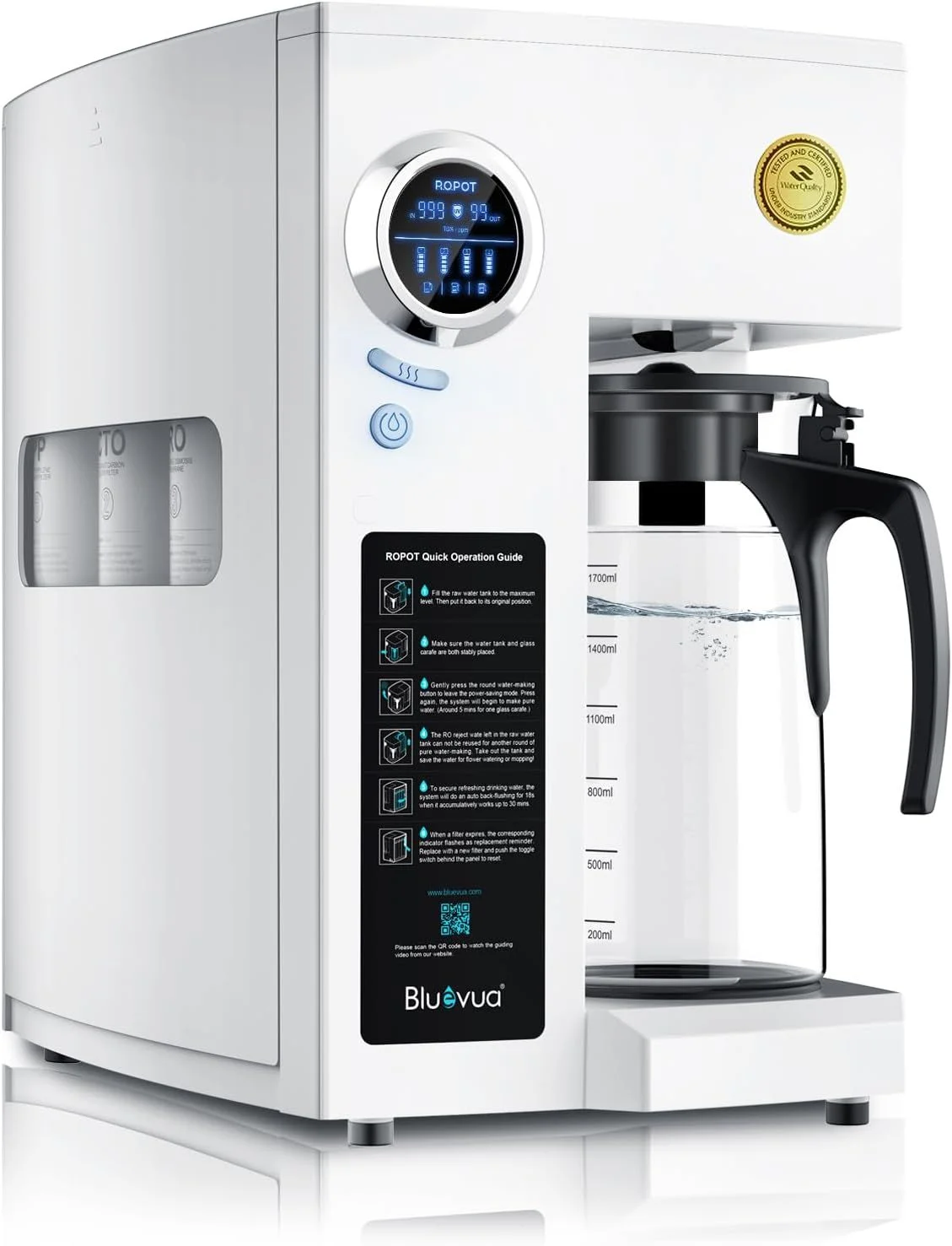
RO100ROPOT-UV (Premium)
- Price tier: $250–$500
- Stages: 6 (RO + UV + Remineralization)
- Water efficiency: 2:1 pure-to-drain
- Flow rate: ~0.5 GPM
- Display: No
- Rating: 4.4 stars (2800 reviews)
- Certification: NSF/ANSI 58
Best for: Well water households, high-volume users, anyone who wants minimal water waste.
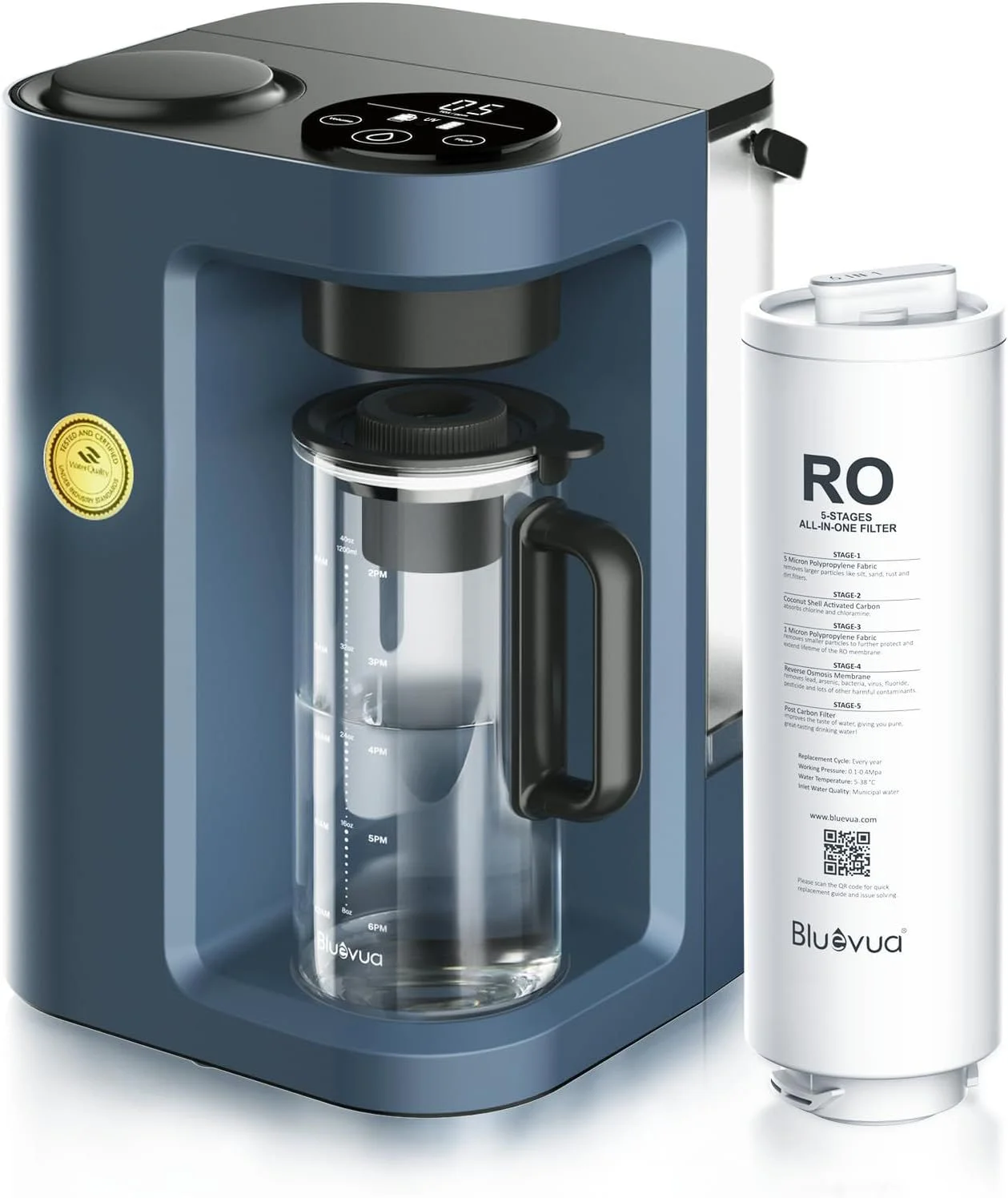
RO100ROPOT-Lite UV (Value)
- Price tier: $100–$250
- Stages: 7 (RO + UV + Remineralization + extra stage)
- Water efficiency: 3:1 pure-to-drain
- Flow rate: ~0.4 GPM
- Display: Smart LED (filter life + TDS)
- Rating: 4.3 stars (1900 reviews)
- Certification: NSF/ANSI 58
Best for: Municipal water users, budget-conscious buyers, anyone who wants the LED filter tracking.
Both models share the same core: an reverse osmosis membrane that strips 95-99% of dissolved solids, a UV-C lamp that kills bacteria and viruses, a remineralization stage that adds minerals back for taste, and a glass carafe that keeps purified water free from plastic contact. The differences are in the details.
Where the RO100ROPOT-UV Wins
Water efficiency is the premium model's strongest advantage. Its 2:1 pure-to-drain ratio means for every 2 gallons of purified water, 1 gallon goes to drain. The Lite UV's 3:1 ratio wastes 50% more water per gallon produced. For a household filtering 3 gallons daily, that's roughly 180 extra gallons of waste water per year with the Lite UV. In areas with high water costs or drought restrictions, this adds up.
Faster filtering speed. The premium model's pump pushes water through the RO membrane at ~0.5 GPM versus the Lite UV's ~0.4 GPM. The difference is noticeable when filling the carafe — roughly 20% faster per cycle. For households that empty the carafe multiple times a day, this reduces wait time meaningfully.
Longer track record. With 2,800+ reviews versus the Lite UV's 1,900+, the premium model has a more established reliability record. More data points mean higher confidence in long-term durability.
Where the Lite UV Wins
Price is the obvious headline. The Lite UV saves roughly 30% off the premium model's price — a meaningful gap for a countertop appliance. That savings can fund a full year of replacement filters, effectively making the first year's total cost lower than just buying the premium unit alone.
The smart LED display is genuinely useful. It tracks remaining filter life and displays real-time TDS readings of the purified water. The premium model has no display at all, meaning you're estimating filter replacement timing rather than measuring it. For first-time RO owners, this guided maintenance removes a real source of uncertainty.
Seven stages versus six. The Lite UV adds an extra filtration stage. In practice, both models produce water with similar TDS reduction (typically 90-99% depending on source water). The additional stage provides a marginal filtration redundancy that is more meaningful for higher-TDS source water.
If you're on municipal water with TDS under 300 ppm and your main concern is lead, PFAS, or chlorine taste — get the Lite UV and pocket the savings. If you're on well water, filter heavy daily volumes, or live in a water-metered area where waste matters — the premium model's 2:1 efficiency pays for itself. Read the full head-to-head comparison for the complete breakdown.
What Both Bluevua Systems Remove
Both models share identical contaminant removal capabilities thanks to their RO membranes and UV stages. Here's what they handle that standard pitcher filters cannot:
- Total dissolved solids (TDS): 95-99% reduction — what TDS means and why it matters
- Lead: Removed at the RO membrane. Critical for older homes with lead pipes or solder
- PFAS (PFOA, PFOS): Removed by RO. These "forever chemicals" are increasingly detected in U.S. water supplies
- Fluoride: 90%+ removal. Carbon pitcher filters do not remove fluoride at all
- Bacteria and viruses: UV-C stage provides 99.99% kill rate. No pitcher or gravity filter offers this
- Heavy metals: Arsenic, mercury, cadmium, chromium — all reduced by the RO membrane
- Chlorine and chloramines: Removed in the carbon pre-filter stage before the RO membrane
- Pharmaceuticals and pesticides: Reduced by both the carbon stages and the RO membrane
Both carry NSF/ANSI 58 certification, the standard specifically for reverse osmosis systems. This means the performance claims above have been independently verified by a third-party lab — not just stated by the manufacturer.
How Bluevua Compares to the Competition
Bluevua's closest competitor in the countertop RO space is the Waterdrop WD-A2, which adds hot and cold water dispensing but uses a plastic reservoir instead of glass. Our Waterdrop WD-A2 vs Bluevua comparison covers the full trade-offs. For buyers specifically choosing between countertop RO and under-sink RO, we also compared the Bluevua against the iSpring RCC7AK — the most popular under-sink option.
Against pitcher filters like the Brita UltraMax or ZeroWater, Bluevua operates in a fundamentally different category. Pitchers use gravity-fed carbon filtration that handles chlorine taste effectively but cannot touch TDS, fluoride, PFAS, or bacteria. The price gap between a pitcher and a Bluevua RO system reflects a genuine capability gap, not a marketing markup. If your water report is clean, a pitcher is all you need. If it's not, no pitcher will solve the problem.
Who Should Buy a Bluevua — and Who Should Skip It
Bluevua is an excellent fit if: You rent an apartment or condo and cannot install an under-sink system. You've received a water quality advisory in your area or your municipal report flags elevated lead, nitrates, or PFAS. You have children or immunocompromised family members for whom biological contamination is a real concern — the UV-C stage addresses that directly. You want to stop buying bottled water but need a genuinely portable solution you can take when you move. In all of these scenarios, both Bluevua models deliver performance that was previously only available from permanent plumbed-in systems.
Bluevua may not be the right fit if: Your household drinks very low volumes of water and a quality pitcher filter addresses your specific contaminants. You have extremely limited counter space — both models require a meaningful footprint plus clearance for the carafe. You need a solution for whole-house filtration rather than drinking water only; for that use case, a whole-house sediment and carbon system paired with a point-of-use RO is a more appropriate approach. And if your water report shows no detectable contaminants of concern and you're filtering primarily for taste, a mid-range carbon pitcher filter will serve you well at a fraction of the cost.
Before buying any filtration system, download your municipality's annual Consumer Confidence Report (CCR) from the EPA's database or your utility's website. It lists every detected contaminant and its measured level against the legal limit. If you see lead, nitrates, PFAS, or arsenic anywhere near their action levels, an RO system like Bluevua is the right tool. If the report is clean and your only complaint is chlorine taste, a pitcher filter rated for chlorine removal is a proportionate and far less expensive solution.
Setup, Maintenance, and Ongoing Costs
Setup is genuinely zero-effort. Unbox, place on counter, plug in, fill the reservoir with tap water, and press start. No faucet connections, no drilling, no plumber. Both models are ready to produce purified water within minutes of opening the box.
Filter replacements follow a predictable schedule. Pre-filters and post-filters need swapping every 6 months. The RO membrane lasts approximately 12 months. Bluevua sells bundled replacement kits that include all stages for a single maintenance session. The Lite UV's LED display tracks remaining filter life automatically; premium model owners should set a calendar reminder.
Annual filter costs are moderate — significantly less than a year of bottled water for a typical household, and comparable to under-sink RO membrane replacements. The biggest ongoing cost difference between the two models is water waste: the Lite UV's 3:1 ratio means higher water bills in metered areas over time.
Total cost of ownership over three years tells the fuller story. Factor in the purchase price, annual filter bundle replacements, and the added water utility cost from drain water. Over a three-year horizon, the premium model's higher upfront cost is partially offset by its lower water waste, while the Lite UV's lower purchase price is partially eroded by the additional drain water it produces. For most municipal water households filtering moderate daily volumes, the Lite UV still comes out ahead on total three-year cost. For well water households or those in areas with high water rates, the math can shift in favor of the premium model within two years.
Frequently Asked Questions
Is Bluevua a reliable brand?
Which Bluevua model should I buy?
Do Bluevua filters remove PFAS and lead?
How much does it cost to maintain a Bluevua RO system?
Can I use a Bluevua system with well water?
Does a Bluevua system need plumbing or installation?
How noisy is the Bluevua during operation?
How long does it take to fill the carafe?
Our Verdict
The Bluevua RO100ROPOT-Lite UV is the right choice for most buyers. It delivers the same RO + UV purification at a lower price, and the LED display is a practical advantage the premium model lacks. Choose the RO100ROPOT-UV if you're on well water, need the faster throughput, or want to minimize water waste with the 2:1 ratio. Either way, you're getting countertop reverse osmosis with UV sterilization and a glass carafe — a combination no other brand at this price range currently matches.
Check Lite UV Price on AmazonGet Our Top 3 Picks
Get our top 3 picks for your budget — one email, then only updates.
Only when something changes. Unsubscribe anytime.