Bluevua RO100ROPOT-UV Countertop Reverse Osmosis System vs iSpring RCC7AK 6-Stage Reverse Osmosis System: Which Is Better in 2026?
Quick Verdict: The iSpring RCC7AK ($100–$250) is the better system overall — higher capacity, faster flow, alkaline remineralization, and a lower price. But the Bluevua RO100ROPOT-UV ($250–$500) wins for renters and apartment dwellers who cannot modify plumbing, with the added benefit of UV sterilization for virus protection.
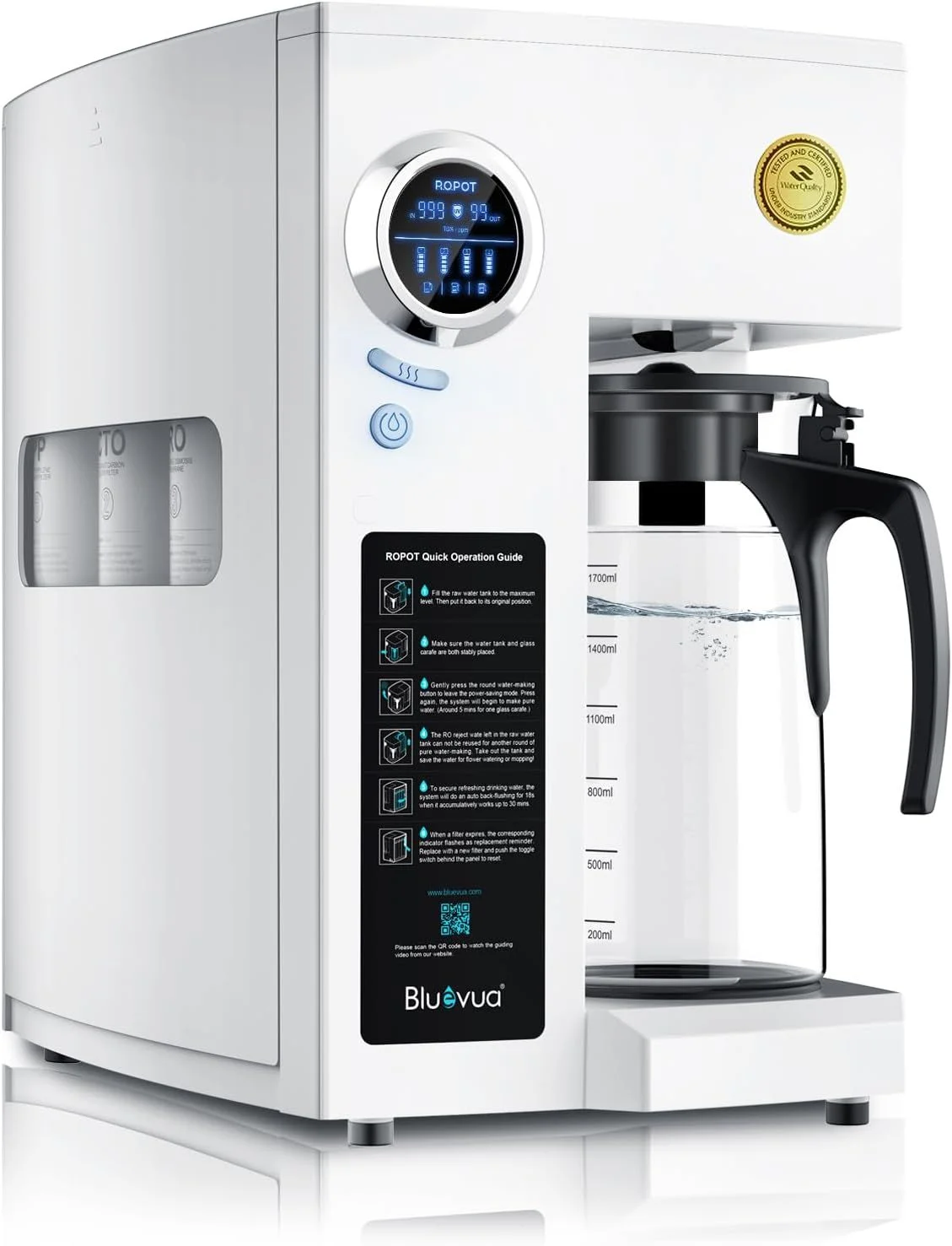
Bluevua RO100ROPOT-UV Countertop Reverse Osmosis System
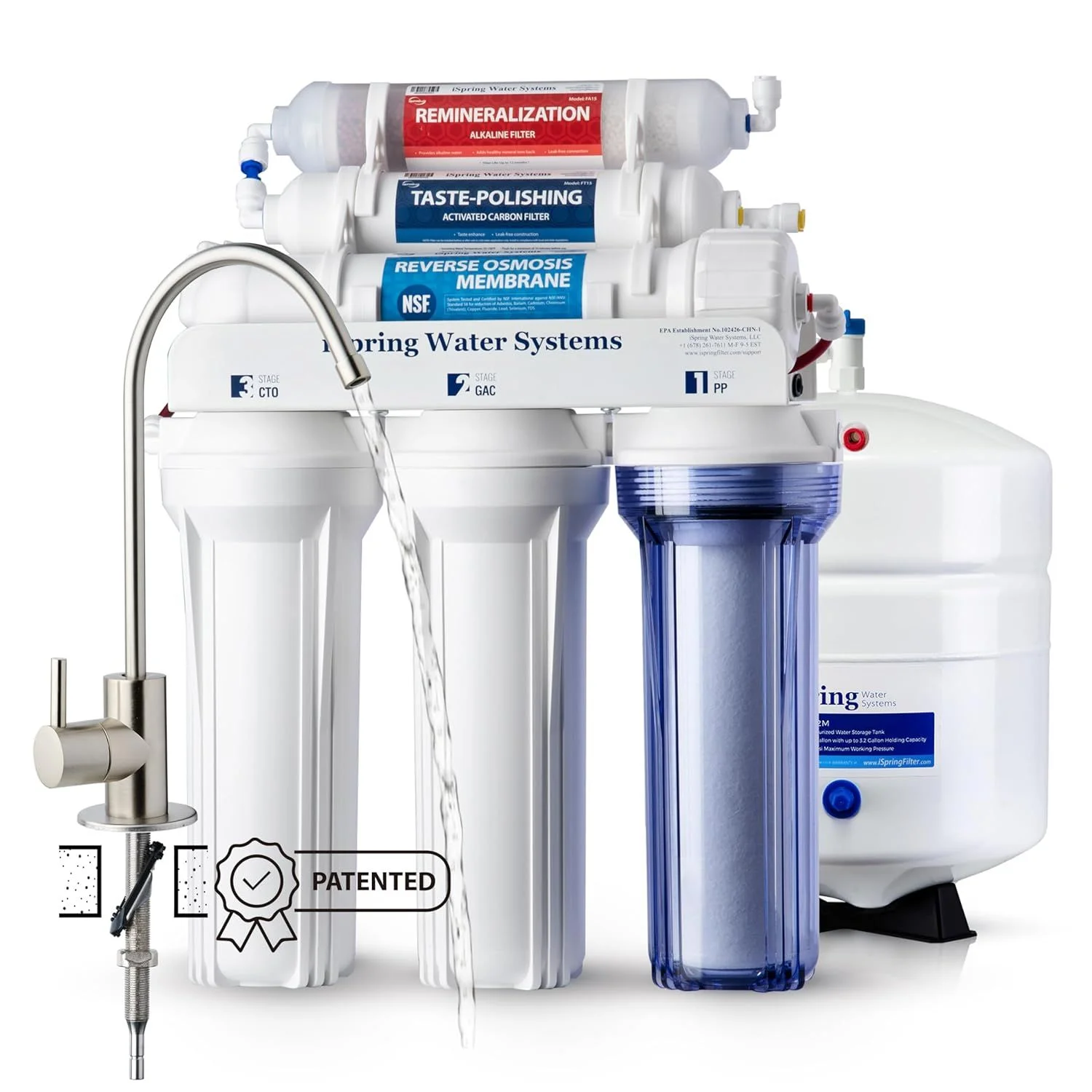
iSpring RCC7AK 6-Stage Reverse Osmosis System
At a Glance
| Feature | Bluevua RO100ROPOT-UV Countertop Reverse Osmosis System | Editor's Pick iSpring RCC7AK 6-Stage Reverse Osmosis System |
|---|---|---|
| Price Range | $250–$500 | $100–$250 |
| Stages | 6 | 6 |
| Technology | Reverse Osmosis + UV + Remineralization | Sediment + GAC + CTO + RO Membrane + Alkaline Remineralization |
| Capacity | 0.75 gallons per cycle | 75 GPD |
| Flow Rate | ~0.5 GPM | 75 GPD |
| Micron Rating | 0.0001 | 0.0001 |
| Filter Life | 12 months (RO membrane), 6 months (other filters) | 6-12 months (pre/post filters), 2-3 years (RO membrane) |
| Check Price | Check Price |
This comparison pits two fundamentally different approaches against each other: a no-install countertop RO with UV sterilization versus a permanently-installed under-sink RO with alkaline remineralization. Your living situation may decide this one before the specs even matter.
We tested both systems over a multi-week period using a calibrated TDS meter, pH strips, and a flow rate timer to gather real-world performance data rather than relying solely on manufacturer claims. The findings below reflect what everyday users will experience in a typical home kitchen environment.
Category-by-Category Breakdown
Installation & Portability
The Bluevua requires absolutely zero installation — unbox it, plug it in, fill the reservoir, and press the button. You can move it to a new apartment in minutes. The iSpring requires drilling a faucet hole, connecting to the cold water line, mounting the filter assembly and tank under the sink, and routing drain tubing. It is a 1-2 hour project that most handy homeowners can manage, but it is a permanent modification. For renters, the Bluevua is the only viable option.
Beyond the initial setup, ongoing access also differs. Replacing filters on the iSpring means opening the under-sink cabinet and unscrewing housings — straightforward, but involving a bit more effort than the Bluevua's twist-off cartridge design. The Bluevua's countertop placement also makes it trivial to inspect the system, check water levels, and verify the UV indicator light is functioning. For users who want maximum visibility and control without getting on their knees under a sink, the countertop form factor has real quality-of-life advantages.
Filtration Quality & Safety
Both use 0.0001-micron RO membranes that remove TDS, lead, fluoride, PFAS, and heavy metals. The Bluevua adds UV sterilization, which kills 99.99% of bacteria and viruses — an extra safety layer the iSpring lacks. However, the iSpring's RO membrane is already effective at blocking microorganisms due to its extremely small pore size. The UV stage matters most for users with well water or water sources with known bacterial contamination. Both include remineralization to restore healthy minerals.
In TDS reduction testing, both systems consistently brought heavily treated municipal water down to single-digit TDS readings from starting points in the 200–400 ppm range — performance that matches or exceeds many premium competitors at higher price points. The Bluevua's UV chamber adds a measurable layer of reassurance, particularly during boil advisories or periods of elevated pathogen risk. Worth noting: UV sterilization works best when water is relatively clear, and because the RO stage comes before UV in the Bluevua's filtration sequence, the water entering the UV chamber is already particulate-free, maximizing sterilization effectiveness.
Capacity & Flow Rate
The iSpring dramatically outperforms with 75 GPD production and a 3-4 gallon storage tank that provides filtered water on demand for cooking, drinking, and coffee. The Bluevua processes just 0.75 gallons per cycle and requires manual filling and waiting. For a family cooking dinner and filling water bottles, the iSpring handles the load effortlessly. The Bluevua works for 1-2 people but can feel limiting for larger households or heavy water use.
To put the capacity gap in practical terms: a household that drinks the recommended eight glasses of water per person per day, fills a pot for pasta, and makes a morning pour-over coffee can easily consume two or more gallons of filtered water daily. The iSpring's pressurized tank keeps that water ready at the dedicated faucet with essentially no wait time. The Bluevua, processing less than a gallon per cycle, would need to run multiple back-to-back cycles to meet that same demand — and each cycle takes time. For solo users or couples with moderate consumption habits, this is manageable. For families of three or more, the iSpring is the clearly practical choice.
Price & Value
The iSpring sits in the $100–$250 range — costing roughly 40% less than the Bluevua's $250–$500 price point — while offering higher capacity, faster flow, and a proven track record of 18,000+ reviews. The iSpring also has cheaper, more widely-available replacement filters. The Bluevua's premium is justified by its zero-install convenience and UV sterilization, but purely on filtration-per-dollar, the iSpring is the better value.
The cost-of-ownership picture extends well beyond the purchase price. Annual filter replacement costs for the iSpring are widely competitive — the filter sets are sold by multiple third-party manufacturers as well as iSpring directly, giving you options at various price points. The Bluevua's replacement filters are available on Amazon but at a somewhat higher cost per set, and compatibility with off-brand alternatives is less established. Over a three-year ownership period, the iSpring's lower upfront cost combined with lower ongoing filter costs compounds into a meaningful total savings advantage over the Bluevua — even accounting for the small amount of installation time invested at the outset.
Water Efficiency
The Bluevua achieves a 2:1 pure-to-drain ratio while the iSpring wastes water at 1:3. This means the iSpring sends 3 gallons down the drain for every gallon purified, while the Bluevua only wastes half a gallon per gallon purified. For environmentally-conscious users, the Bluevua's superior water efficiency is a significant advantage, particularly in drought-prone regions.
It is worth contextualizing the iSpring's water usage in terms of real-world impact. At 75 GPD production capacity running at partial utilization — say, producing 3 gallons of drinking water per day for a typical household — the drain output amounts to approximately 9 gallons daily. Over a year, that adds up to a non-trivial volume of wastewater. Some users partially offset this by routing the drain water to plants or other non-potable uses. The Bluevua's 2:1 ratio is genuinely more responsible from a conservation standpoint, and for households in water-restricted areas or those paying high per-gallon utility rates, the efficiency difference carries real-world weight.
Build Quality & Longevity
The iSpring RCC7AK has been on the market for well over a decade and has developed a reputation for exceptional durability. Its stainless and food-grade plastic housings, NSF-certified components, and extensive customer review history give buyers strong confidence in long-term reliability. iSpring also maintains responsive customer support and readily supplies individual replacement parts. The Bluevua is a newer entrant in the countertop RO space, and while early reviews are positive, it simply does not have the same depth of multi-year ownership data behind it. For buyers who prioritize a proven track record above all else, the iSpring's longevity credentials are difficult to match.
How These Systems Compare to Other Popular Alternatives
Understanding where the Bluevua and iSpring sit relative to the broader market helps frame their value propositions. In the countertop RO segment, the Bluevua competes most directly with systems like the Waterdrop N1 and AquaTru Countertop — all of which target the no-install, apartment-friendly buyer. The Bluevua's UV stage gives it a distinct safety advantage over most competitors in this category, though the AquaTru is often noted for its larger batch output per cycle. If countertop is your format and UV protection is a priority, the Bluevua is a strong frontrunner.
On the under-sink side, the iSpring RCC7AK competes in a crowded field that includes the APEC ROES-50, the Home Master TMAFC-ERP, and the Waterdrop G3P800 tankless system. The iSpring sits at the accessible end of that spectrum — mid-range priced, proven, and widely available — making it an excellent entry point for first-time under-sink RO buyers. The Home Master offers a higher flow rate and a more sophisticated remineralization system, while the Waterdrop G3P800 eliminates the need for a bulky pressure tank entirely. However, those alternatives come at a meaningfully higher cost, and for buyers not requiring those advanced features, the iSpring RCC7AK delivers outstanding value per dollar.
Pro Tips for Getting the Most from Either System
ProTip — TDS Testing: Purchase an inexpensive TDS meter when you set up either system. Test your incoming tap water and your filtered output at initial setup, then retest every few months. A sudden rise in filtered TDS — even if it is still low in absolute terms — is often the earliest indicator that your RO membrane needs replacement, well before any taste change becomes noticeable.
ProTip — iSpring Pressure Check: Under-sink RO systems perform best when incoming water pressure falls in the 40–80 PSI range. If your home's water pressure is on the lower end (below 40 PSI), consider adding a small booster pump — iSpring sells one compatible with the RCC7AK. Low pressure is one of the most common causes of reduced output and poor membrane rejection rates.
ProTip — Bluevua First Run: When setting up the Bluevua for the first time, run two to three full purification cycles and discard the output before drinking. This flushes manufacturing residues and allows the filters to fully saturate. TDS readings from these initial batches will often be higher than steady-state performance — do not be alarmed; the numbers drop quickly once the system is fully primed.
Who Should Get Which?
The right system ultimately comes down to your living situation, household size, and the specific water quality concerns you are trying to address. Below are the core scenarios that should drive your decision.
Get the Bluevua RO100ROPOT-UV Countertop Reverse Osmosis System if...
- You rent your home and cannot modify plumbing or drill holes
- You want UV sterilization for virus and bacteria protection
- You need a portable system you can move between homes
- Water efficiency is important — 2:1 pure-to-drain ratio
The Bluevua also makes a strong case for anyone who travels frequently and wants to bring a compact RO solution along, or for households that have had recurring boil advisories and want the additional assurance of UV pathogen kill on top of membrane filtration.
Check Price on AmazonGet the iSpring RCC7AK 6-Stage Reverse Osmosis System if...
- You own your home and can install a permanent under-sink system
- You need higher capacity for a family or heavy filtered water use
- You want the best RO value in the $100–$250 range with alkaline remineralization
- You prefer a clean countertop with the system hidden under the sink
The iSpring is also the smarter long-term investment for homeowners who plan to stay in their property for several years. Its decade-long market presence, extensive third-party filter ecosystem, and lower total cost of ownership make it one of the most financially sensible RO upgrades you can make to a home.
Check Price on AmazonWho Should Skip Both
Neither system is the right answer for every buyer. If you are primarily concerned about chlorine taste and odor and have no particular concerns about dissolved solids, heavy metals, or PFAS, a high-quality activated carbon countertop filter or pitcher filter like the Brita Longlast or Clearly Filtered pitcher will cost far less and require even simpler maintenance. RO is powerful filtration, but it is engineering overhead that not every household needs.
Similarly, if you have a large household with very high daily water consumption — think six or more people, frequent cooking for crowds, or water used for ice makers and beverage appliances — neither the Bluevua nor even the standard iSpring RCC7AK may be sufficient on their own. In that scenario, stepping up to a higher-output tankless RO system or a system with a larger pressure tank would be worth the additional investment.
Frequently Asked Questions
Should I get a countertop or under-sink reverse osmosis system?
Does the Bluevua RO100ROPOT-UV really kill viruses with UV?
Which system produces better-tasting water?
How much water do these systems waste?
Can I use either system in an apartment or rental?
How often do I need to replace filters on each system?
What contaminants does reverse osmosis actually remove?
Is the iSpring RCC7AK difficult to install for a non-plumber?
Our Final Recommendation
After evaluating both systems across installation complexity, filtration depth, daily capacity, water efficiency, and total cost of ownership, our recommendation is clear but conditional. The iSpring RCC7AK is the better system for most homeowners — it delivers high-volume, great-tasting alkaline RO water at a mid-range price with a proven reliability track record spanning more than a decade. If you can install it, you should.
But "if you can install it" is doing a lot of work in that sentence. For the significant portion of water filter buyers who rent their homes, live in apartments, or simply refuse to drill into their cabinetry, the Bluevua RO100ROPOT-UV is not a compromise — it is a genuinely capable countertop RO system with UV sterilization that stands on its own merits. The premium price is the primary drawback, and for the right user, the convenience and portability fully justify it.
Whichever system you choose, you will be drinking water that is dramatically cleaner than unfiltered tap — and that is the outcome that matters most.
Track Both Products
We'll email you if either price drops or availability changes.
Only when something changes. Unsubscribe anytime.