Big Berkey vs ProOne Big+: Which Large-Capacity Gravity Filter Is Better in 2026?
Quick Verdict: The ProOne Big+ is the safer, smarter purchase in 2026. It costs $77 less, carries IAPMO certification to four NSF standards (the Berkey has zero), includes built-in fluoride removal, and faces no regulatory issues. The Big Berkey remains the performance king with dramatically faster flow (3.5 GPH vs 0.52 GPH) and longer filter life (6,000 gallons vs 2,000 gallons) — but the EPA Stop Sale Order and lack of independent certification create real risk that the ProOne simply does not carry.
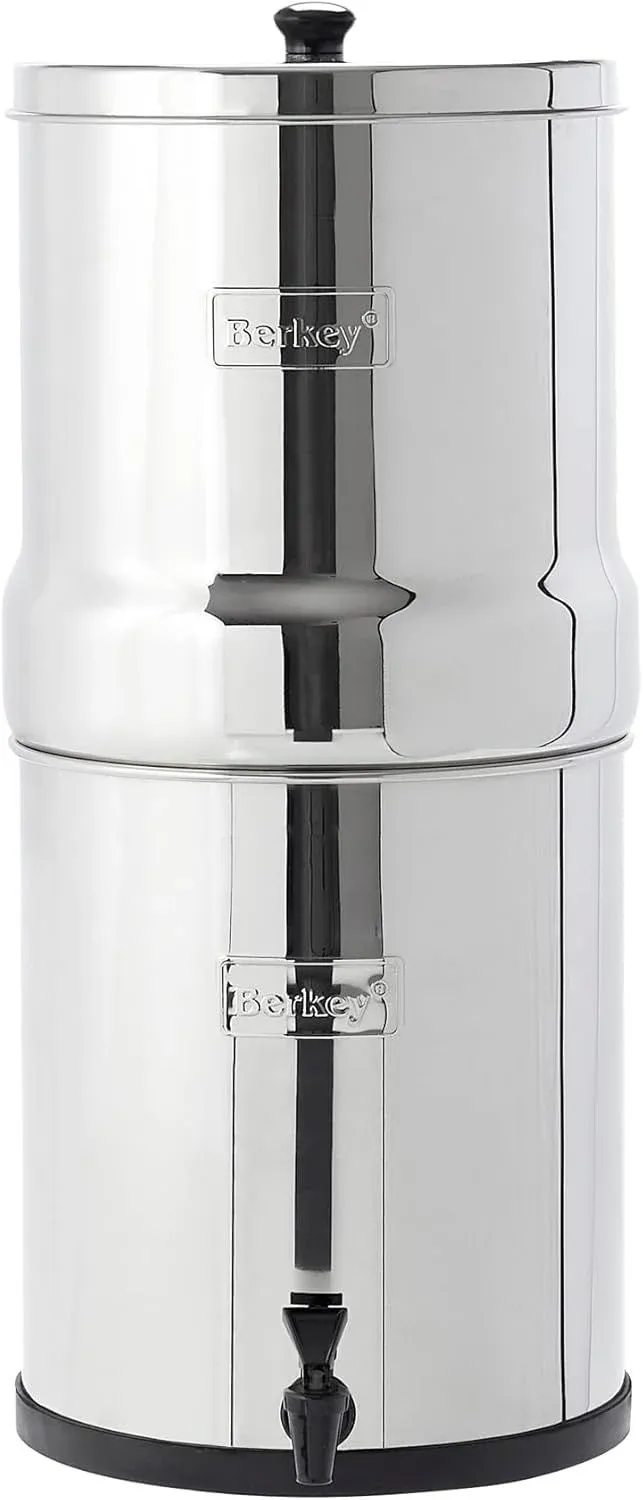
Big Berkey Gravity-Fed Stainless Steel Countertop Water Filter System 2.25 Gallon
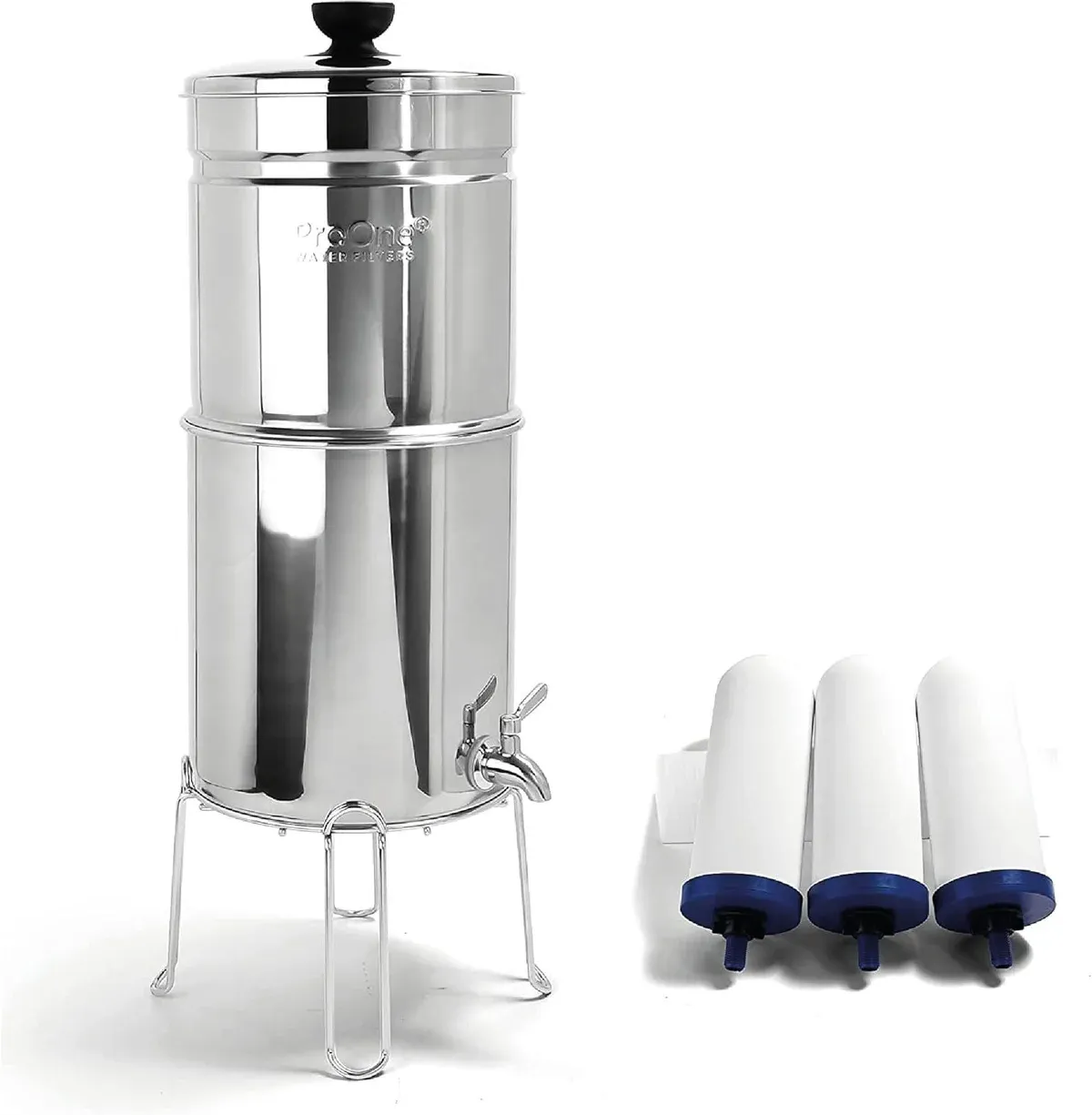
ProOne Gravity Water Filter System 3 Gallon with 2 Filter Elements
At a Glance
| Feature | Big Berkey Gravity-Fed Stainless Steel Countertop Water Filter System 2.25 Gallon | Editor's Pick ProOne Gravity Water Filter System 3 Gallon with 2 Filter Elements |
|---|---|---|
| Price | $250–$500 | $250–$500 |
| Filtration | Proprietary 6-media blend (microfiltration + adsorption + ion exchange) | 3-stage G3.0 (ceramic shell + carbon granular media + carbon block core) |
| Capacity | 2.25 gallons | 3 gallons |
| Flow Rate | 3.5 GPH (2 elements) / 7.0 GPH (4 elements) | ~0.52 GPH (2 filters) |
| Filter Life | 6,000 gallons per pair | 1,000 gallons per filter |
| Certifications | — | IAPMO — NSF 42/53/401/372 |
| Contaminants | 200+ including lead, mercury, arsenic, chlorine, pharmaceuticals, VOCs, radiologicals | 200+ including lead, fluoride, PFAS, chlorine, microplastics, bacteria, pharmaceuticals |
| Weight | 7 lbs (empty) | ~10 lbs |
| Check Price | Check Price |
The Big Berkey and ProOne Big+ are the two gravity filters most often compared by buyers shopping for a countertop system that handles a family's daily water needs. The Berkey is the legacy brand — the name that dominated gravity filtration for over a decade and built a passionate following among preppers, homesteaders, and health-conscious families. The ProOne Big+ is the certified challenger — offering independently validated contaminant removal, built-in fluoride reduction, and a lower price point. Since the Big Berkey's EPA regulatory troubles began in late 2022, this comparison has become one of the most consequential decisions in the gravity filter market.
Category-by-Category Breakdown
Regulatory Status & Certification
This is the single most important category in this comparison, and the ProOne wins it decisively. The ProOne Big+ carries IAPMO certification to NSF 42 (taste/odor), NSF 53 (health contaminants including lead), NSF 401 (emerging contaminants including pharmaceuticals), and NSF 372 (lead-free materials). These certifications mean that an independent, ANSI-accredited laboratory has tested the ProOne's G3.0 filters and verified their contaminant removal claims under standardized conditions.
The Big Berkey has no NSF or IAPMO certification. Berkey has submitted their Black Berkey filters to independent laboratories for testing, and those lab reports show impressive contaminant removal numbers. However, Berkey has never completed the full NSF certification process, which includes not just a single lab test but ongoing factory audits, production sampling, and annual re-certification. The distinction matters: a one-time lab test shows what a filter CAN do under controlled conditions, while NSF certification shows what a filter DOES do consistently across production runs.
More critically, the Big Berkey has been under an EPA Stop Sale Order since late 2022. The EPA classified Berkey's silver-impregnated filters as a pesticide device under FIFRA because the colloidal silver is intended to prevent bacterial growth within the filter element — a pesticidal claim that requires EPA registration. Berkey is contesting the classification, but the legal process is ongoing. The practical consequences include: Berkey products are not available in California or Iowa, replacement filter availability is inconsistent, and counterfeit filters have proliferated in the supply chain during the disruption. The ProOne faces none of these issues.
Flow Rate & Throughput Performance
The Big Berkey with 2 Black Berkey elements delivers approximately 3.5 GPH — and with the optional expansion to 4 elements, it reaches 7.0 GPH. The ProOne Big+ with 2 G3.0 filters delivers approximately 0.52 GPH. The Berkey is nearly 7 times faster. This is not a marginal difference — it is a category-defining performance gap.
In daily use, the flow rate difference is the most noticeable distinction between these two systems. Fill the Big Berkey's upper chamber, and you have filtered water in under an hour. Fill the ProOne Big+'s upper chamber, and you are waiting close to 6 hours for a full batch. For a family of four consuming 2 gallons per day, the Berkey can produce that volume in about 35 minutes of passive filtering. The ProOne needs nearly 4 hours.
The Berkey's flow rate advantage is a function of its proprietary 6-media filtration blend, which uses a combination of microfiltration, adsorption, and ion exchange that is less restrictive to water flow than the ProOne's ceramic-carbon block architecture. The ProOne's denser filtration media provides more thorough contact time for chemical adsorption — a quality-vs-quantity trade-off. The ProOne can be upgraded to 3 filters (increasing flow to approximately 0.78 GPH), but even at maximum capacity, it produces less than a quarter of the Berkey's throughput.
For households that use significant volumes of filtered water for cooking, coffee, ice, pet bowls, and drinking throughout the day, the Berkey's throughput is a genuine quality-of-life advantage. For households that can plan ahead — filling the upper chamber at night and drawing from a full lower reservoir during the day — the ProOne's slower speed is less burdensome.
Filter Lifespan & Long-Term Economics
The Big Berkey's Black Berkey elements are rated for 3,000 gallons each — 6,000 gallons per pair. The ProOne Big+'s G3.0 filters are rated for 1,000 gallons each — 2,000 gallons per pair. The Berkey's filters last 3 times longer per element, delivering the lowest per-gallon filtration cost of any gravity system we have reviewed.
At 1 gallon per day of household consumption, the Berkey's filters last approximately 16.4 years before both elements need replacing. The ProOne's filters last approximately 5.5 years. That is an 11-year difference in filter longevity — three full replacement cycles for the ProOne during the period that a single set of Berkey elements remains functional.
However, this advantage is complicated by the Berkey's regulatory situation. The EPA Stop Sale Order has disrupted the supply chain for genuine Black Berkey replacement filters. Counterfeit filters have appeared on Amazon and other marketplaces, and distinguishing genuine from counterfeit elements requires careful attention to packaging details and authorized dealer verification. If genuine replacement filters become unavailable due to regulatory enforcement, the Berkey's 6,000-gallon rating becomes theoretical rather than practical. The ProOne's shorter filter life is a known, manageable cost — while the Berkey's longer filter life depends on a supply chain that is currently under stress.
The upfront economics also favor the ProOne. At $290 versus the Berkey's $367, you save $77 at purchase — enough to cover a significant portion of your first replacement filter set. When you factor in the purchase price plus the cost of one complete filter replacement cycle, the total 10-year cost of ownership is comparable between the two systems, assuming genuine Berkey filters remain available.
Contaminant Removal & Fluoride
Both systems claim to remove 200+ contaminants including lead, mercury, arsenic, chlorine, pharmaceuticals, VOCs, and microplastics. The Big Berkey's independent lab tests show removal rates exceeding 99.9% for many contaminants — impressive numbers that are consistent across multiple third-party tests. The ProOne's contaminant removal is validated by its IAPMO certification, which means the numbers are not just lab-achievable but production-consistent across manufactured units.
The ProOne Big+ has one decisive advantage in contaminant removal: built-in fluoride reduction. The G3.0 filter elements incorporate activated alumina media that adsorbs fluoride during the standard filtration process. The Big Berkey does not remove fluoride with its standard Black Berkey elements — Berkey offers separate PF-2 fluoride/arsenic add-on filters that mount below the Black Berkey elements. These PF-2 filters add cost, require separate replacement cycles (approximately 1,000 gallons each), and add complexity to the system. The ProOne's integrated approach is simpler, cheaper, and more elegant.
For the roughly 73% of American households on fluoridated municipal water, the ProOne's built-in fluoride removal is a meaningful differentiator. Berkey's PF-2 add-on approach works, but it adds approximately $70 per replacement pair to the ongoing cost and introduces a second filter replacement schedule to track. The ProOne handles fluoride as part of its standard filtration — no add-ons, no extra cost, no separate maintenance schedule.
Build Quality & Design
Both systems use 304 stainless steel housings, and both feel solidly constructed. The Big Berkey's polished finish has a premium look that has become iconic in the gravity filter market — the mirror-like stainless steel is immediately recognizable. The ProOne Big+'s brushed finish is more practical, hiding fingerprints and water spots that the Berkey's polished surface shows conspicuously.
The Big Berkey measures 19.25 inches tall and 8.5 inches in diameter, holding 2.25 gallons. It nests down to 13 inches for storage and transport — a travel-friendly feature that the ProOne does not offer. The ProOne Big+ measures 22.75 inches tall (28.75 inches with stand) and 9 inches in diameter, holding 3 gallons. The ProOne's larger reservoir is a capacity advantage, but the taller profile can be a problem under kitchen cabinets.
The Berkey's nesting capability is a genuine design advantage for users who travel with their filter, store it seasonally, or want to pack it for camping. Collapsing the upper chamber into the lower chamber reduces height by 6 inches and creates a single compact unit. The ProOne does not nest — it stores at full height. For permanent countertop installation this is irrelevant, but for portable use, the Berkey's nesting design is superior.
Price & Value Proposition
The ProOne Big+ at $290 is $77 less than the Big Berkey at $367 — a 21% price difference. For that lower price, the ProOne delivers broader certifications, built-in fluoride removal, a larger reservoir (3 gallons vs 2.25), and zero regulatory risk. The Big Berkey's $367 price buys faster flow, longer filter life, and a legacy brand name — but also the uncertainty of the EPA situation.
The value analysis depends on how you weigh performance versus risk. The Berkey is objectively the higher-performing filter on throughput and filter longevity metrics. But performance claims without independent certification carry less weight than certified performance at a lower price. If the Berkey's EPA situation resolves favorably and genuine replacement filters remain consistently available, the Berkey's value proposition improves significantly over a 10-year horizon due to its dramatically longer filter life. If the situation worsens — further regulatory action, continued counterfeit proliferation, or supply chain disruption — the Berkey's value proposition deteriorates rapidly.
The ProOne Big+'s value is more predictable. Its certifications are in place, its price is lower, its filter supply chain is straightforward (despite the Culligan transition), and its contaminant removal is independently validated. For risk-conscious buyers, the ProOne represents the better dollar-for-dollar investment because its value does not depend on the outcome of a federal regulatory proceeding.
The EPA Situation: What You Need to Know
The Big Berkey's EPA Stop Sale Order is the elephant in the room of this comparison, and we owe you a clear, honest summary. In late 2022, the EPA issued a Stop Sale, Use, or Removal Order against New Millennium Concepts (Berkey's parent company) under FIFRA. The EPA's position is that Black Berkey filters make pesticidal claims — specifically, that the colloidal silver impregnated in the filter elements is intended to prevent bacterial growth, which classifies the product as a pesticide device requiring EPA registration.
Berkey is contesting the classification, arguing that the silver is a structural component of the filter media rather than a pesticide application. The legal process is ongoing. In the meantime, the practical consequences for buyers include: Berkey products are not sold in California or Iowa, availability on Amazon and authorized dealer sites fluctuates, and the market has seen a significant increase in counterfeit Black Berkey filter elements that may not provide the same contaminant removal performance.
We want to be clear: the EPA Stop Sale Order does not mean the Big Berkey is unsafe. The order is about regulatory classification, not product safety. Thousands of existing Berkey owners continue to use their systems daily. However, for a new buyer making a purchase decision in 2026, the regulatory uncertainty is a real factor that affects replacement filter availability, potential resale value, and the long-term viability of the Berkey platform. The ProOne Big+ carries no comparable risk.
The Culligan MaxClear Transition
The ProOne is not without its own transition story. ProOne is moving its product line to the Culligan MaxClear brand. Culligan is one of the oldest and largest water treatment companies in North America, with extensive manufacturing facilities, retail distribution through home improvement stores, and a national service network. The transition to Culligan backing may ultimately be positive for ProOne buyers — more production capacity, wider retail availability, and the financial stability of a major corporation.
However, during the transition period, there is some uncertainty about G3.0 filter availability. Current ProOne G3.0 filters are available while supplies last, and the Culligan MaxClear replacement filters are expected to use comparable filtration technology. We recommend that ProOne Big+ buyers purchase one or two extra G3.0 filter elements at the time of system purchase as insurance against any availability gaps during the brand transition. The sealed filters have a long shelf life in their original packaging.
Comparing the two transitions: the Big Berkey faces a federal regulatory action with uncertain resolution and active enforcement. ProOne faces a corporate rebrand with the backing of a larger, well-resourced company. These are qualitatively different situations. The Berkey's transition is adversarial (government enforcement), while ProOne's is voluntary (strategic brand consolidation). For risk assessment purposes, the ProOne's transition is the less concerning of the two.
Who Should Get Which?
Get the Big Berkey Gravity-Fed Stainless Steel Countertop Water Filter System 2.25 Gallon if...
- Flow rate is your top priority — 3.5 GPH is nearly 7x faster than the ProOne
- You need the longest possible filter life — 6,000 gallons per pair is unmatched
- You travel with your filter and value the nesting design for compact transport
- You are comfortable with the EPA regulatory situation and counterfeit filter risk
- You do not live in California or Iowa (where Berkey is not available)
- Brand legacy and community support matter — Berkey has the largest user community
Get the ProOne Gravity Water Filter System 3 Gallon with 2 Filter Elements if...
- Certifications matter — you want independently validated contaminant removal (NSF 42/53/401/372)
- You want built-in fluoride removal without add-on filters or extra cost
- You prefer the lower price — $290 vs $367 with better certification coverage
- Regulatory risk concerns you — the ProOne has no EPA issues
- You live in California or Iowa where Berkey is not sold
- You want the option to upgrade to 3 filters later for improved flow
- Budget allows stocking spare G3.0 filters during the Culligan transition
Pro Tip: If you are currently a Big Berkey owner looking to switch to ProOne, do not discard your Berkey stainless steel housing. The 304 stainless steel upper and lower chambers, spigot, and lid are high-quality components unaffected by the EPA order — the regulatory issue is exclusively about the Black Berkey filter elements. Some gravity filter enthusiasts have successfully mounted ProOne-compatible filters in Berkey housings using adapter kits, though this is not manufacturer-supported and may void warranties. Alternatively, keep the Berkey housing as a backup gravity system — its nesting design makes it an excellent emergency storage item even if you switch your daily-use system to the ProOne Big+.
Transitioning from Berkey to ProOne: What to Expect
Many buyers in this comparison are existing Berkey owners considering a switch to the ProOne Big+. Having used both systems, we can set realistic expectations for the transition. The most noticeable change is the flow rate reduction. If you are accustomed to the Berkey's 3.5 GPH throughput — having filtered water available within an hour of filling the upper chamber — the ProOne's 0.52 GPH pace will require an adjustment in your refill routine. Plan to fill the upper chamber before bed and draw from a full lower reservoir throughout the next day.
The second adjustment is the G3.0 break-in period. ProOne's ceramic-carbon filters may produce a slight chemical smell during the first 3-4 filtration cycles as the carbon media activates. This is normal and expected — discard the first 2-3 batches of filtered water. The Big Berkey's Black Berkey elements also have a priming process, so the concept is familiar, but the sensory experience is different.
On the positive side, Berkey-to-ProOne switchers consistently report satisfaction with the ProOne's water quality. The G3.0 carbon block produces clean-tasting water comparable to or better than the Black Berkey elements for most municipal water sources. The built-in fluoride removal is a welcome simplification for users who previously ran PF-2 add-on filters. And the peace of mind from IAPMO-certified contaminant removal — knowing your filter's claims are independently validated — is a psychological benefit that many switchers describe as significant.
Frequently Asked Questions
Is the Big Berkey still safe to use despite the EPA Stop Sale Order?
Why is the ProOne Big+ cheaper than the Big Berkey despite having certifications?
Can I use Black Berkey filters in a ProOne housing?
Which system is better for emergency preparedness and off-grid use?
What happens when ProOne transitions to Culligan MaxClear?
How do the Big Berkey and ProOne Big+ compare on taste and water quality?
Our Final Recommendation
For most buyers in 2026, the ProOne Big+ is the better purchase. It costs $77 less than the Big Berkey, carries independently certified contaminant removal across four NSF standards, includes built-in fluoride reduction, and operates under no regulatory cloud. Its slower flow rate is a genuine inconvenience, but one that can be managed with planning and potentially mitigated by upgrading to a third filter element.
The Big Berkey remains a remarkable piece of filtration engineering. Its 3.5 GPH flow rate and 6,000-gallon filter life are specifications that no competitor has matched. For existing Berkey owners with a supply of genuine Black Berkey elements, there is no urgent reason to switch — the system performs as well as ever. But for new buyers evaluating a first gravity filter purchase, the combination of lower price, broader certification, fluoride removal, and zero regulatory risk makes the ProOne Big+ the more prudent choice.
We say this with genuine respect for the Berkey brand: the Big Berkey's performance claims are credible, and its loyal community is justified in their enthusiasm. But in a market where independent certification is available at a lower price, buying an uncertified system under active EPA enforcement is a risk that most new buyers should not take when a certified alternative exists. If the Berkey's regulatory situation resolves favorably, we will reassess this recommendation. Until then, the ProOne Big+ is the gravity filter we would buy with our own money.
Track Both Products
We'll email you if either price drops or availability changes.
Only when something changes. Unsubscribe anytime.