Big Berkey vs British Berkefeld: Which Gravity Filter Is Better in 2026?
Quick Verdict: The British Berkefeld ($250–$500) is the safer recommendation for most households — it carries genuine NSF 42/53 certification through Doulton, backed by over 200 years of ceramic filtration heritage. The Big Berkey ($250–$500) offers significantly faster flow and longer filter lifespan, but has never been independently tested by NSF and faced an EPA stop-sale order in 2023 for unsubstantiated health claims. If verified contaminant removal matters to you — and it should — the Berkefeld is the gravity filter whose performance claims you can actually trust.
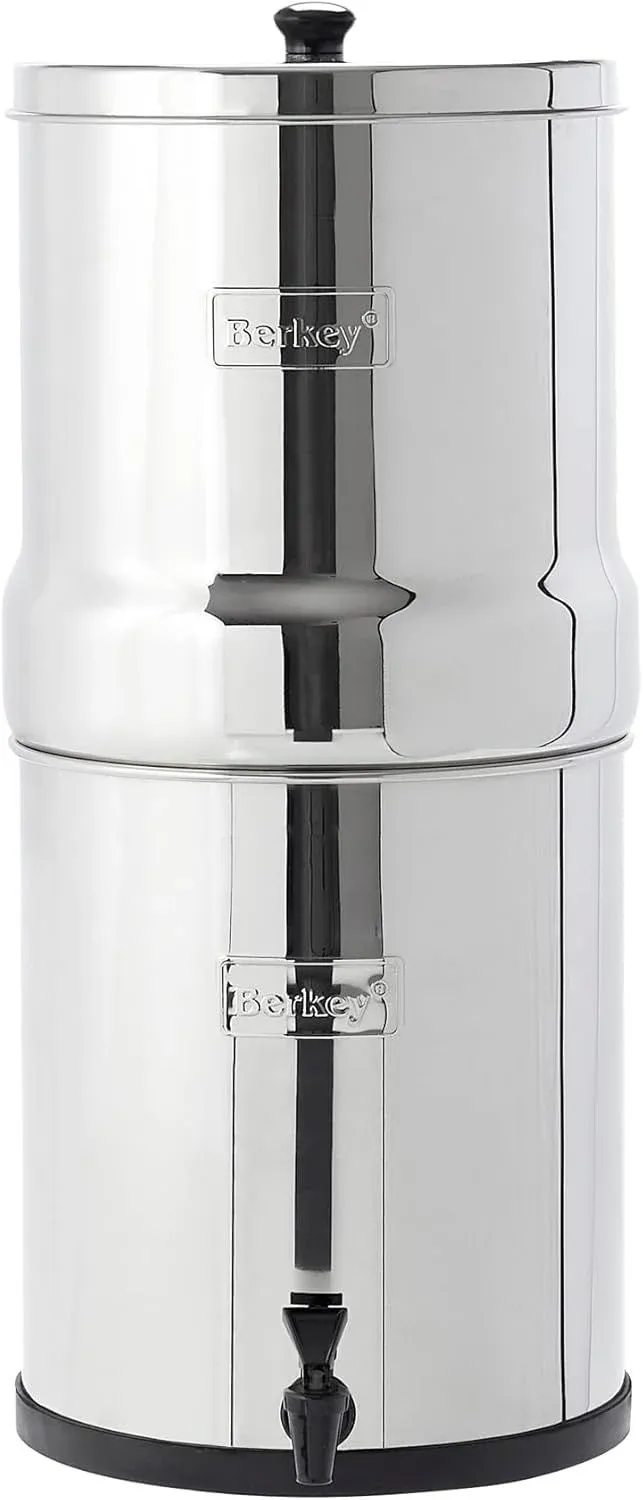
Big Berkey Gravity-Fed Stainless Steel Countertop Water Filter System 2.25 Gallon
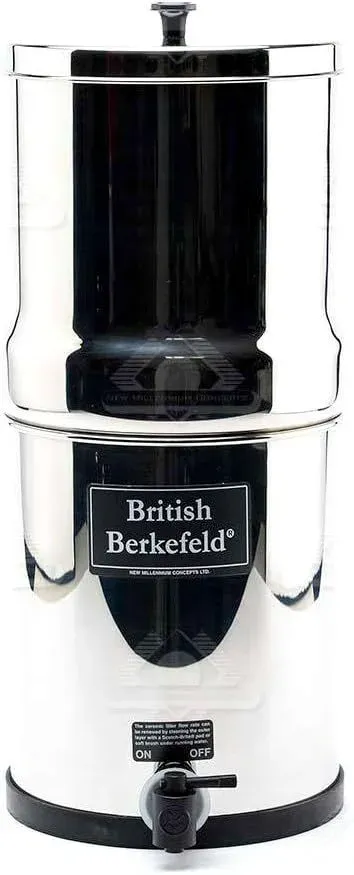
British Berkefeld Gravity Water Filter with 4 Super Sterasyl Ceramic Elements
At a Glance
| Feature | Big Berkey Gravity-Fed Stainless Steel Countertop Water Filter System 2.25 Gallon | Editor's Pick British Berkefeld Gravity Water Filter with 4 Super Sterasyl Ceramic Elements |
|---|---|---|
| Price | $250–$500 | $250–$500 |
| Capacity | 2.25 gallons | ~2.1 gallons |
| Flow Rate | 3.5 GPH (2 elements) / 7.0 GPH (4 elements) | ~1 GPH (4 filters) |
| Certifications | — | NSF/ANSI 401 |
| Filter Life | 6,000 gallons per pair | 400 gallons per filter |
| Filtration | Proprietary 6-media blend (microfiltration + adsorption + ion exchange) | Triple-stage ceramic (0.2 micron shell + GAC + heavy metal media) |
| Check Price | Check Price |
This is the defining gravity filter comparison. The Big Berkey is the most recognized name in gravity filtration — the brand that built the category in the American market. The British Berkefeld is the quieter, pedigree alternative — an NSF-certified system from Doulton, the company that has been making ceramic water filters since 1826. Both use stainless steel housings with gravity-fed filtration, but their approaches to certification, transparency, and performance verification could not be more different.
We are comparing these two systems across six categories that matter most to gravity filter buyers: filtration certification, flow rate, filter lifespan and cost, build quality and trust, ease of maintenance, and brand reputation. Each product wins in different areas — this is not a one-sided comparison. But we do have a clear overall recommendation, and the reasoning behind it may challenge assumptions if you have been following the gravity filter market primarily through Berkey's own marketing channels.
Category-by-Category Breakdown
Filtration Performance & Certification
The British Berkefeld wins this category decisively, and it is the single most important factor in this entire comparison. The Berkefeld's Super Sterasyl candles are manufactured by Doulton, which holds NSF 42 and NSF 53 certification — meaning an independent, accredited laboratory has tested and verified the filter's ability to reduce chlorine taste and odor (Standard 42) and health-related contaminants including lead, cysts, and bacteria (Standard 53). This is not a marketing claim. It is a verified, auditable fact that Doulton submits to ongoing compliance testing to maintain.
The Big Berkey, by contrast, has never been independently tested or certified by NSF, IAPMO, or any other nationally recognized testing laboratory. Berkey's parent company, New Millennium Concepts, publishes its own internal test data claiming removal of over 200 contaminants — but these tests were conducted by Berkey themselves or by labs they commissioned, not through the blind, standardized testing protocols that NSF certification requires. The difference matters enormously: NSF testing uses specific challenge water compositions, controlled flow rates, and end-of-life filter conditions designed to stress-test the filter at its weakest performance point. Manufacturer self-testing can choose favorable conditions and does not carry the same rigor or accountability.
The 2023 EPA stop-sale order against New Millennium Concepts brought this certification gap into sharp public focus. The EPA's action was based on Berkey marketing their filters as pesticide devices — specifically claiming removal of bacteria and viruses — without the EPA registration required to make such claims. Berkey was not found to be selling a dangerous product; they were found to be making performance claims they could not legally substantiate because they had never submitted their filters for the required independent testing. For a product category where the entire value proposition is protecting your family's drinking water, the absence of independent verification is a significant liability that we cannot overlook.
The Doulton ceramic filtration technology used in the British Berkefeld has a documented track record spanning nearly two centuries. The Super Sterasyl candle uses a micro-porous ceramic shell with a nominal pore size of 0.2 microns, impregnated with silver ions to prevent bacterial growth within the filter media itself. Inside the ceramic shell sits an activated carbon core that handles chemical reduction — chlorine, organic compounds, and taste/odor contaminants. This dual-barrier design is well understood, independently tested, and has been deployed in institutional and governmental water treatment contexts worldwide.
Flow Rate & Daily Capacity
The Big Berkey dominates flow rate by a wide margin. With its standard 2 Black Berkey Elements installed, the Big Berkey produces approximately 3.75 gallons per hour — fast enough to keep up with the drinking water needs of a large household without any noticeable wait time. Refill the upper chamber, and within an hour or so, the lower chamber has several gallons of filtered water ready to dispense. For families of four or more, or households that also use filtered water for cooking and coffee, this throughput is genuinely practical.
The British Berkefeld with its 4 Super Sterasyl candles filters at approximately 0.44 gallons per hour — roughly one-eighth the speed of the Big Berkey. In practice, this means filling the Berkefeld's upper chamber before bed and waking up to a full lower chamber, or filling it in the morning and having filtered water available by afternoon. For a two-person household this pace is manageable with planning, but for larger families or heavy-use households, the Berkefeld's slow throughput can become a genuine friction point.
The flow rate difference is inherent to the filtration technologies. Berkey's carbon block elements allow water to pass through relatively quickly — which is either an advantage (more water faster) or a concern (less contact time with filtration media), depending on your perspective. Doulton's ceramic candles force water through a dense micro-porous ceramic shell with 0.2-micron pores, which is physically slower but provides mechanical filtration at a finer level. It is worth noting that slower flow rate is generally correlated with finer filtration in gravity-fed systems — the water spends more time in contact with the filtration media, which theoretically improves contaminant capture. But for day-to-day household use, the Big Berkey's speed advantage is real and meaningful.
One practical consideration: the Big Berkey's 2.25-gallon capacity combined with its faster flow rate means you can realistically cycle through multiple fills per day without planning ahead. The Berkefeld requires more deliberate water management — you learn to keep it topped off and to refill proactively rather than waiting until the lower chamber runs dry. This is a lifestyle adjustment that some users find annoying and others barely notice, depending on how much filtered water your household consumes daily.
Filter Lifespan & Cost Per Gallon
The Big Berkey holds a commanding advantage in filter longevity. Each Black Berkey Element is rated for 3,000 gallons, and the standard Big Berkey configuration includes 2 elements — giving a combined capacity of 6,000 gallons before replacement is needed. At a typical household usage of 3 gallons per day, that is roughly 5 to 6 years of filter life from a single pair of elements. The per-gallon cost of filtration with the Big Berkey is among the lowest of any gravity system on the market — fractions of a cent per gallon over the element's lifetime.
The British Berkefeld's Super Sterasyl candles are rated for approximately 400 to 530 gallons per candle, depending on source water quality and sediment levels. With 4 candles installed, total capacity before a full candle replacement is roughly 1,600 to 2,120 gallons. At the same 3-gallons-per-day usage rate, a full set of 4 candles lasts approximately 18 months to 2 years. Each candle costs approximately $25 to $35, so a full replacement set runs $100 to $140 — a significantly higher ongoing expense than the Big Berkey's element replacement cost over the same filtration volume.
However, there is an important nuance that Berkey's marketing rarely emphasizes: the 3,000-gallon-per-element rating has never been independently verified. NSF testing protocols evaluate filter performance at rated capacity — meaning they test whether the filter still meets its claimed contaminant removal percentages after processing the rated number of gallons. Since Berkey has never undergone NSF testing, the 3,000-gallon claim is a manufacturer assertion, not a verified specification. Doulton's 400-530-gallon rating for the Super Sterasyl, by contrast, is tied to its NSF certification and has been validated through standardized end-of-life testing. You can be confident that a Doulton candle is still performing to specification at gallon 399. With a Black Berkey Element at gallon 2,999, you are relying on the manufacturer's word.
The ceramic candles in the Berkefeld also offer a cost-mitigation feature that carbon block elements do not: they can be scrubbed clean. When flow rate drops due to sediment buildup on the ceramic surface, you can remove the candle, scrub it gently under running water with a Scotch-Brite pad, and restore the flow rate without replacing the candle. This extends the practical life of each candle and is especially valuable in areas with high-sediment source water. Black Berkey Elements cannot be cleaned in this way — when flow rate drops, replacement is the only option.
Build Quality & Trust
The British Berkefeld wins on build quality trust for a reason that goes beyond the physical hardware: provenance. Doulton has been manufacturing ceramic water filtration products since 1826 — nearly 200 years of continuous operation. The company holds a Royal Warrant from Queen Victoria, supplied ceramic filtration to British military expeditions, and its products are used in institutional water treatment settings across dozens of countries. When you buy a British Berkefeld, you are buying from a manufacturer with a documented, verifiable, multi-generational track record in water purification.
The Big Berkey's parent company, New Millennium Concepts, was founded in 1998. The company has built a strong direct-to-consumer brand and a loyal customer base, particularly in the preparedness and off-grid communities. The stainless steel housing is well-constructed and durable — no complaints there. But the company's transparency record is less reassuring. Beyond the 2023 EPA stop-sale order, Berkey has faced criticism for its reluctance to submit products for independent testing, its reliance on the proprietary red dye test as a performance indicator, and the opacity of its manufacturing and quality control processes. When asked directly why they do not pursue NSF certification, Berkey has stated that NSF testing is too expensive and that their internal testing is sufficient — an answer that independent water quality experts have found unconvincing given the company's substantial revenue.
Both systems use food-grade stainless steel housings that are durable, rust-resistant, and built to last for many years of daily use. The physical construction of the housing is comparable between the two systems. The meaningful difference is in the filter elements themselves and the degree of independent oversight applied to their manufacturing and performance claims. Doulton's manufacturing facility in the UK operates under ISO 9001 quality management standards and submits to regular NSF auditing. New Millennium Concepts' manufacturing processes are not subject to equivalent external oversight.
Ease of Use & Maintenance
Both gravity filter systems follow the same basic operational principle: fill the upper chamber with source water, and gravity pulls it through the filter elements into the lower chamber for dispensing. Neither system requires electricity, plumbing connections, or any technical expertise to operate. Assembly out of the box is straightforward for both — install the filter elements into the upper chamber, stack the chambers, and fill with water. Most users can go from unboxing to first filtered water in under 30 minutes with either system.
The Big Berkey's maintenance routine is minimal due to its long element lifespan. Aside from periodic cleaning of the stainless steel chambers (wiping with a damp cloth, occasional deep clean with mild soap), there is very little hands-on maintenance required between element replacements. The system does need to be primed when first installed — a process involving running water through the elements to purge manufacturing residue — but this is a one-time task per element set. Berkey recommends running the red dye test periodically to verify element performance, though as we have discussed, the validity of this test as a filtration metric is questionable.
The British Berkefeld requires slightly more frequent attention due to its ceramic candles. The candles benefit from periodic scrubbing (every few weeks to every few months, depending on source water sediment levels) to restore flow rate. This scrubbing process takes about 5 minutes per candle — remove, scrub gently under running water, reinstall. While this is more maintenance than the Big Berkey requires, many Berkefeld owners view it as an advantage: the ability to physically see and clean the filtration surface provides tangible reassurance that the system is working, and it extends the candle's useful life. Replacement intervals are more frequent (every 18 months to 2 years vs every 5 to 6 years for Berkey), which means more ordering and swapping — but each swap is simple and tool-free.
One maintenance consideration specific to all gravity filters: both systems should be cleaned and dried if left unused for more than a few days. Standing water in a gravity filter can allow bacterial growth, particularly in warm environments. This applies equally to both the Berkey and the Berkefeld, though the Berkefeld's silver-impregnated ceramic provides some additional bacteriostatic protection within the candle itself.
Brand Reputation & Transparency
The British Berkefeld, operating under Doulton's umbrella, wins this category on the strength of its regulatory compliance and transparent certification status. Doulton's NSF certification is publicly verifiable — you can search the NSF database and confirm exactly which models are certified and which contaminant reduction claims are validated. The company's manufacturing heritage, UK-based production, and institutional adoption across government and humanitarian organizations provide layers of credibility that are independently confirmable, not just marketing assertions.
The Big Berkey has built an enormously successful brand, particularly in the American prepper, homesteading, and off-grid communities. It is, without question, the most recognized gravity filter brand in the United States. Berkey's marketing has been aggressive and effective, and its loyal customer base is deeply enthusiastic. However, brand popularity and verified product performance are separate things. The 2023 EPA stop-sale order highlighted a pattern that water quality professionals have noted for years: Berkey makes extensive performance claims that have never been independently validated, relies on a proprietary test (the red dye test) that no accredited laboratory recognizes, and has resisted submitting to the standardized testing protocols that every major competitor in the gravity filter market has voluntarily undergone.
To be fair, Berkey's EPA situation does not mean the Big Berkey is an unsafe product. Many users, including water quality testers on YouTube and independent forums, have reported positive results with Black Berkey Elements. The product may well perform as claimed. The issue is verification — in a product category where the stakes are your family's drinking water safety, "probably works as claimed" and "independently verified to work as claimed" represent meaningfully different levels of assurance. The British Berkefeld offers the latter. The Big Berkey, at present, offers only the former.
It is also worth noting that Berkey has historically used aggressive legal tactics against resellers, reviewers, and competitors — behavior that has not enhanced its reputation for transparency within the water filtration industry. Doulton, by contrast, operates in a more conventional commercial manner with publicly available technical documentation, accessible certification records, and standard industry relationships.
Who Should Get Which?
Get the Big Berkey Gravity-Fed Stainless Steel Countertop Water Filter System 2.25 Gallon if...
- You need high-volume filtered water for a large household (4+ people)
- Flow rate is a top priority — you do not want to wait hours for filtered water
- You want the lowest possible long-term filter replacement cost
- You are comfortable with the brand despite the absence of independent certification
- You already own Berkey accessories or spare elements
Get the British Berkefeld Gravity Water Filter with 4 Super Sterasyl Ceramic Elements if...
- You want independently verified filtration — NSF 42/53 certification matters to you
- Transparent, auditable performance claims are a priority for your family's water safety
- You value proven manufacturing heritage and regulatory compliance
- You prefer ceramic candles you can scrub clean and visually inspect
- You are a 1-3 person household where slower flow rate is manageable
The Certification Question: Why It Matters More Than Most Buyers Realize
We want to address the certification issue directly because it is the single most important differentiator in this comparison and the one that Berkey's marketing most effectively obscures. NSF certification is not a rubber stamp. It is a rigorous, ongoing process that involves initial product testing against specific contaminant challenge concentrations, annual facility audits, periodic retesting, and public reporting of certified model numbers and performance claims. When a product carries NSF 42/53 certification, you can verify exactly what it is certified to remove, at what percentages, and under what conditions — all publicly accessible through the NSF database.
The gravity filter market is unusual in that its most popular brand — Berkey — has achieved market dominance without ever submitting to this process. Berkey's explanation — that NSF testing is too expensive — is difficult to accept at face value when smaller companies with fewer resources have obtained NSF certification, and when Berkey's estimated annual revenue comfortably exceeds the cost of NSF testing by orders of magnitude. The more likely explanation is that submitting to independent testing would require Berkey to anchor its claims to specific, verifiable numbers — which would either validate their marketing (in which case, why not test?) or reveal gaps between claimed and actual performance.
This does not mean the Big Berkey is a bad product. It means we cannot independently confirm that it is a good one. The British Berkefeld, through Doulton's NSF certification, removes that uncertainty entirely. For a product that your family relies on to make drinking water safe, we believe that certainty has real value — arguably more value than faster flow rate or lower replacement filter costs.
Frequently Asked Questions
Why did the EPA issue a stop-sale order against Berkey?
Is the Berkey red dye test a valid measure of filtration quality?
What is the difference between ceramic candle filters and carbon block elements?
How much do replacement filters cost for each system?
Which gravity filter is better for off-grid or emergency preparedness use?
Are Berkey clones and knockoff gravity filters safe to use?
Our Final Recommendation
After evaluating both gravity filters across certification, flow rate, filter lifespan, build quality, maintenance, and brand trust, we recommend the British Berkefeld as the safer choice for most gravity filter buyers. The word "safer" is deliberate — not because the Big Berkey is dangerous, but because the Berkefeld is the only system in this comparison whose contaminant removal performance has been independently verified by a recognized testing authority. In a product category where the fundamental promise is protecting your family's drinking water, independently verified performance is not a nice-to-have. It is the baseline.
The Big Berkey remains a genuinely compelling product for buyers who prioritize flow rate and long-term filter economy above all else. Its 3.75 GPH throughput is unmatched in the gravity filter category, and its 6,000-gallon combined element capacity means years of use between replacements. For large households, high-volume users, and buyers who have done their own due diligence and are comfortable with Berkey's self-reported performance data, the Big Berkey delivers real practical advantages that the slower Berkefeld cannot match. We understand why it is popular, and we are not dismissing its utility.
But when we are asked which gravity filter we would recommend to a family member — someone who trusts our judgment and wants a system they can rely on without needing to become a water filtration expert themselves — we choose the British Berkefeld. Its NSF 42/53 certification through Doulton, its 200-year manufacturing heritage, its transparent and auditable performance claims, and its clean regulatory record add up to a level of trustworthiness that the Big Berkey, for all its popularity, has not earned through independent verification. The Berkefeld costs more per gallon to operate and filters more slowly. Those are real trade-offs. But when the alternative is trusting unverified marketing claims with your family's drinking water, we believe the Berkefeld's trade-offs are worth accepting.