Common Water Filter Mistakes and How to Avoid Them
After reviewing 29 water filters and reading thousands of customer reviews, we see the same mistakes repeated over and over. Some waste money, some reduce filter effectiveness, and a few can actually make your water quality worse. Here are the eight most common water filter mistakes — and exactly how to avoid each one.
Mistake #1: Not Testing Your Water Before Buying
The problem: Most people buy a water filter based on marketing, reviews, or a friend's recommendation without ever finding out what is actually in their water. This leads to two outcomes — buying a filter that does not address your real contaminants, or spending hundreds of dollars on RO when a basic pitcher filter would have been fine.
Real-world example: We regularly see reviews from people who bought expensive RO systems for municipal water that tested at 50 ppm TDS with no lead or PFAS. They spent hundreds of dollars on a premium system when a budget-tier Brita dispenser would have achieved the same practical result for their water.
The fix: Before buying anything, get your water quality data. If you are on municipal water, request your annual Consumer Confidence Report from your utility (it is free and often available online). For well water, invest in a certified lab test. The Environmental Working Group's Tap Water Database lets you search by ZIP code for a quick overview.
Mistake #2: Ignoring Filter Replacement Schedules
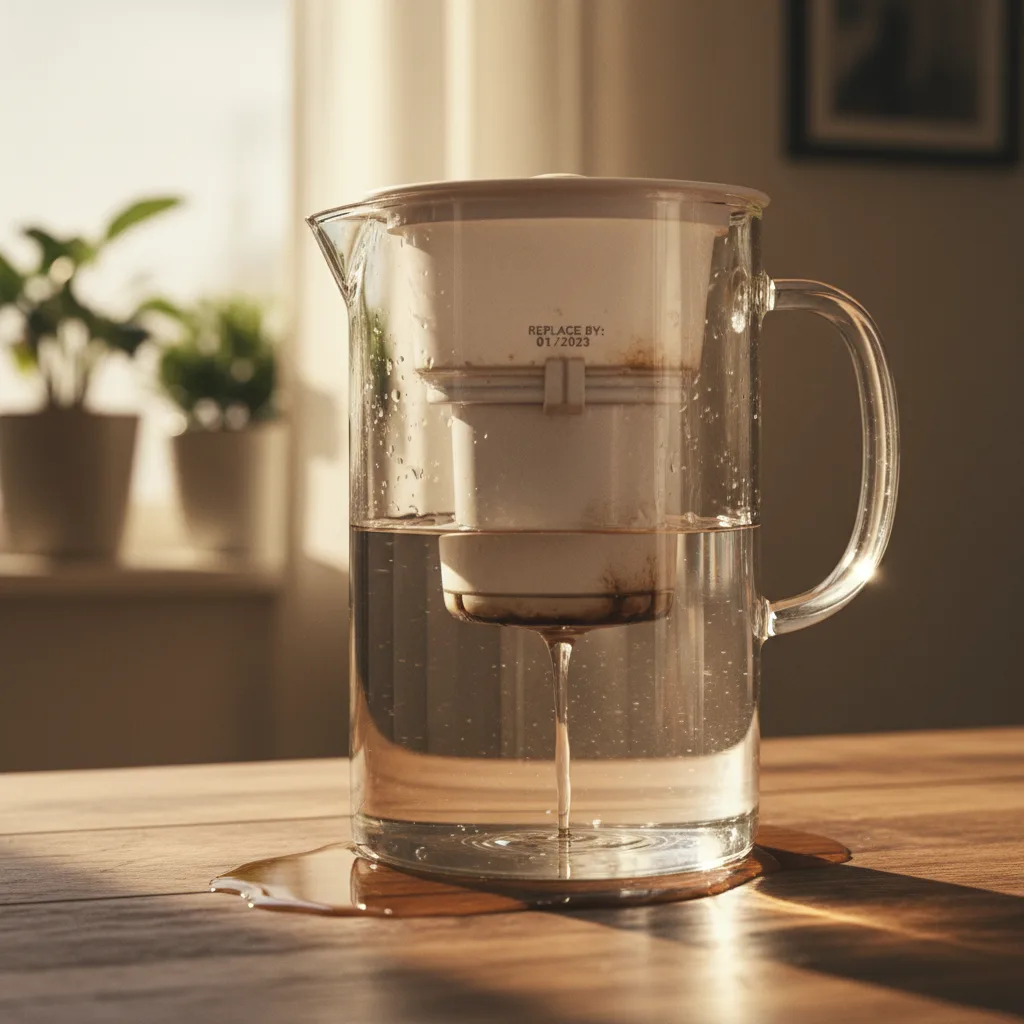
The problem: This is the single most damaging mistake in water filtration. An exhausted filter does not just stop filtering — it can become a health hazard. The warm, moist, carbon-rich environment inside a used-up filter is an ideal breeding ground for bacteria. Studies have found that water from overused filters can have higher bacterial counts than unfiltered tap water.
The science: Activated carbon works through adsorption — contaminants bind to the carbon surface. But there are a limited number of binding sites. Once those sites are full, the carbon is saturated. Continuing to use it means contaminants pass straight through, and in some cases, previously captured contaminants can desorb (release back) into the water.
The fix: Follow the manufacturer's replacement schedule as a baseline. Replace sooner if you notice slow flow or taste changes. Set a recurring phone reminder on the day you install each new filter.
- Brita Standard / PUR / Amazon Basics: Every 2 months (40 gallons)
- Brita Elite: Every 6 months (120 gallons)
- Refrigerator filters: Every 6 months
- Under-sink pre-filters: Every 6 months
- RO membranes: Every 2-3 years
Mistake #3: Choosing Based on Price Alone
The problem: Both extremes cause issues. Buying the cheapest uncertified filter means you might not actually be filtering anything. But overspending on a premium system you do not need wastes money.
Real-world example: We see two common traps. First, people buy cheap unbranded pitcher filters from marketplace sellers with zero NSF certification — these have no verified filtration claims. Second, people overspend on countertop RO when their municipal water is already clean and they just needed a basic pitcher for taste improvement.
The fix: Focus on NSF certification first, then compare prices among certified options. The Amazon Basics 10-Cup Pitcher at Under $25 proves that excellent filtration does not require a premium price — it carries NSF 42/53 certification (chlorine, lead, mercury) at the lowest price in our catalog. Pay for the certifications you need, not the brand name.
Mistake #4: Ignoring NSF Certifications
The problem: Marketing claims on water filter packaging are not regulated the way NSF certifications are. A filter can legally claim "removes contaminants" without specifying which ones or proving it. Only NSF (or equivalent IAPMO) certification means an independent lab has tested and verified the claim.
What the certifications mean:
- NSF 42: Reduces aesthetic issues — chlorine taste, odor, clarity. Minimum standard for any filter.
- NSF 53: Reduces health-related contaminants — lead, cysts, VOCs. This matters for safety.
- NSF 58: Specific to RO systems — verifies TDS reduction rate.
- NSF 401: Reduces emerging contaminants — pharmaceuticals, pesticides, PFAS compounds.
- NSF 372: Lead-free materials — the filter itself does not leach lead.
The fix: Never buy a water filter without at least NSF 42 certification. For health protection, look for NSF 53. For the most comprehensive pitcher filtration, the Brita Elite at $25–$50 carries NSF 42/53/401 triple certification.
Mistake #5: Buying More Filtration Than You Need
The problem: There is a common belief that "more filtration stages = better water." This leads people to buy 5-stage, 6-stage, or even 8-stage systems when their water quality does not warrant it. More stages mean more maintenance, higher replacement costs, and in the case of RO, more water waste.
When this happens: The most common version of this mistake is buying a ZeroWater pitcher because "it removes the most." ZeroWater's 5-stage filters remove 99.6% of TDS, but each filter only lasts 15-25 gallons (vs. 40-120 for competitors) and costs significantly more per cartridge. In a high-TDS area, that is a new filter every 2-3 weeks at a per-gallon cost that can exceed bottled water — more expensive than many bottled waters.
The fix: Match filtration to your actual water quality issues. If your TDS is under 200 ppm and you have no lead or PFAS concerns, a standard carbon filter is all you need. Save the 6-stage RO for water that actually has problems carbon cannot solve.
Mistake #6: Forgetting About Ongoing Costs
The problem: People compare the purchase price of filters but ignore the replacement cartridge cost — which is always the bigger expense over time. A "cheap" filter with expensive or short-lived cartridges costs more than a "expensive" filter with long-lasting cartridges.
Example that surprises people: The ZeroWater pitcher has a low upfront cost, but replacement filters are expensive relative to their short lifespan of only 15-25 gallons. A family of 4 may need 15-20 filters per year, making the annual cartridge cost several hundred dollars. Meanwhile, the iSpring RCC7AK at $100–$250 costs more upfront but has far lower annual replacement filter costs — and provides far superior filtration.
The fix: Calculate the total first-year cost (purchase + replacement filters) and the annual cost from year two onward before buying. Our Water Filter Cost Analysis guide breaks down the math for every system we review.
Mistake #7: Using the Wrong Filter for Your Water Source
The problem: Well water and municipal water have very different challenges. Using a pitcher filter on untreated well water is risky because pitchers do not remove bacteria. Using an RO system on clean municipal water is overkill and wastes water.
Common mismatches:
- Pitcher filter on well water: Dangerous. Pitcher filters do not remove bacteria or protozoa. Well water can contain E. coli, Giardia, and other pathogens that require UV sterilization or at minimum 0.1-micron ultrafiltration.
- Survival filter straw for daily home use: Inefficient. Filter straws like the Timain are designed for emergency and outdoor use. They do not improve taste or remove chemicals — they focus on biological threats.
- RO system on clean city water: Wasteful. If your city water has low TDS and no major contaminants, RO wastes 2-4 gallons per filtered gallon unnecessarily.
The fix: Test your water first, then match the filter technology to your specific contaminants. Our How to Choose a Water Filter guide includes a decision flowchart that maps water issues to the right filter type.
Mistake #8: Not Flushing New Filters Before Use
The problem: Brand-new carbon filters contain loose carbon fines — tiny carbon particles that break free during manufacturing and shipping. If you do not flush them out, your first few glasses of water will contain a harmless but unpleasant black residue. More importantly, air pockets in un-flushed filters reduce filtration effectiveness.
The fix: Every filter type needs flushing before first use:
- Pitcher filters: Fill and discard the first 2-3 pitchers of water.
- Refrigerator filters: Run about 2 gallons through before drinking. Discard the first 2-3 batches of ice.
- Under-sink systems: Run the faucet for 5-10 minutes after installing new filters.
- RO systems: Fill and drain the tank at least twice before drinking. The first fills will have a carbon taste.
Bonus Mistakes Worth Mentioning
Using Hot Water Through Carbon Filters
Hot water damages activated carbon and can cause it to release trapped contaminants. Always filter cold water. If you need hot filtered water, filter it cold first, then heat it.
Storing Pitchers in Direct Sunlight
UV light and warmth promote algae and bacterial growth inside the reservoir. Store your pitcher in the refrigerator or a dark cabinet — never on a sunny countertop.
Ignoring the Pitcher/Dispenser Cleaning
The pitcher body needs washing every 2-4 weeks even though you are replacing the filter. Biofilm and mineral deposits build up on the plastic surfaces. Disassemble, wash with warm soapy water, and dry completely before reassembling.
Assuming Filtered Water Lasts Indefinitely in the Pitcher
Filtered water stored in a pitcher reservoir is not sterile — it can still develop bacterial growth over time, especially if the pitcher sits at room temperature. As a general rule, consume refrigerated filtered water within two to three days and never leave a filled pitcher sitting out on the counter for more than a few hours. Treat filtered water with the same care you would any perishable food item, because once bacteria establish a foothold in the reservoir, replacing the filter cartridge alone will not solve the problem.
Who Should Be Most Concerned About These Mistakes
While these mistakes affect all filter users, certain households face higher stakes. Families with infants, pregnant women, elderly members, or immunocompromised individuals should treat filter maintenance as a non-negotiable health practice rather than a convenience — a lapsed filter schedule in these households poses a genuinely elevated risk. Renters who inherit an existing under-sink or refrigerator filter system should assume the worst: prior occupants rarely documented their replacement dates, so replacing all cartridges on move-in day is the safest starting point. Similarly, anyone who has recently moved to a new city or switched from well water to municipal supply (or vice versa) should re-test their water and reassess their filter choice rather than assuming the old setup still fits the new source water chemistry.
Frequently Asked Questions
What is the most common mistake people make with water filters?
Is it bad to use a water filter past its expiration?
Should I buy the most expensive water filter available?
Can I trust marketing claims on water filters?
Do I need a whole-house filter and a drinking water filter?
Is ZeroWater better because it removes more TDS?
How do I know if my water filter is actually working?
Can I use any replacement filter brand in my pitcher?
Filter Smart, Not Expensive
Avoiding these mistakes saves you money, protects your health, and ensures your filter actually does its job. The common thread is simple: know your water, match the filter, maintain the schedule. For a step-by-step guide to making the right choice from day one, start with our Complete Buying Guide. And if you are on a tight budget, our Best Budget Filters guide proves that great filtration is affordable for everyone.
Get Filter Picks Delivered
One email per week. Honest reviews, no spam.
No spam. Unsubscribe anytime.