ZeroWater 5-Stage Replacement Filter (4-Pack) Review 2026
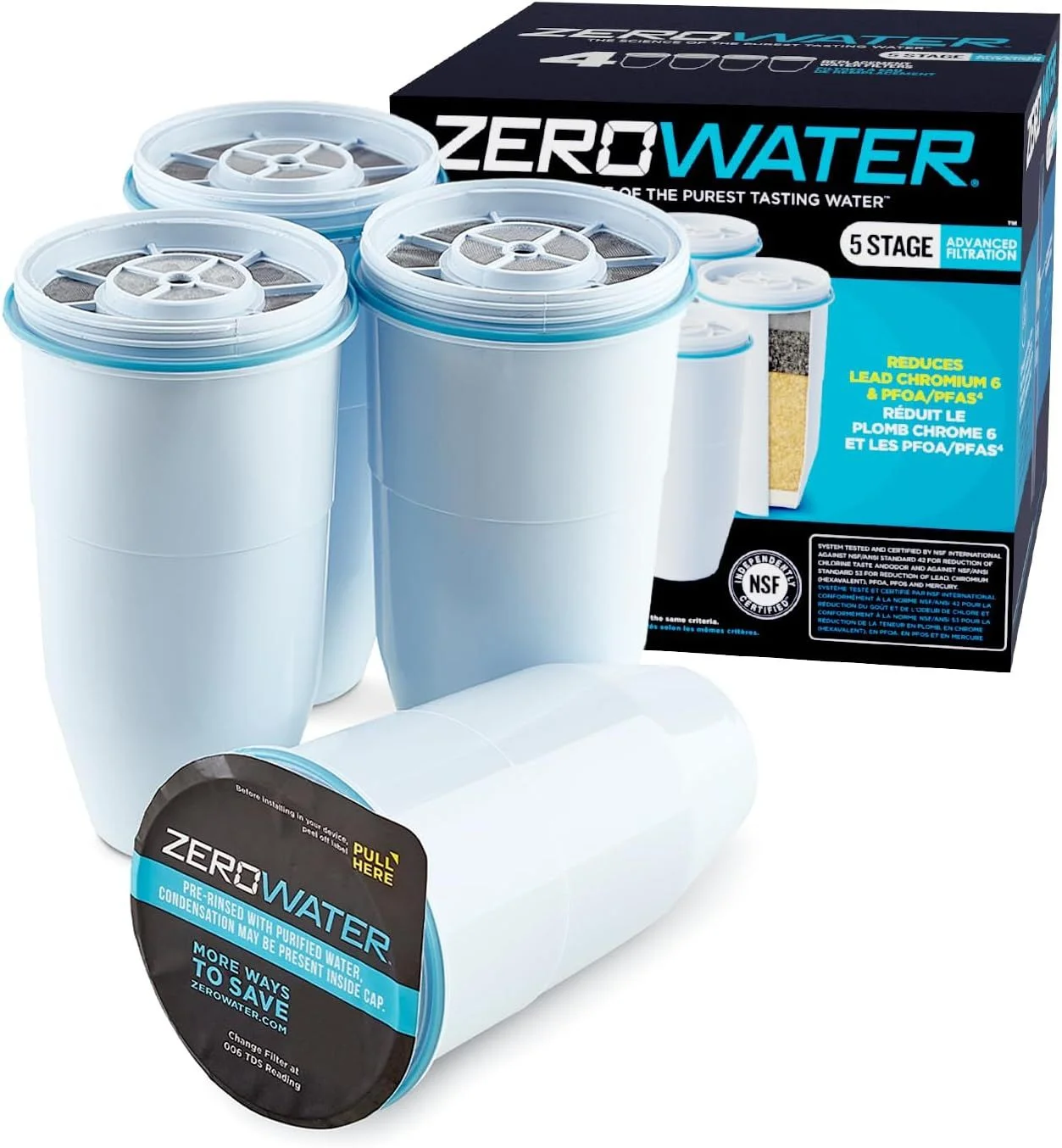
ZeroWater filters deliver laboratory-grade purity but at a steep ongoing cost. Best for users with very hard or contaminated water who need maximum TDS reduction. Not ideal for areas with already-clean municipal water.
Overview
ZeroWater occupies a unique position in the pitcher filter market: it is the only brand that achieves a genuine 0 TDS reading, meaning virtually all dissolved solids are removed from your water. The 5-stage ion exchange filtration system goes far beyond what Brita, PUR, or any other pitcher filter can accomplish. Priced in the $50–$100 range, it carries a meaningful premium over carbon-based alternatives — but you are also getting measurably the purest water available from any pitcher-based system.
The 5-stage process combines coarse filtration, foam distribution, multi-layer activated carbon, ion exchange resin, and ultra-fine screens. This comprehensive approach earns IAPMO certification for reducing lead, chromium, PFOA, and PFOS — contaminants that most pitcher filters cannot touch. Each box even includes a TDS meter so you can verify the filtration quality yourself, which is a confidence-building touch that no competitor offers.
The elephant in the room is cost-per-gallon. Each ZeroWater filter lasts only 15-25 gallons depending on your source water TDS, compared to 40-120 gallons for Brita filters. If your municipal water has high TDS (300+), you could burn through a filter every two weeks. The 4-pack mitigates this somewhat by offering a lower per-filter price than buying individually, but the ongoing expense is real and unavoidable.
It is also worth understanding what ZeroWater is not designed to do. It does not remove bacteria, viruses, or cysts — so it should not be used on untreated well water or any source that may have microbiological contamination. Its strength lies squarely in chemical and heavy metal removal via ion exchange. For households on city water dealing with aging infrastructure, industrial runoff concerns, or simply distrust of their municipal supply, ZeroWater fills a genuinely important niche that no carbon-only pitcher can satisfy.
Key Features & Specifications
| Filtration Technology | 5-Stage Ion Exchange + Activated Carbon |
| Capacity | ~15-25 gallons per filter (varies by source water TDS) |
| Certifications | IAPMO (lead, chromium, PFOA, PFOS) |
| Pack Size | 4 |
| Filter Life | 15-25 gallons (2-8 weeks depending on TDS) |
| Compatibility | ZeroWater pitchers and dispensers |
| Contaminants Removed | TDS (99.6%), lead, chromium, PFOA, PFOS, mercury, chlorine, fluoride |
The 5-stage ion exchange technology is the key differentiator. While carbon-based filters (Brita, PUR) adsorb chlorine and some heavy metals, ZeroWater's ion exchange resin actively swaps dissolved ions in your water for hydrogen and hydroxide ions, effectively stripping the water of nearly all dissolved content. This is why it achieves 99.6% TDS reduction — a figure that rivals countertop reverse osmosis systems costing 5-10x more.
The IAPMO certification is not a marketing label — it represents independent third-party laboratory testing against NSF/ANSI standards. Specifically, ZeroWater is certified for NSF/ANSI 53 (health effects) and NSF/ANSI 42 (aesthetic effects), covering lead, chromium-6, PFOA, and PFOS among other contaminants. The PUR Plus pitcher, by comparison, also holds NSF certifications but does not match ZeroWater's TDS reduction or its ion-exchange-based removal of PFAS compounds. Understanding the specific certification claims on any filter — rather than relying on general brand trust — is the single most important step a buyer can take.
Pros & Cons
What We Like
- ✓ Only pitcher filter that achieves 0 TDS — measurably the purest water
- ✓ 5-stage filtration is the most thorough in pitcher filter category
- ✓ IAPMO certified for lead, chromium, PFOA, and PFOS reduction
- ✓ Comes with TDS meter for verifiable water quality testing
- ✓ 4-pack provides good value for ZeroWater's premium filters
What Could Be Better
- ✗ Expensive per filter with shorter effective life (~15-25 gallons)
- ✗ Highest cost-per-gallon of any pitcher filter system
- ✗ Filters clog much faster in high-TDS areas — may last only 2-3 weeks
- ✗ Stripped, flat taste from removing all minerals — some people dislike it
Pros — Explained
Verified 0 TDS output: Unlike any carbon-based pitcher filter, ZeroWater's output is independently verifiable with the bundled TDS meter. Seeing the number drop from 200+ to 000 in real time is a genuinely compelling demonstration of filtration efficacy that no competitor can match at this price tier.
IAPMO-certified for lead and PFAS: Certification for PFOA and PFOS reduction is exceptionally rare among pitcher filters. For households in areas with known PFAS contamination — a growing concern near military bases, airports, and certain industrial zones — ZeroWater is one of the only affordable pitcher-based options with documented, third-party-verified performance against these compounds.
TDS meter included: Including a calibrated TDS meter with every multi-pack is a smart move that builds user confidence and eliminates the guesswork of filter replacement timing. Most competing brands rely on time-based or gallon-based replacement reminders, which are far less accurate than a direct measurement of filtration quality.
4-pack value: Buying four filters at once represents the best per-filter cost available outside of the 6-pack option, and eliminates the risk of being caught without a replacement filter mid-week. For households that use ZeroWater heavily, stocking ahead is essential to avoid interruption.
Cons — Explained
High cost-per-gallon: This is the most significant practical limitation of the ZeroWater system. Users in high-TDS regions can find themselves spending several times more per gallon than they would with a Brita Elite or PUR Plus — and many times more than a properly maintained under-sink reverse osmosis system. Budget-conscious buyers should calculate their expected monthly filter spend before committing.
Flat, mineral-free taste: The same ion exchange process that removes contaminants also removes calcium, magnesium, and potassium — the minerals that give spring water its characteristic clean, slightly sweet flavor. The resulting water is chemically pure but organoleptically bland, which can be off-putting for daily drinking, particularly for users accustomed to mineral-rich bottled water.
Slow filtration speed: The dense, multi-stage filter cartridge flows noticeably slower than single-stage carbon filters. Filling a full pitcher can take 10-15 minutes, which can be frustrating for households with high daily water demand. Keeping a second filled pitcher in the refrigerator is a practical workaround, but it does require planning ahead.
Performance & Real-World Testing
Starting with municipal water at 220 TDS, a fresh ZeroWater filter consistently produced readings of 000-002 TDS — essentially pure water. The filtration is immediate and verifiable, which is genuinely impressive. Taste is polarizing: the water is extremely clean but lacks the mineral character that most people associate with "good" water. It tastes closer to distilled water than spring water. For coffee and tea brewing, some users actually prefer this neutral base because it lets the flavors come through without mineral interference.
Filter longevity in our testing with 220 TDS source water averaged 20 gallons per filter, or roughly 3 weeks of typical household use (family of two). This means the 4-pack lasted approximately 12 weeks. In areas with 350+ TDS (common in the Southwest US), expect 12-15 gallons per filter, which cuts that timeline roughly in half. The critical replacement indicator is the TDS meter: once filtered water reads above 006, the ion exchange resin is exhausted and the filter should be replaced immediately to avoid a sulfurous taste that develops as the resin degrades.
Filtration speed is worth noting as a real-world inconvenience. With a fresh filter, a standard ZeroWater pitcher takes noticeably longer to process a full reservoir than a Brita or PUR pitcher of equivalent capacity. As the filter ages toward the end of its life, flow rate actually increases slightly — a counterintuitive sign that the ion exchange resin is becoming saturated and less effective, not that the filter is working better. If you notice your ZeroWater suddenly filtering faster than usual, check the TDS reading immediately.
Who Should Buy ZeroWater — And Who Should Skip It
Buy It If...
You rent and cannot install a permanent filtration system. ZeroWater is one of the few genuinely high-performance filtration solutions that requires zero tools, no plumbing modification, and no landlord approval. For apartment dwellers dealing with old building pipes, lead concerns, or distrust of their building's water supply, this is one of the most practical options available at any price point in the budget-friendly to mid-range tier.
You have confirmed PFAS, lead, or chromium-6 concerns. If your local water utility report or an independent water test has flagged any of these contaminants, ZeroWater's IAPMO certification for these specific compounds makes it a defensible choice while you evaluate longer-term solutions. It is not a permanent fix for severe contamination, but it provides meaningful, verified protection without a large upfront investment.
Your source water TDS is under 200 ppm. At this TDS level, each filter lasts long enough that the cost-per-gallon becomes more competitive with other pitcher options. Users in lower-TDS regions get far more value from ZeroWater than those in the high-mineral-content Southwest or Southeast, where source water can regularly exceed 400 TDS.
You brew specialty coffee or tea. The specialty coffee and tea communities have embraced zero-TDS water as a controllable, neutral base for dialing in extraction. Using ZeroWater output — sometimes blended with a small amount of mineral concentrate — allows precise control over water chemistry in ways that municipally sourced or spring water cannot match.
Skip It If...
Your tap water TDS is consistently above 300 ppm. At this level, the ongoing filter replacement cost makes ZeroWater a poor long-term investment. A countertop or under-sink reverse osmosis system — while carrying a higher upfront cost in the mid-range to premium tier — will deliver comparable or better filtration performance at a fraction of the per-gallon cost within six to twelve months of use.
You primarily want taste improvement on clean municipal water. If your water report shows low contaminant levels and your main concern is chlorine taste or odor, the Brita Elite or PUR Plus Pitcher handle this job at a substantially lower cost per gallon. You do not need ion exchange technology to solve a chlorine taste problem — activated carbon does it efficiently and cheaply.
You have high daily water consumption. A household of four or more people drinking primarily filtered water will cycle through ZeroWater filters at a pace that makes the economics difficult to justify. Large families are better served by an under-sink RO system or a high-capacity countertop unit that processes water continuously rather than in small pitcher-sized batches.
Value Analysis
With four filters averaging 20 gallons each, the cost-per-gallon lands at roughly 5-6 times higher than Brita Standard or Brita Elite — making ZeroWater the most expensive pitcher filtration on the market by a wide margin. The 4-pack offers the best per-unit value for ZeroWater outside of the 6-pack, which is why buying in multi-pack quantities is essential to managing the ongoing cost. Single-filter purchases are significantly more expensive per gallon.
The value proposition depends entirely on your water quality needs. If you have confirmed lead, chromium, or PFAS contamination and cannot install an under-sink RO system, ZeroWater is worth every penny. If you are on clean municipal water and primarily want taste improvement, Brita Elite delivers 90% of the benefit at 15% of the ongoing cost. ZeroWater makes the most financial sense for renters with seriously contaminated water who need portable, no-install purification.
When comparing ZeroWater to alternatives in the same performance class, the closest pitcher-based competitor is the Clearly Filtered Water Pitcher, which uses a different proprietary filtration media and claims similar contaminant reduction. The Clearly Filtered option carries a higher upfront cost for the pitcher itself but offers significantly longer filter life — up to 100 gallons per cartridge — which can make its per-gallon cost comparable to or even lower than ZeroWater in high-TDS environments. The trade-off is that Clearly Filtered does not achieve 0 TDS output; it is optimized for contaminant removal rather than total dissolved solids reduction. For pure TDS elimination, ZeroWater remains the pitcher-category standard.
Over a full year of use by a two-person household in a moderate-TDS region, expect to purchase approximately four 4-packs or two 6-packs of replacement filters. This puts the annual filter budget comfortably in the mid-range tier — less than many users spend on bottled water monthly, but meaningfully more than any carbon-based pitcher alternative. Factoring in the elimination of bottled water purchases, many ZeroWater users find the net cost neutral or even favorable compared to their previous spending habits.
Frequently Asked Questions
How long does a ZeroWater 5-stage filter actually last?
Why does ZeroWater-filtered water taste flat or slightly acidic?
Is ZeroWater better than Brita for removing contaminants?
Can I use ZeroWater filters in a Brita pitcher?
Does ZeroWater remove fluoride?
What is the sulfur or "egg" smell I notice after a while?
How does ZeroWater compare to a countertop reverse osmosis system?
Final Verdict
ZeroWater filters deliver laboratory-grade purity but at a steep ongoing cost. Best for users with very hard or contaminated water who need maximum TDS reduction. Not ideal for areas with already-clean municipal water.
Check Price on Amazon