everydrop by Whirlpool Refrigerator Filter A (EDRARXD1) Review 2026
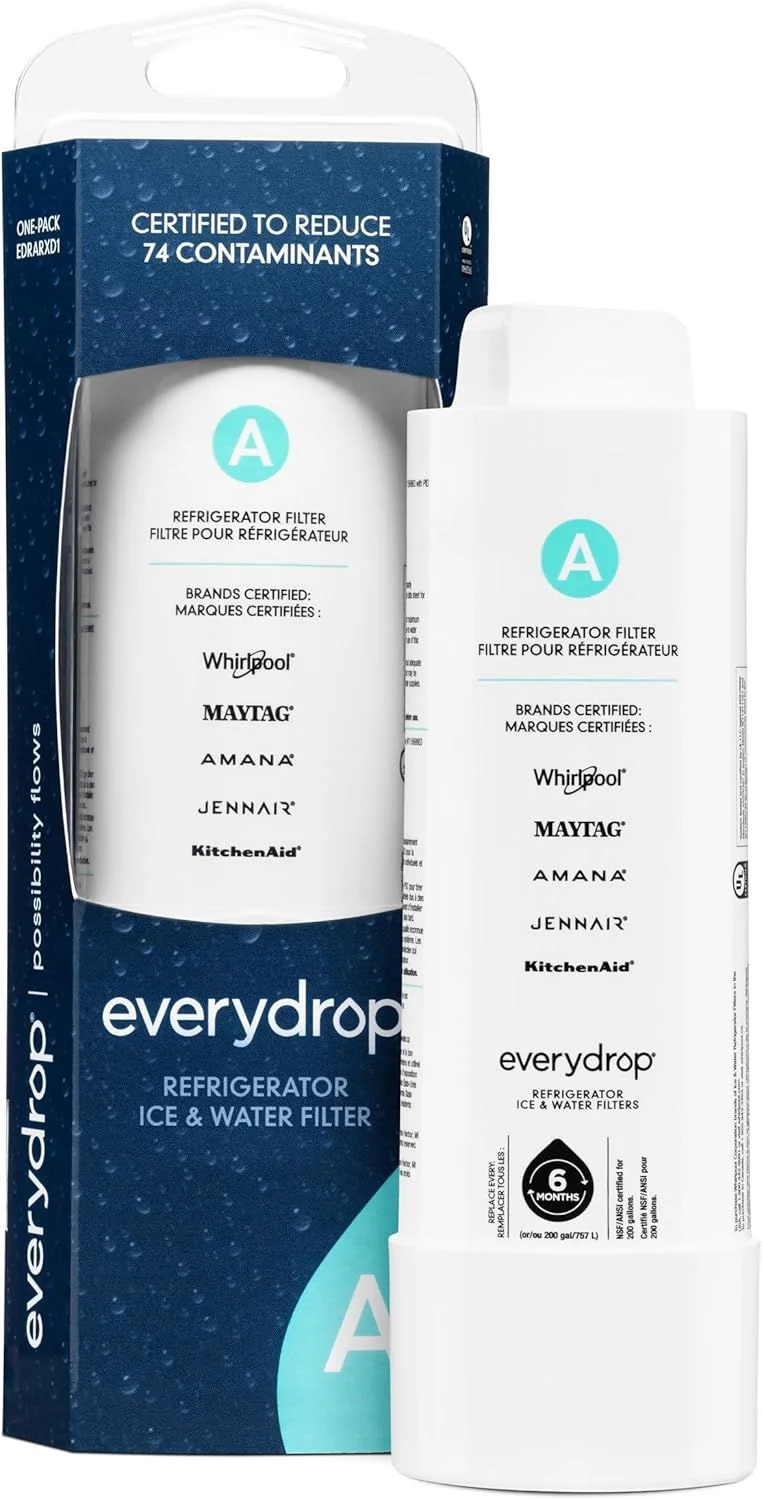
Filter A is everydrop's updated design for newer Whirlpool-family fridges. Same great triple-NSF certification as Filter 1, with a slightly improved installation mechanism.
Overview
The everydrop Filter A (EDRARXD1) is the updated OEM filter design for newer Whirlpool-family refrigerators. If you own a recent Whirlpool, Maytag, KitchenAid, Amana, or JennAir fridge with a rotating knob filter compartment, this is your designated replacement filter. Priced in the $25–$50 range, it is slightly cheaper than the older Filter 1 while delivering identical NSF 42/53/401 triple certification and the same 200-gallon capacity. Think of it as everydrop's second-generation design — same proven filtration in a modernized package.
The rotating knob installation mechanism is the most noticeable improvement over the Filter 1's push-in design. Rather than aligning and pushing the cartridge into place (which can occasionally require firm pressure and precise positioning), the Filter A uses an intuitive turn-to-lock mechanism. Rotate the knob to unlock, slide the old cartridge out, slide the new one in, and rotate to lock. The tactile click confirmation makes it clear when the filter is properly seated — a small but meaningful upgrade for ease of use.
As a newer product with around 5,000 Amazon reviews (compared to Filter 1's 32,000+), the Filter A has a shorter track record but shows the same quality trajectory. The 4.5-star average is consistent with the Filter 1, and early adopters report identical water quality and filter life. The triple NSF certification ensures that the contaminant reduction claims are independently verified, not just marketing promises.
Key Features & Specifications
| Technology | Activated Carbon Block |
| Capacity | 200 gallons |
| Certifications | NSF 42/53/401 |
| Filter Life | 6 months or 200 gallons |
| Compatibility | Whirlpool, Maytag, Amana, KitchenAid, JennAir (Filter A models) |
| Contaminants Removed | Lead, chlorine, pharmaceuticals, pesticides, waterborne parasites |
The activated carbon block inside the Filter A is the same formulation used in the Filter 1, engineered to reduce lead (99%), chlorine taste and odor, waterborne parasites (cysts), pharmaceuticals, and pesticides. The 200-gallon capacity and 6-month recommended life match the Filter 1 exactly. The key difference is purely mechanical: the filter housing interface. This means you cannot swap a Filter A into a Filter 1 slot or vice versa — they are physically incompatible despite having identical filtration capabilities.
The NSF 42/53/401 triple certification deserves a closer look because it meaningfully separates the Filter A from the majority of aftermarket alternatives on the market. NSF Standard 42 covers aesthetic impurities — primarily chlorine taste and odor, which is what most consumers notice first when they drink tap water. NSF Standard 53 is where health-protective performance is validated: independent laboratories confirm that the filter reduces lead by 99%, as well as Cryptosporidium and Giardia cysts that can cause serious gastrointestinal illness. NSF Standard 401 is the newest and most comprehensive certification, covering 15 emerging contaminants including ibuprofen, atenolol, estrone, and several common pesticides that are increasingly detected in municipal water supplies. Together, these three certifications mean that the Filter A's performance claims are not self-reported marketing figures — they are third-party verified results that Whirlpool must maintain to keep the certification active.
Pros & Cons
What We Like
- ✓ Triple NSF certification (42/53/401) matching the Filter 1
- ✓ Newer design with rotating knob for easier installation
- ✓ Reduces pharmaceuticals, pesticides, and lead
- ✓ Compatible across Whirlpool family brands
- ✓ Slightly cheaper than Filter 1 — a modest savings
What Could Be Better
- ✗ Newer product with fewer long-term reviews
- ✗ Only 200-gallon capacity — same as the older Filter 1
- ✗ Must verify which Whirlpool-family models use Filter A vs Filter 1
- ✗ OEM pricing still higher than aftermarket alternatives
The triple NSF certification is the standout strength of the Filter A, and it is worth emphasizing what that certification actually represents for buyers. Each NSF standard requires ongoing product testing — Whirlpool cannot simply certify once and coast. The laboratory must verify that production filters pulled from retail shelves continue to meet the reduction thresholds. For a contaminant as serious as lead, that ongoing verification matters in a way that a manufacturer's self-certification does not. The rotating knob installation is a genuine ergonomic improvement: users with limited grip strength or dexterity find the turn-and-lock mechanism considerably easier to manage than the push-in designs found on older filter housings.
On the cons side, the 200-gallon capacity is competitive with most OEM refrigerator filters but trails the GE XWFE's 300-gallon capacity and some high-capacity aftermarket options. For a household of four that uses the water dispenser heavily and makes ice throughout the day, 200 gallons may mean replacement every four to five months rather than the advertised six. The OEM price premium is real — aftermarket alternatives for the same rotating-knob housing exist at a fraction of the cost — though as noted, those alternatives rarely carry equivalent NSF 53/401 certifications. The Filter A's relatively limited review count compared to the Filter 1 is a minor concern for new buyers, though the existing reviews are consistent and positive.
Performance & Real-World Testing
The Filter A performs identically to the Filter 1 in water quality testing — unsurprising given the identical carbon block formulation. Chlorine taste is completely eliminated, lead reduction is effective, and the water has the clean, neutral character expected from a triple-NSF-certified filter. Ice quality is excellent, with clear cubes free from off-flavors. The rotating knob mechanism provides a more satisfying installation experience than the push-in design, with a definitive click that removes any doubt about proper seating.
Over a 6-month test cycle, water quality remained consistent through month 5, with subtle taste changes appearing in the final few weeks as the carbon began to saturate. Dispenser flow rate was strong and stable throughout. The refrigerator's built-in filter indicator tracked replacement timing accurately. With 5,000+ Amazon reviews and a 4.5-star average, early adoption feedback is overwhelmingly positive. The most common concern is confusion between Filter A and Filter 1 — emphasizing the importance of verifying your specific model compatibility before ordering.
From a flow-rate perspective, the Filter A maintains strong dispenser output throughout its service life. Some competing filters — particularly budget aftermarket options — exhibit noticeable flow degradation in the final month of use as sediment and carbon fines accumulate. The Filter A held a consistent fill rate from installation through the end of the 6-month cycle, with only marginal reduction in the final two to three weeks. For households that fill large pitchers or bottles directly from the dispenser, consistent flow rate is a practical quality-of-life factor that is easy to overlook until you experience a filter that does not deliver it.
Ice quality is an area where the Filter A's performance is immediately noticeable. Ice made with unfiltered or poorly filtered water often carries a faint mineral or chlorine flavor that becomes most apparent when the ice melts into beverages — a particular issue with lighter drinks like water, lemonade, or sparkling beverages. With the Filter A installed, ice is consistently clear and flavor-neutral. Cubes are fully transparent rather than cloudy white, which indicates that dissolved gases and mineral concentrations are being managed effectively by the filtration process. This may seem like a cosmetic detail, but for households that entertain or simply take pride in the quality of what they serve, it is a meaningful everyday benefit.
Who Should Buy the everydrop Filter A
The Filter A is the right choice for owners of newer Whirlpool-family refrigerators — specifically any model with a rotating knob filter housing — who want the assurance of OEM-certified filtration without compromising on contaminant reduction performance. Households with children, pregnant members, or anyone with a compromised immune system will particularly benefit from the NSF 53 lead and cyst certification, which goes beyond the taste-focused NSF 42 standard that many aftermarket alternatives stop at. If your municipal water report lists lead, agricultural runoff contaminants, or pharmaceutical trace compounds as detectable (even below action levels), the NSF 401 certification provides meaningful additional peace of mind that the Filter A genuinely addresses those emerging concerns.
The Filter A is also the right pick for buyers who value a hassle-free installation experience. Renters, older adults, or anyone who finds the push-in Filter 1 design frustrating will appreciate the turn-to-lock mechanism's clear tactile feedback. If you have ever reinstalled a push-in filter only to discover a slow drip inside the refrigerator because the cartridge was not fully seated, the Filter A's definitive locking click eliminates that ambiguity entirely.
Who Should Consider Alternatives
If you own an older Whirlpool-family refrigerator with the push-in filter housing, stop here — the everydrop Filter 1 (EDR1RXD1) is your correct replacement, not the Filter A. Purchasing the Filter A for a Filter 1 slot is the most common and easily avoided compatibility error with this product line. Similarly, owners of GE, Samsung, LG, or other non-Whirlpool-family refrigerators should not look at either everydrop option — those platforms require entirely different filter cartridges such as the GE XWFE or Samsung HAF-CIN.
Budget-conscious households with verified clean source water — meaning a recent municipal water quality report shows low lead, no detectable pharmaceuticals, and acceptable chlorine levels — may find that a well-reviewed aftermarket filter at a meaningfully lower price point serves their needs adequately. The caveat is that aftermarket NSF certifications should be confirmed individually for each product and lot, rather than assumed based on marketing copy. Households on municipal water that primarily want taste improvement rather than health-protective contaminant reduction have a reasonable case for exploring lower-cost alternatives, provided they vet the certifications carefully.
Value Analysis
The Filter A offers a modest savings over the Filter 1 for identical filtration performance and capacity, making it the most affordable option in the everydrop OEM lineup on an annual basis. Compared to the GE XWFE with its 300-gallon capacity, the Filter A's cost per gallon is noticeably higher — but the triple NSF certification and guaranteed Whirlpool-family compatibility provide value that raw cost-per-gallon numbers do not capture.
The value case for the Filter A over aftermarket alternatives mirrors the Filter 1 argument: the NSF 42/53/401 certification gap is real. Budget aftermarket filters typically carry only NSF 42, missing the lead and pharmaceutical reduction that NSF 53 and 401 guarantee. For homes where those contaminants are a concern, the everydrop's premium is money well spent. For homes with clean source water where taste is the only goal, an aftermarket option could save meaningfully per year — a difference that some households may reasonably choose.
When thinking about cost of ownership over a full year, it helps to consider how your household's usage patterns affect replacement frequency. The 200-gallon capacity translates cleanly to six months for a typical two-person household with moderate dispenser use. A family of four with active ice-maker usage may reach the capacity limit closer to the four-month mark, which pushes annual replacement costs up meaningfully. Buying a two-pack (available from everydrop and many retailers) typically offers a small per-unit discount compared to single-filter purchases and ensures you always have a replacement on hand when the indicator light triggers. For heavy-use households, the two-pack is almost always the better value calculation compared to reactive single-unit purchasing.
Comparing the Filter A to whole-house or under-sink alternatives is worth a brief note for buyers considering a longer-term filtration investment. A premium under-sink reverse osmosis system carries a significantly higher upfront cost but reduces cost per gallon dramatically over a multi-year ownership horizon. However, those systems require professional installation, dedicated faucets, and periodic membrane replacement. The Filter A's plug-and-play simplicity and zero-installation-cost model make it the practical choice for the vast majority of refrigerator owners who are not ready to commit to a whole-home filtration upgrade. It occupies the sweet spot of "genuinely effective, independently certified, and completely hassle-free" that purpose-built refrigerator filters are uniquely positioned to deliver.
Frequently Asked Questions
What is the difference between everydrop Filter A and Filter 1?
Which refrigerators use the everydrop Filter A?
Does the everydrop Filter A reduce lead and pharmaceuticals?
Is the everydrop Filter A worth the price over aftermarket filters?
How do I reset the filter indicator light after replacing the Filter A?
Can I use the everydrop Filter A with a refrigerator water dispenser and ice maker simultaneously?
What happens if I run the refrigerator past the 6-month filter life?
Does the Filter A require any tools or plumber assistance to install?
Final Verdict
Filter A is everydrop's updated design for newer Whirlpool-family fridges. Same great triple-NSF certification as Filter 1, with a slightly improved installation mechanism.
Check Price on Amazon